
Using an ATR stop loss is a smart way to manage risk in trading. Unlike fixed dollar or percentage-based stop losses, ATR-based levels adjust dynamically to market volatility. Here's what you need to know:
- ATR (Average True Range) measures market volatility by calculating price movement over a specific period, typically 14 days.
-
Stop Loss Formula:
-
Long position:
Entry Price - (ATR × Multiplier) -
Short position:
Entry Price + (ATR × Multiplier)
-
Long position:
-
Multiplier: Adjusts the stop loss distance based on risk tolerance. Common ranges:
- 1.5–2.0: Tighter stops, ideal for short-term trades.
- 2.0–2.5: Balanced for swing trades.
- 2.5–3.0: Wider stops for long-term trades.
Benefits:
- Adjusts to market conditions, reducing premature stop-outs.
- Works across different markets and timeframes.
- Removes emotional bias by relying on data.
Limitations:
- Wider stops in volatile markets can increase potential losses.
- ATR is a lagging indicator and may not respond quickly to abrupt market changes.
- It doesn’t consider technical levels like support and resistance.
Example:
If you buy Apple (AAPL) at $150 with a 14-day ATR of $3.20 and a 2.0 multiplier:
- Stop loss = $150 - ($3.20 × 2.0) = $143.60.
ATR stop loss is a tool, not a one-size-fits-all solution. Combine it with other strategies for better risk management and trading outcomes.
How to Calculate ATR Stop Loss Levels
Now that we've discussed the benefits of ATR-based stop losses, let's examine how to calculate them. While the formula itself is straightforward, the details matter for safeguarding your capital. Here's a step-by-step guide with examples to make the process clear.
ATR Formula and Multiplier
For long positions: Stop Loss = Entry Price - (ATR × Multiplier)
For short positions: Stop Loss = Entry Price + (ATR × Multiplier)
The multiplier is where you can adjust your risk tolerance. Most traders stick to multipliers between 1.5 and 3.0, each suited for different trading styles:
- 1.5 to 2.0: Tighter stops, ideal for day trading or managing risk in highly volatile markets.
- 2.0 to 2.5: A balanced approach, often used for swing trading or medium-term positions.
- 2.5 to 3.0: Wider stops, suitable for position trading or when anticipating larger price swings.
Choose a multiplier that aligns with your strategy and stick to it consistently.
Step-by-Step Example
Let’s break this down with an example using Apple Inc. (AAPL) stock. Suppose you plan to buy AAPL at $150.00 per share, and the current 14-day ATR is $3.20.
- Step 1: Decide your multiplier based on your strategy. For this swing trade, let’s use 2.0.
- Step 2: Calculate the ATR buffer: $3.20 × 2.0 = $6.40.
- Step 3: Apply the long position formula: $150.00 - $6.40 = $143.60.
Your stop-loss level would be $143.60. This means if AAPL drops to $143.60 or lower, you’ll exit the trade, limiting your loss to $6.40 per share.
For a short position, the calculation flips: $150.00 + $6.40 = $156.40. In this case, you’d cover your short if AAPL rises to $156.40.
Now, let’s consider a more volatile stock like Tesla Inc. (TSLA). Suppose TSLA is trading at $200.00 with a 14-day ATR of $8.50. Using the same 2.0 multiplier, the calculation for a long position stop loss would be:
$200.00 - ($8.50 × 2.0) = $183.00.
Notice how Tesla's stop loss is much wider ($17.00 away) compared to Apple’s ($6.40 away), even with the same multiplier. This reflects Tesla’s higher volatility, helping to prevent you from getting stopped out by routine price swings.
Common Calculation Mistakes
To make the most of ATR stop-loss levels, avoid these common pitfalls:
- Using outdated ATR values: ATR changes daily as new price data comes in. A stop-loss level based on last week’s ATR might not reflect current conditions.
- Overusing multipliers: Extremely high multipliers (e.g., 4.0 or 5.0) can expose you to unnecessary losses. On the other hand, using a 1.0 multiplier often results in stops that are too tight for most strategies.
- Ignoring price gaps: ATR measures typical price ranges but doesn’t account for overnight gaps or sudden news-driven jumps. Be prepared for situations where actual losses may exceed your calculated stop-loss level.
- Mixing timeframes: Always use ATR values that match your trading timeframe. For example, a 14-day ATR is ideal for swing trading, but shorter timeframes may be better suited for day trading.
Accurate ATR calculations are essential for protecting your capital and ensuring your stop-loss levels align with your strategy - and a stop only protects you if it is actually working, which is why many traders keep ATR-based stops running on an algo trading VPS rather than a laptop. Mastering these basics lays the groundwork for more advanced ATR techniques in the future.
Order flow
Built for scalpers. Heatmaps on dedicated resources.
Order-flow heatmaps and DOM ladders run on dedicated CPU, memory and NVMe, so your charts keep responding during volatility.
Explore the hardware







From $29.99/mo · Windows or Linux
How to Set Stop Losses with ATR Indicator (Like a PRO)
Random stop placement (fixed points, round numbers, guesses based on yesterday's low) ignores what the market is doing. ATR-based stops anchor your risk to real, measured volatility instead of personal preference.
"A stop that ignores typical market movement gets hit for the wrong reasons, not because your trade was wrong, but because your risk management was blind."
Warning: Using round numbers or fixed-point stops is one of the most common mistakes traders make. These levels are unrelated to actual market behavior and will erode your account over time.
Tip: ATR-based stops adapt dynamically to current market conditions, widening in high-volatility environments and tightening when markets are calm and range-bound.
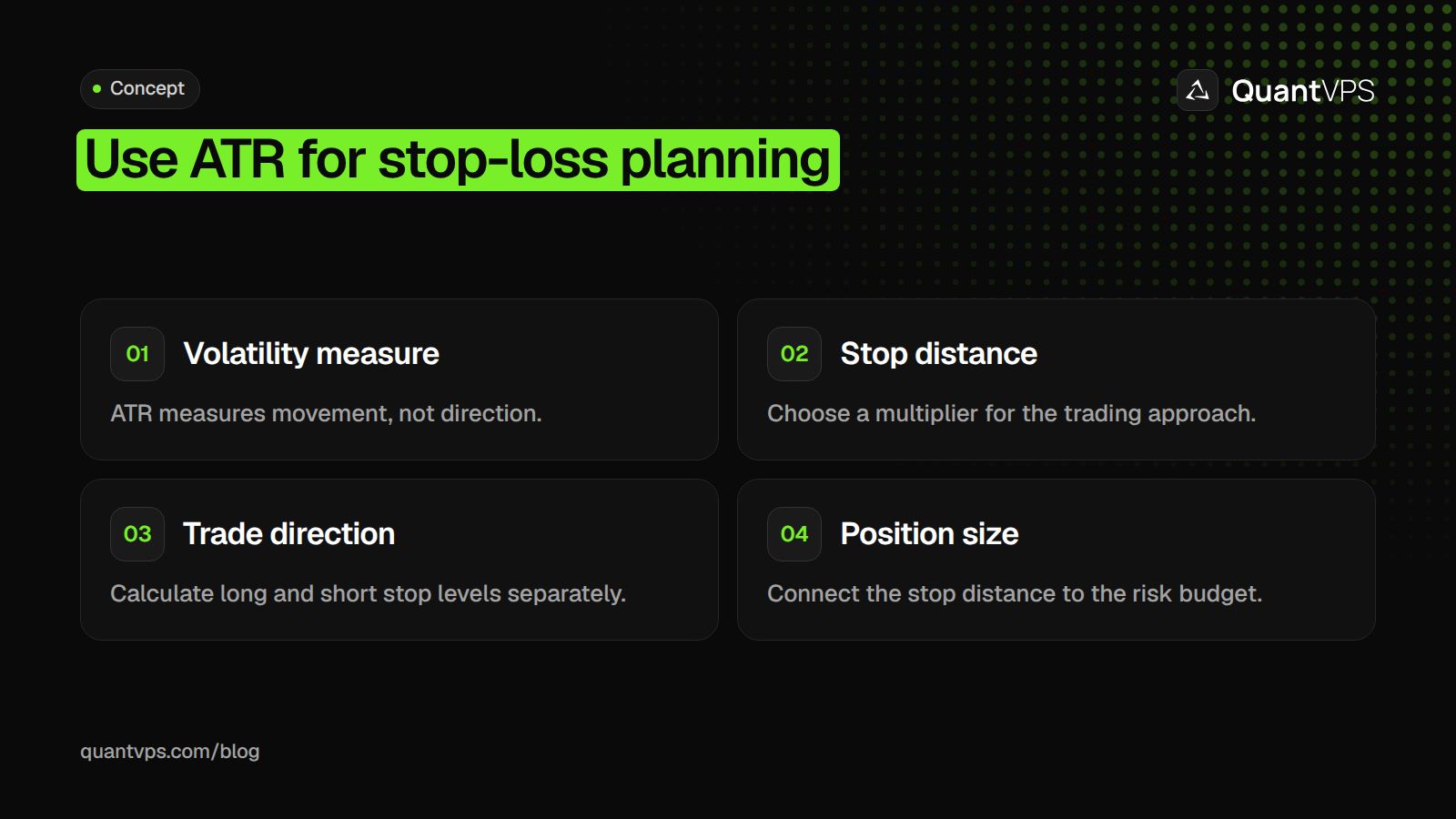
J. Welles Wilder Jr. introduced ATR in his 1978 book "New Concepts in Technical Trading Systems" to give traders a reliable measure of market volatility, not a directional signal. ATR tells you how much price typically moves, not where it's going. A stop that ignores typical movement gets hit for the wrong reasons.
| Stop Type | Based On | Adapts to Volatility? |
|---|---|---|
| Fixed Point Stop | Arbitrary number | No No |
| Round Number Stop | Psychological levels | No No |
| Yesterday's Low | Single price point | No Rarely |
| ATR-Based Stop | Real measured volatility | Yes Yes |
Key Point: ATR is a pure volatility tool: it measures how much the market moves, never which direction. This makes it uniquely suited for stop-loss placement that respects real market behavior.
How the calculation actually works
True Range is the largest of three values: current high minus current low, absolute difference between current high and previous close, or absolute difference between current low and previous close. ATR is a smoothed average of True Range across a chosen period. Wilder's original default of 14 periods remains the most widely used starting point. A 14-period ATR on a daily chart reflects roughly three weeks of typical price movement, providing a stable, noise-resistant baseline for stop placement.
Choosing the Right ATR Period
While 14 periods remain the standard, shorter periods produce more responsive readings that adapt quickly to recent price swings, whereas longer periods smooth out temporary spikes and provide a more stable measure of volatility.
| ATR Period | Represents | Best For |
| 5 periods | Roughly one trading week | Very short-term trading |
| 14 periods | About three trading weeks | General-purpose trading |
| 21 periods | Approximately one trading month | Swing trading |
| 63 periods | Around one trading quarter | Position trading |
| 252 periods | Roughly one trading year | Long-term investing |
How does Wilder's smoothing method affect ATR calculations?
Most charting platforms calculate ATR using Wilder's smoothing method rather than a simple moving average. Wilder's method weights recent price action more heavily, allowing ATR to adjust more naturally as market volatility changes.
How do you calculate a stop loss using ATR?
Calculating a stop loss is straightforward. Say you enter a long trade at $100, and the 14-period ATR reads $2. Using a 2x multiplier, your stop is $100 minus ($2 × 2), which equals $96. According to the LuxAlgo Blog, a multiplier of 1.5x to 2x ATR below the entry is commonly used for long positions because this distance places the stop outside the asset's normal intraday fluctuation range, preventing price noise from triggering an exit before your trade idea plays out.
Remember, Long and Short Trades Are Different
For long positions, subtract the ATR stop distance from your entry price. For short positions, add it above your entry price. In both cases, your stop sits outside normal price fluctuations while defining your maximum loss.
Choosing the right multiplier for your style
The multiplier is where strategy meets judgment. Day traders typically use 1.5x to 2x because their short holding periods require tight risk per trade. Swing traders generally work with 2x to 3x, allowing positions to absorb multi-day price changes. Position traders and trend followers often extend to 3x to 4x to capture larger trend pullbacks. The TrendSpider Learning Center notes that ATR trailing stops commonly use 2x to 3x the ATR value. The trade-off is consistent: smaller multipliers reduce dollar risk but increase whipsaws relative to normal volatility, while larger multipliers require reducing position size to keep total risk under control.
| Trading Style | Typical ATR Multiplier | Purpose |
| Day Trading | 1.5×–2× ATR | Tight stops for intraday moves |
| Swing Trading | 2×–3× ATR | Balanced protection against normal market swings |
| Position Trading | 3×–4× ATR | Allows room for long-term trend fluctuations |
When ATR stops outperforming other methods
Fixed-dollar stops treat calm and volatile markets identically, making them either too tight or too wide. Percentage-based stops offer consistency across instruments but ignore volatility. Support and resistance stops tie risk to meaningful price levels and work well with ATR as a secondary filter to confirm volatility appropriateness. ATR stops Excel from trending and, in volatile markets, where fixed reference points become stale within days. The honest limitation: ATR does not identify good trade locations. It measures how wide your stop should be, not whether the trade is worth taking. Position sizing, risk-to-reward ratios, and trade thesis determine profitability. ATR simply ensures normal market noise does not shake you out before the price reaches your target.
Using ATR as a Trailing Stop
ATR can help manage profits as a trade moves in your favor. Rather than moving your stop by a fixed number of points or pips, many professional traders use ATR multiples so the stop automatically adjusts as volatility changes. During strong trends, this allows the winning trades room to continue while steadily protecting accumulated gains.
A commonly used framework looks like this:
| Profit Level | ATR Multiplier | Purpose |
| Initial Entry | 2× ATR | Initial protection |
| 1R Profit | 2.5× ATR | Gives the trend additional breathing room |
| 2R or More | 3× ATR | Locks in profits while following the trend |
For example, if EUR/USD has an ATR of 50 pips, a 2.5× ATR trailing stop places your stop approximately 125 pips from the current reference price. As ATR expands or contracts, the trailing stop adjusts accordingly, helping you stay in strong trends while reducing the risk of surrendering significant profits.
ATR and Position Sizing
Professional traders use ATR to determine position size, not only where to place their stop-loss.
Position Size = Dollar Risk per Trade ÷ (ATR × Multiplier)
For example, with a $50,000 account risking 1% ($500) per trade, an ATR of $2.50, and a 2× multiplier: 500 ÷ (2.50 × 2) = 100 shares
This keeps risk consistent across different market conditions. As volatility increases and ATR rises, position sizes automatically decrease. When volatility falls, traders can take larger positions while maintaining the same risk level.
ATR Works Best Alongside Other Analysis
Although ATR is one of the most effective tools for setting stop-losses, it should not be used to generate trading signals on its own. It measures volatility, not trend, momentum, or market direction.
Many experienced traders combine ATR with other forms of technical analysis, including:
- Moving averages to identify the prevailing trend.
- Support and resistance levels to anchor stop placement around key market structure.
- Trend lines and price channels to manage positions during sustained moves.
- Risk-to-reward analysis to ensure the potential reward justifies the risk being taken.
By combining ATR with sound trade selection and disciplined position sizing, traders create a risk management framework that adapts naturally to changing market conditions.
But knowing the right stop distance is only part of the equation, and the part most traders overlook is what happens between placing the order and the moment the market tests it
Uptime
99.999% uptime. Built for 24/7 trading reliability.
Your VPS runs in Tier IV datacenters with redundant power and network, monitored 24/7 on site.
See the uptime SLAFrom $29.99/mo · Windows or Linux
Practical ATR Stop Loss Strategies
When using an ATR stop-loss strategy, it's essential to align it with your trading style and the timeframe you're working with. ATR values fluctuate depending on the timeframe - short-term charts reflect rapid price movements, while long-term charts capture broader trends. Adjust these strategies to match current market volatility for the best results.
Timeframe Considerations
The timeframe of your trades plays a big role in determining the right ATR multiplier. Here's how different trading styles approach it:
- Day Traders: They rely on tighter stops that react quickly to price changes. This approach helps protect against short-term fluctuations while staying in tune with the market's momentum.
- Swing Traders: These traders use moderate multipliers to strike a balance. Their stops are wide enough to handle daily volatility but still allow them to capitalize on multi-day trends.
- Position Traders: For those holding positions over longer periods, wider multipliers are key. This accommodates greater volatility on long-term charts, reducing the chances of being stopped out by normal market cycles.
During high-volatility events - like earnings reports or major economic news - adjusting your ATR multiplier can be crucial. It helps you avoid getting stopped out by routine price swings while still keeping your risk under control.
ATR Stop Loss Benefits and Limitations
Managing risk effectively means weighing both the strengths and weaknesses of any strategy, including those based on the Average True Range (ATR). ATR-based stop-loss methods have their pros and cons, and understanding these can help traders make more informed decisions.
ATR Stop Loss Advantages
One of the standout features of ATR stop-loss strategies is their ability to adjust dynamically to market volatility. Unlike fixed stop-loss levels that remain static, ATR stops adapt to current market conditions. For instance, during volatile periods, they widen to accommodate larger price swings, giving trades more room to breathe. Conversely, in calmer markets, they tighten to protect profits more closely.
This flexibility helps reduce the chances of being stopped out prematurely due to normal price fluctuations. Instead of relying on arbitrary percentages, ATR stops align with typical price movements, making them more in tune with actual market behavior.
Another advantage is the improvement in risk-reward ratios. By basing stop-loss distances on market volatility rather than fixed percentages, traders can size positions more accurately and set realistic profit targets. This consistency in risk management is especially helpful when trading across different instruments or market conditions.
ATR stops also shine in their versatility across asset classes. With stocks, forex, or cryptocurrencies, the methodology adapts to the unique volatility profile of each asset. For example, a 2% stop-loss might be too tight for a volatile tech stock but excessive for a stable utility stock. ATR eliminates this guesswork by tailoring stops to the asset's price behavior.
Additionally, ATR-based stops encourage objective decision-making. By relying on mathematical calculations rather than emotional judgments, traders can maintain greater discipline, even in high-pressure scenarios.
Limitations and Potential Issues
Despite its strengths, ATR-based stop-loss strategies come with notable challenges. One of the biggest downsides is the creation of wider stops during volatile periods. When markets become extremely volatile, ATR-based stops can end up being uncomfortably far from the entry price. This increases the potential loss per trade, which might not align with a trader's risk tolerance or account size.
Another limitation stems from ATR's nature as a lagging indicator. Since it relies on historical data, ATR reacts to changes in volatility rather than predicting them. Sudden market shifts or news events may not be immediately reflected in the ATR calculation, leaving traders vulnerable to unexpected price movements.
Choosing the right multiplier is another critical factor. The multiplier determines how far the stop-loss is placed from the entry price. A multiplier that works well in trending markets might be too conservative during range-bound conditions, and adjusting this often requires extensive backtesting and constant fine-tuning.
ATR stops also overlook key technical levels such as support and resistance zones or psychological price points. A mathematically calculated stop might inadvertently place an exit level in an area that contradicts broader technical analysis.
Finally, ATR's reliance on historical data can be a drawback during market regime changes or unprecedented events. If future volatility deviates significantly from recent patterns, ATR stops may fail to adapt, leaving trades poorly positioned.
Pros and Cons Comparison
| Advantages | Disadvantages |
|---|---|
| Adapts to market volatility automatically | Wider stops during volatile periods |
| Reduces premature stop-outs | Potential for larger losses per trade |
| Effective across various instruments and timeframes | Relies on historical data (lagging indicator) |
| Provides objective, mathematical stop placement | May conflict with technical analysis strategies |
| Improves risk-reward ratios | Requires careful multiplier selection and testing |
| Reduces emotional decision-making | Slower to adapt to sudden market changes |
ATR stops are particularly well-suited for trend-following strategies, where sustained directional moves justify wider stops. On the other hand, mean-reversion strategies may find ATR stops less effective due to their tendency to widen during volatile conditions.
Account size also plays a significant role in determining the practicality of ATR stops. Traders with smaller accounts may struggle to accommodate the larger stop distances required during volatile markets, while those with larger accounts can more easily adjust position sizes to maintain consistent risk levels.
Ultimately, ATR stops are a valuable tool but not a one-size-fits-all solution. Their effectiveness depends on your trading style, risk tolerance, and the specific market conditions you're navigating. For best results, consider combining ATR stops with other analysis techniques and position-sizing strategies to create a well-rounded risk management approach.
Conclusion
ATR stop-loss strategies offer a way to adapt to market volatility, helping traders protect their capital while still giving trades the space they need to develop.
Main Takeaways
- Adapting to volatility: ATR-based stops adjust automatically, widening during volatile times and tightening in calmer markets. This removes the need for guesswork when setting stop levels.
- Multiplier selection is key: Multipliers between 2x and 2.5x work well for most strategies, but backtesting is essential to find the best fit for your specific approach.
- Blend with technical tools: Enhance ATR stops by combining them with support and resistance levels or trend analysis. This helps address the mathematical limitations of ATR while maintaining its flexibility.
- Consistent risk control: ATR stops make it easier to size positions based on current market conditions, leading to more stable portfolio performance across different environments.
These principles can guide you toward refining your trading strategy for better results.
Next Steps
- Backtest your strategy: Replace fixed-percentage stops with ATR stops in your current strategy. Experiment with different multipliers and evaluate their impact on win rates, average losses, and overall profitability.
- Implement gradually: Start by applying ATR stops to a small portion of your trades. This lets you compare performance with your existing risk management approach while minimizing overall risk.
- Fine-tune as conditions change: Keep track of how ATR settings perform across various market environments. Use this data to make adjustments and improve your strategy over time.
- Integrate with your trading plan: Consider how ATR stops affect broader aspects of your strategy, such as position sizing, profit targets, and portfolio allocation. Build a system where all components work together to support long-term goals.
FAQs
What is the best ATR multiplier to use for my trading strategy?
The ATR multiplier you choose should align with your trading style and the current market conditions. For day traders, smaller multipliers like 1.5x to 2x are often a good fit, as they provide tighter stop-loss levels. Swing traders, on the other hand, might lean toward multipliers in the 2x to 3x range for added flexibility. For position traders with a focus on long-term trends, higher multipliers, such as 3x to 4x, can be more appropriate.
To fine-tune your risk management, consider adjusting the multiplier based on how volatile the market is. During periods of high volatility, a larger multiplier might be necessary, while in calmer markets, a smaller one could suffice. A solid starting point is using a 14-period ATR and then tweaking the multiplier to align with your risk tolerance and trading strategy. Regularly testing and refining these settings can improve your overall performance over time.
Can an ATR stop-loss strategy work well with other risk management methods?
Yes, you can combine an ATR (Average True Range) stop-loss strategy with other risk management techniques to enhance your trading approach. For example, using ATR-based stop-losses alongside position sizing ensures that the risk on each trade aligns with your overall risk tolerance. Similarly, pairing ATR with trailing stops can help you secure profits as the market moves in your favor.
Incorporating ATR stop-losses with tools like trend confirmation indicators allows traders to better navigate market volatility while keeping a balanced risk-reward strategy. This approach can help safeguard profits, minimize losses, and maintain controlled exposure in ever-changing market conditions.
What are the risks of using only ATR stop-loss strategies in volatile markets?
In volatile markets, relying solely on ATR (Average True Range) stop-loss strategies can present some hurdles. Because ATR adjusts to sudden price swings, it might lead to exiting trades too early, cutting off potential profits. This can be especially frustrating when typical market movements trigger the stop-loss unnecessarily.
During periods of high volatility, ATR-based stops may also be placed too far from the entry point. This increases the risk of facing larger losses if the market takes a sharp turn against your position. To navigate these challenges, traders might find it helpful to pair ATR with other risk management tools. This approach can offer a better balance between flexibility and protection in unpredictable market conditions.


