Algorithmic trading in futures markets lives or dies on one thing: the quality of your data. If your historical price feeds are incomplete, your tick data unreliable, or your real-time quotes delayed, even the most carefully built trading strategy will produce untrustworthy results. This article breaks down the most reliable market data sources for algorithmic trading, helping you make informed decisions about where to source your price data, order book data, and trade execution records before writing code.
Having access to clean, accurate market data is only half the equation. Once your algorithm is ready to run, it needs a stable, always-on environment to operate from: QuantVPS provides this. Our trading VPS keeps your automated strategy running around the clock with low latency connections to exchanges and data providers, ensuring your backtesting results match your live trading performance.
Summary
- Algorithmic trading strategies fail far more often due to data problems than to flawed logic. Silent errors like survivorship bias, backfilled features, and unadjusted prices create backtests that measure fiction rather than edge. A Sharpe Ratio built on contaminated data is not a signal of a working strategy. It is a sign that something went wrong before testing even began.
- The financial stakes associated with data quality are steadily rising. Algorithmic trading revenues reached $10.4 billion in 2024, and the market is projected to expand at a compound annual growth rate of 9.3%, reaching $6.68 billion by 2033. As more capital flows into systematic strategies, the competitive disadvantage of working from incomplete or inaccurate data only compounds.
- Free data sources carry costs that are not visible upfront. Most exclude delisted instruments, reflect only end-of-day pricing, and offer no guarantees of retroactive data correction. A professional data provider typically costs between $50 and $200 per month, a small number compared to the capital lost discovering data flaws during live trading after months of development.
- Tick-level precision directly determines whether trading signals are real or artifacts of missing data. High-frequency trading firms require data latency below 1 millisecond for competitive execution, and for most systematic futures traders, a tick-gap rate above 0.1% is enough to make volume-weighted signals unreliable. Bar-level data simply cannot replicate what tick-accurate feeds reveal about actual market behavior.
- Algorithmic trading now accounts for 60 to 73 percent of all US equity trading volume, which means the strategies competing against yours are built on complete, adjusted, multi-exchange data feeds. Unadjusted prices around contract rolls or equity splits create artificial volatility that algorithms misread as real signals, inflating backtest returns in ways that only become visible under live market conditions.
- The definition of market data has expanded well beyond price feeds. Flight tracking, Reddit sentiment, congressional trading disclosures, and patent filings are now documented inputs in systematic research, and providers like Finnhub and CoinMarketCap have built APIs that combine traditional and alternative data in a single authenticated session. For event-driven and sentiment-based strategies, this consolidation reduces both integration complexity and the risk of data arriving from mismatched sources.
- A trading VPS addresses the final layer of this problem by keeping the execution infrastructure co-located with exchange matching engines, so the data quality built into a research pipeline does not degrade at the point where algorithms actually place orders.
Why Data Is Everything in Algorithmic Trading
Most traders blame their algorithm when a strategy fails. But the failure point is upstream, buried inside the data that trained and tested the model.
🎯 Key Point: The algorithm is rarely the problem: bad data is the silent killer of failed trading strategies.
"The failure point is upstream, buried inside the data that trained and tested the model in the first place." — A truth every algorithmic trader must internalize before writing a single line of code.

A backtest is a simulation of decisions made against historical price data. If that data contains gaps, stale prices, or survivorship bias, the simulation is not testing your strategy — it is testing something that is not real. A Sharpe Ratio of 3.5 built on bad data is not a sign of genius. It is a warning that something has gone wrong before you even started.
⚠️ Warning: A high Sharpe Ratio built on flawed data is one of the most dangerous false signals in algorithmic trading — it creates false confidence that can lead to real financial loss.
| Data Problem | What It Corrupts | Why It's Dangerous |
|---|---|---|
| Gaps in price data | Backtest continuity | Simulates trades that couldn't have been executed |
| Stale prices | Signal accuracy | Produces misleading entry/exit points |
| Survivorship bias | Universe selection | Only includes winners, hiding true risk |
💡 Tip: Before trusting any backtest result, audit your data source for these three failure points — your Sharpe Ratio is only as reliable as the data behind it.
The hidden tax of flawed data
The same pattern shows up across momentum strategies, mean-reversion systems, and breakout models: inflated backtest metrics that collapse in live trading. Traders spend months refining entry logic, position sizing, and risk parameters, only to discover silent data pipeline errors that backfill features with future information. The strategy never had an edge—it had a leak. According to Forbes and Dell Technologies BrandVoice, algorithmic trading revenues hit $10.4 billion in 2024. With that much capital at stake, bad data becomes a structural disadvantage.
Why are the most damaging data errors so hard to detect?
The most dangerous data errors are invisible. Survivorship bias exemplifies this: if your historical dataset excludes delisted or bankrupt companies, your momentum backtest only captures stocks that survived. The result is an impressive performance curve and a real-world portfolio that loses money. The error leaves no trace.
Why free data costs more than you think
Most retail traders start with free data sources because the barrier feels low. However, free data typically comes with no correction guarantees, excludes delisted instruments, reflects only end-of-day pricing, and sometimes changes retroactively without notice. A professional data provider costs $50–$200 per month, a small price compared to building a six-month strategy on flawed inputs and losing real capital discovering the truth in live markets.
Does infrastructure reliability depend on data trustworthiness?
Running a live algorithm on a trading VPS keeps your strategy online with fast, low-latency data connections around the clock. But reliable infrastructure matters only if the data feeding your system is trustworthy. A fast, stable connection to poor data still produces poor decisions. Coherent Market Insights projects the algorithmic trading market will reach $6.68 billion by 2033, growing at 9.3% annually, signaling that data quality will become increasingly critical.
What separates reliable data from unreliable data?
Knowing that data quality matters is one thing. Knowing what separates good data from bad data is where most traders still have a gap.
Key Data Requirements for Algorithmic Trading

Run 24/7 while you sleep. Keep bots, platforms, and trade copiers online on a dedicated VPS.
Low-latency VPS hosting for your trading platform.
 CHINYC
 LON
LONFrom $29.99/mo


 CHI/CME futuresNYC/US marketsLON/FX EAs
 DUB/Polymarket
 AMS/EU FX
 FRA/Central EU
 TYO/APAC crypto
Understanding what specific data is needed helps decide whether a feed can support algorithmic decision-making or work against it — making data requirement analysis one of the most critical first steps in any algorithmic trading setup.
💡 Tip: Before committing to any data feed, map out your algorithm's exact data dependencies — including tick-level precision, latency thresholds, and historical depth — to avoid costly mismatches down the line.
"The quality and specificity of your data inputs are not secondary concerns — they are the foundation upon which every algorithmic decision is built or broken."
⚠️ Warning: Choosing a data feed without first defining your key data requirements is one of the most common — and expensive — mistakes in algorithmic trading strategy development.
| Data Requirement | Why It Matters | Impact if Missing |
|---|---|---|
| Tick-Level Granularity | Enables precise entry/exit signals | Missed opportunities, signal lag |
| Low Latency Delivery | Supports real-time execution | Slippage and poor fills |
| Historical Data Depth | Powers backtesting accuracy | Unreliable strategy validation |
| Asset Coverage | Matches trading universe | Gaps in algorithmic coverage |

🔑 Takeaway: Matching your data feed capabilities to your algorithm's specific requirements isn't optional — it's the difference between a high-performing strategy and one that consistently underdelivers.
How much history is enough?
Algorithms need historical depth, just as engineers need stress-test data before building a bridge. Without sufficient price history spanning multiple market cycles—bull runs, corrections, and volatility spikes—your backtest draws conclusions from an untrustworthy sample. A strategy that looks brilliant across 18 months of calm trending markets but fails when conditions shift reveals overfitting. Most futures strategies require at least 10 years of history, including at least one major drawdown period, during which strategies either prove themselves or expose their fragility.
Why tick accuracy determines whether your signals are real
Accurate data for every tick (price change) determines whether your execution simulation reflects reality. Missing ticks create phantom gaps in price movement that generate false breakout signals—opportunities in backtests that produce losses in live markets. According to the Tradetron Blog's comprehensive guide to algorithmic trading, high-frequency trading firms require data latency under 1 millisecond for competitive execution. For most systematic futures traders, a tick-gap rate above 0.1% renders volume-weighted signals unreliable.
What latency actually costs you
When data feeds are delayed, your algorithm operates on outdated prices while the market moves forward. Your entries and exits execute against stale data, causing slippage that backtests miss (since they use timely historical data). Most traders discover this gap after 60–90 days of live trading, when real performance consistently lags simulated performance by amounts that commissions alone cannot explain.
Why do even swing strategies suffer from delayed data feeds?
Many traders reduce latency costs by choosing the cheapest data plan, assuming speed matters only for high-frequency strategies. Even swing-oriented futures strategies suffer during high-volatility windows—economic releases and market open—when delayed feeds push fills outside acceptable ranges. Our Trading VPS infrastructure minimizes this problem by placing execution environments closer to exchange data centers, reducing the physical distance data must travel before your algorithm can act.
Why corporate actions and exchange coverage are not optional
The failure point in most backtests is not the algorithm logic but unadjusted historical prices. When a futures contract rolls or an equity splits, unadjusted data can create artificial price discontinuities that your algorithm interprets as real volatility, producing incorrect signals and inflated returns. Exchange coverage matters equally: incomplete venue coverage creates selection bias in liquidity that only reveals itself under real market pressure. According to the Tradetron Blog, algorithmic trading accounts for 60 to 73 percent of all US equity trading volume. Your competitors work from complete, adjusted, multi-exchange feeds. Matching that standard is not an advantage—it is the baseline.
Now that you know what separates high-quality market data from low-quality feeds, let's compare the providers that deliver it.
Top 20 Market Data Sources For Algorithmic Trading
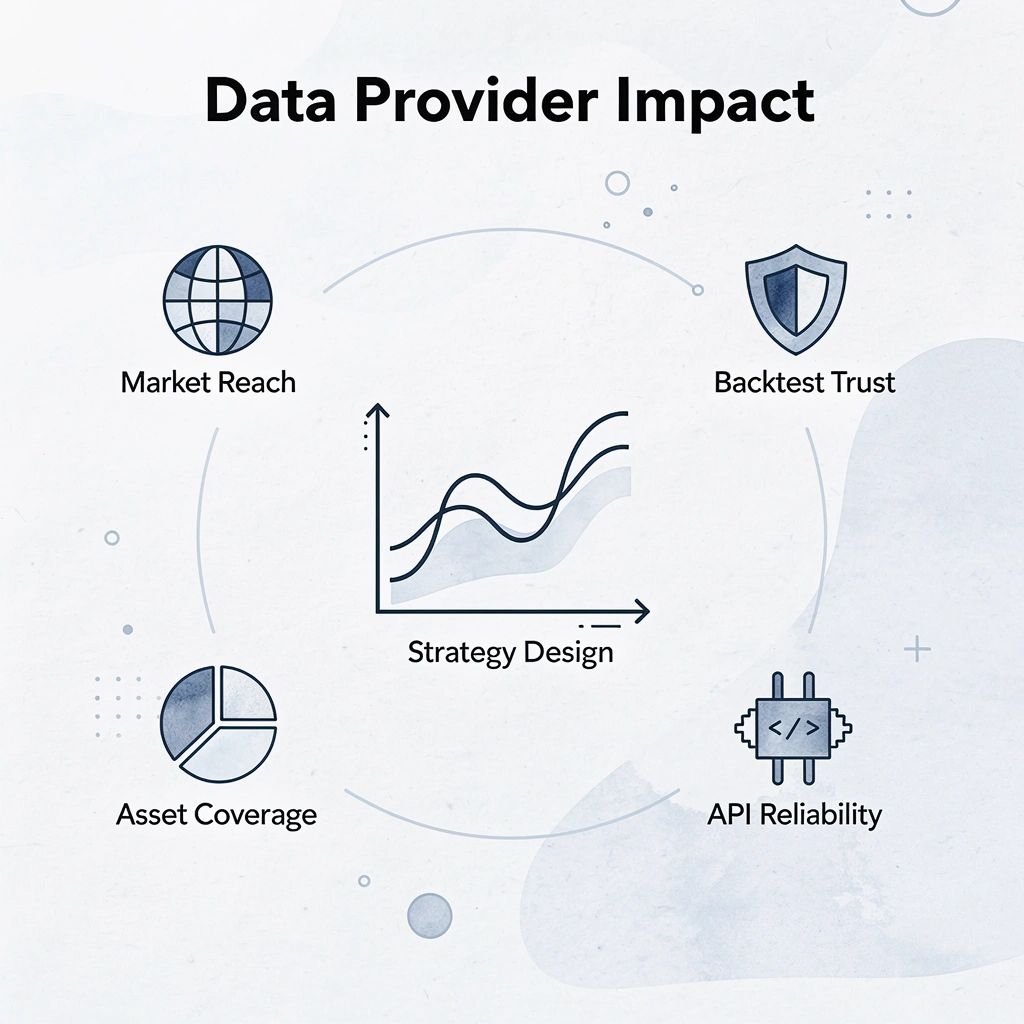
Choosing the right data provider is an infrastructure decision that compounds over time. The provider you select shapes what strategies you can build, what markets you can reach, and how confidently you can trust your backtest results.
"Differences between top market data providers are significant — speed of data delivery, historical depth, asset coverage, and API reliability vary enough to change which strategies work on a given platform." — For Traders
🔑 Takeaway: No two data providers are equal. The gap between a strong and a weak provider can be the difference between a strategy that works and one that only appears to work in backtesting.
💡 Tip: Before committing to any provider, audit their API reliability, historical data depth, and asset class coverage against your specific strategy requirements.
What follows is a structured comparison of 20 providers, organized to help you identify the right fit for your specific trading context.
| Evaluation Factor | Why It Matters |
|---|---|
| Speed of Data Delivery | Determines the viability of high-frequency strategies |
| Historical Depth | Impacts backtest accuracy and signal reliability |
| Asset Coverage | Defines which markets you can realistically trade |
| API Reliability | Affects live execution and system uptime |
⚠️ Warning: Selecting a provider based on price alone is one of the most common — and costly — mistakes algorithmic traders make. A cheap data feed with poor reliability can silently corrupt your entire strategy pipeline.
1. Polygon.io
- Best for: US equities and multi-asset API development
- Markets covered: Stocks, options, forex, crypto, futures, and indices across 32,000+ tickers
- Data strengths: Microsecond-precision tick history, 2ms WebSocket response times on enterprise plans, and real-time forex sourced directly from institutional liquidity providers rather than third-party brokers.
- Tradeoffs: Futures coverage starts only from 2017, limiting long-horizon backtesting for commodity or rates strategies. The free tier is exploratory only, not production-ready.
- Pricing: Free tier available. Paid plans start around $29/month on third-party marketplaces, with production use at $199/month. Enterprise plans unlock full throughput.
- Ideal trader: Quant developers and algorithmic traders building multi-asset strategies who need institutional-grade infrastructure without institutional procurement processes.
- Why choose it over competitors: Polygon processes over 70 million messages per second with 99.99% uptime, a reliability level most mid-market vendors cannot match. Microsecond tick precision and multi-asset breadth in a single API make it the strongest general-purpose choice for serious developers.
2. Alpaca
- Best for: Commission-free algorithmic trading with integrated data and execution
- Markets covered: US equities, ETFs, options, cryptocurrencies, tokenized equities
- Data strengths: SIP-sourced data covering 100% of US market volume, multi-resolution historical bars, WebSocket streaming across all plans, and a paper trading environment that mirrors live endpoints.
- Tradeoffs: Limited international coverage and no futures support, which excludes traders needing CME or commodity exposure.
- Pricing: Free Basic plan with IEX feed access. Algo Trader Plus subscription adds full SIP coverage. Broker API pricing scales with usage for platform builders.
- Ideal trader: Retail algorithmic traders and developers who want to backtest, paper trade, and go live within a single API without switching providers.
- Why choose it over competitors: No other mid-market provider combines commission-free execution with SIP-grade data in one authenticated session. For US equity algo traders, QuantVPS eliminates the data-to-execution handoff, reducing latency and integration risk.
3. Yahoo Finance
- Best for: Research, prototyping, and early-stage backtesting
- Markets covered: US equities, international stocks, ETFs, indices, mutual funds, currencies, crypto, bonds, futures
- Data strengths: Decades of daily price history, fundamental data including earnings and balance sheet metrics, and broad cross-asset coverage accessible without authentication.
- Tradeoffs: Quotes are delayed up to 15 minutes for US equities. The API is unofficial, so endpoint changes can break libraries without warning. Not suitable for live trading.
- Pricing: Free through unofficial endpoints and yfinance. Third-party wrappers on RapidAPI start at $10 per month for higher request volumes.
- Ideal trader: Students, researchers, and early-stage quant developers who need broad historical coverage at no cost before committing to a paid provider.
- Why choose it: No authentication, no cost, and a Python wrapper (yfinance) that installs in minutes. For prototyping a strategy before validating with cleaner data, nothing starts faster.
4. Kenneth French Data Library
- Best for: Factor-based strategy research and academic backtesting
- Markets covered: US equity portfolios sorted by size, value, profitability, investment, momentum, and industry
- Data strengths: Decades of factor return data, Fama-French 3-Factor and 5-Factor models, momentum portfolios, and industry classifications, all freely downloadable and compatible with pandas-datareader.
- Tradeoffs: No API, no real-time data, no individual stock prices. Designed exclusively for portfolio-level factor research, not live trading pipelines.
- Pricing: Free.
- Why choose it: No comparable free source exists for Fama-French factor data. If your strategy involves size, value, profitability, or momentum factors, this library is the standard reference for academic and institutional research.
5. Damodaran Data
- Best for: Basic valuation inputs and cost of capital modeling
- Markets covered: Global equities organized by sector and geography
- Data strengths: Industry-level betas, equity risk premiums by country, revenue growth rates, EV multiples, dividend yields, and option pricing inputs, all updated annually and organized for cross-industry comparison
- Trade-offs: Annual updates only. No API, intraday, or real-time data. Requires manual download or programmatic CSV loading.
- Pricing: Free.
- Ideal trader: Equity analysts, valuation practitioners, and quant researchers building systematic models with fundamental factors, risk premiums, and cost of capital.
- Why choose it over competitors: Damodaran fills a gap no other free source covers at this level. For DCF or comparables-based valuation strategies, this is the reference dataset institutional analysts use as their starting point.
6. SimFin
- Best for: Basic information for machine learning and factor model development
- Markets covered: About 5,000 US stocks, with European and Asian coverage expanding toward a 30,000+ global company goal
- Data strengths: 20+ years of verified quarterly and yearly financial statements, 7,000+ key financial metrics recalculated daily per stock, built-in backtesting tool and stock screener, Python API that outputs directly into Pandas DataFrames
- Trade-offs: The free tier limits historical depth to 5 years, and international coverage is still expanding.
- Pricing: A free account provides access to 5,000 US stocks with five years of history. Basic and Pro plans offer longer history and faster API access. Enterprise licenses are available for commercial data redistribution.
- Ideal trader: Algorithmic traders and data scientists building factor models or training machine learning models on fundamental data. This tool suits those needing clean, validated financial statements without Bloomberg-level costs.
- Why choose it over competitors: SimFin verifies every financial statement before publishing and traces each data point to the original company filing—unusual quality assurance at this price point and critical when training models on financial ratios.
7. EODData
- Best for: Bulk end-of-day price data for global exchanges
- Markets covered: US exchanges (NYSE, Nasdaq, AMEX), international exchanges across Europe and Asia, ETFs, and indices
- Data strengths: Reliable daily OHLCV data across a broad universe, simple bulk file downloads compatible with automated pipelines, and affordable pricing for traders needing daily bars at scale.
- Tradeoffs: No modern REST API. Intraday data requires a paid subscription. Not designed for real-time or tick-level strategies.
- Pricing: Free for end-of-day data on major US exchanges. Premium subscriptions unlock intraday data and expanded international coverage.
- Ideal trader: Systematic traders who build and maintain local databases for backtesting daily or swing strategies across multiple global markets.
- Why choose it over competitors: EODData does one thing well and keeps it affordable. For traders needing consistent, clean daily price history across global exchanges, it's a practical choice without unnecessary platform complexity.
8. Intrinio
- Best for: Algorithmic trading with reliable fundamental and options data
- Markets covered: US stocks, options, ETFs, mutual funds, and 450+ global indices
- Data strengths: 50+ years of adjusted stock price history, 15+ years of standardized financial statements, end-of-day and intraday options data with Greeks and implied volatility, 20ms median API response time, 99.99% uptime
- Tradeoffs: No forex or cryptocurrency data. Entry-level pricing at $750/quarter ($3,000/year) makes it one of the more expensive options for individual traders, with institutional packages reaching $60,000/year.
- Pricing: A two-week free trial is available. EOD Historical Stock Prices costs $3,100 per year, IEX Real-Time costs $6,000 per year, and Nasdaq Basic costs $9,000 per year. The standard API limit is 2,000 calls per minute.
- Ideal trader: Algorithmic traders and quantitative analysts requiring institutional-grade US equity and options data with reliable uptime and official SDK support across Python, Java, JavaScript, C#, R, and Ruby.
- Why choose it over competitors: The combination of 50+ years of adjusted price history, intraday options data with Greeks, and 20ms median response time is difficult to find in a single provider at this price level. For options-focused systematic strategies, Intrinio's depth is a key differentiator.
Stay online and closer to execution. Choose a VPS location for CME futures, New York markets, London FX, API trading, and more.
Host your platform near the market route that matters.
CHINYCLONFrom $29.99/mo
CHI/CME futuresNYC/US marketsLON/FX EAsDUB/PolymarketAMS/EU FXFRA/Central EUTYO/APAC crypto9. Binance
- Best for: Cryptocurrency market data at a large, professional scale
- Markets covered: Hundreds of spot trading pairs, perpetual futures, and altcoins with funding rates, open interest, and liquidation data included
- Data strengths: Historical OHLCV from 2017 across 13 bar resolutions, tick-level trade history via REST, WebSocket streams supporting up to 1,024 simultaneous connections, taker buy/sell volume, and perpetuals data from 2019.
- Tradeoffs: Regulatory status varies by jurisdiction, which is relevant for US-based traders. The platform is not a regulated US exchange, and data is exchange-specific rather than aggregated across venues.
- Pricing: Free. Rate limits: 6,000 request weights per minute on REST, 5 incoming messages per second on WebSocket.
- Ideal trader: Crypto-focused algorithmic traders needing deep liquidity, broad altcoin coverage, and perpetuals data for funding rate arbitrage and momentum models.
- Why choose it over competitors: Binance's free data access, 1,024-stream WebSocket capacity, and perpetuals metrics (funding rates, open interest) make it the default infrastructure choice for serious crypto algo traders. No other exchange matches this combination at zero cost.
10. Coinbase Advanced Trade API
- Best for: Regulated crypto market data for US-based algorithmic traders
- Markets covered: Hundreds of crypto spot pairs meeting US compliance standards
- Data strengths: Level 2 order book updates, ticker and trade WebSocket feeds, strong uptime during high-volatility events, and regulatory clarity for US traders.
- Trade-offs: Narrower asset coverage than Binance by design. Historical tick data depth varies by asset. Altcoin selection is more conservative due to compliance standards.
- Pricing: Free for market data access. Trading fees apply only to order execution.
- Ideal trader: US-based algorithmic traders who prioritize regulatory compliance and exchange reliability over asset breadth, particularly those running strategies on major pairs like BTC and ETH.
- Why choose it over competitors: For US traders, Coinbase is the most trusted regulated alternative to Binance. Its strong track record during volatile market conditions provides a genuine advantage for real-time trading systems.
11. CoinMarketCap
- Best for: Combining crypto from different exchanges and analyzing market sentiment
- Markets covered: 20,000+ cryptocurrencies, 600+ exchanges, NFT market data, global market dominance metrics
- Data strengths: Historical data including delisted assets (useful for survivorship-bias-free research), global market cap rankings, volume statistics, price conversion endpoints, and WebSocket streaming on higher-tier plans.
- Tradeoffs: Not an exchange API, so data comes from multiple sources rather than a single venue's order book. WebSocket access and historical depth require paid plans. The free tier limits you to 10,000 API call credits per month.
- Pricing: Free tier offers 10,000 credits/month. Paid plans start at $29/month (Hobbyist) and scale through Enterprise tiers, which include higher API call limits and WebSocket access.
- Ideal trader: Crypto researchers and systematic traders who need cross-exchange market cap data, sentiment signals, or survivorship-bias-free historical coverage unavailable from single exchanges.
- Why choose it over competitors: CoinMarketCap covers assets that have since been delisted, which is critical for researchers who want to avoid survivorship bias in crypto backtests. No single exchange API replicates this breadth of historical coverage.
12. Finnhub
- Best for: Alternative data combined with traditional market feeds in a single API
- Markets covered: Global stocks across 60+ exchanges, forex via 10+ brokers, crypto from 15+ exchanges
- Data strengths: 30+ years of tick-level and OHLC data, 30+ years of standardized financial statements for 65,000 global companies, 15+ years of earnings call transcripts with audio, social sentiment from Reddit and Twitter, congressional trading data, USPTO patent filings, H-1B visa data, FDA calendars, ESG scores
- Tradeoffs: The All-In-One plan at $3,000/month is expensive for individual traders, and per-market premium plans at $49- $ 50/month add up quickly for multi-region strategies.
- Pricing: The free tier offers 60 API calls per minute with real-time WebSocket access. Premium plans start at $49 per month per market. All-In-One plan costs $3,000 per month (billed annually).
- Ideal trader: Quantitative researchers and event-driven traders who combine traditional price data with alternative signals (sentiment, insider transactions, government data) without managing multiple API subscriptions.
- Why choose it over competitors: Finnhub uniquely consolidates congressional trading data, patent filings, and earnings call audio with real-time price feeds through a single API, offering valuable efficiency for event-driven systematic strategies.
13. Tiingo
- Best for: News data and forex feeds with institutional-grade reliability
- Markets covered: US equities, ETFs, cryptocurrencies, 140+ forex pairs, historical news across 65,000+ equity tickers and 4,000 cryptocurrencies
- Data strengths: News archive dating to 1995, WebSocket firehose streaming, independently audited uptime metrics, and institutional-grade server infrastructure for forex.
- Tradeoffs: Not a multi-asset platform in the Polygon sense. International equity coverage is limited. Best suited for traders whose strategies focus on news sentiment or forex signals.
- Pricing: The free plan allows up to 500 requests per hour. Paid plans offer higher rate limits, access to the IEX intraday feed, and commercial usage rights.
- Ideal trader: Systematic traders building NLP-based news sentiment models or forex strategies who need deep historical news archives and reliable real-time feeds at competitive pricing.
- Why choose it over competitors: A news archive spanning 1995 across 65,000+ tickers is rare. For strategies that depend on sentiment and require long-term training data, Tiingo's news depth provides a structural advantage over providers that offer only recent headlines.
14. Nasdaq Data Link
- Best for: Finding curated financial and alternative datasets across a wide catalog
- Markets covered: Stocks, futures, commodities, interest rates, macro indicators, energy, metals, and alternative data
- Data strengths: Decades of historical information on traditional financial series, diverse organized datasets from a single provider, official client libraries for Python, R, MATLAB, and Excel, and a substantial free catalog.
- Tradeoffs: Most datasets update daily, weekly, or quarterly rather than in real time, making them unsuitable for low-latency trading. Premium datasets cost several hundred to several thousand dollars per year.
- Pricing: Many datasets are free to access without signing up, though premium pricing varies by dataset.
- Ideal trader: Quantitative researchers and systematic strategy developers who need diverse, carefully selected datasets covering commodities, macro indicators, and alternative data from a single source.
- Why choose it over competitors: Nasdaq Data Link's defining advantage is its breadth of catalogs. The platform's filtering and discovery tools save researchers significant time when exploring datasets across asset classes.
15. FlightRadar24
- Best for: Event-driven alternative data strategies using corporate aircraft tracking
- Markets covered: Global flight data, including private jets, corporate aircraft, airport traffic, and route histories
- Data strengths: Real-time and historical flight tracking is useful for identifying M&A activity, regulatory interactions, or executive travel before public announcements.
- Tradeoffs: Premium alternative data source with event-specific signals rather than systematic daily inputs. Enterprise plans required for high-volume historical access.
- Pricing: Business API pricing varies by usage tier; enterprise plans are required for commercial high-volume access.
- Ideal trader: Event-driven systematic traders and hedge funds running M&A arbitrage or corporate event strategies who use unconventional signals to identify potential deal activity before formal announcements.
- Why choose it over competitors: No other provider offers flight-level corporate activity signals. Private jet tracking near company headquarters or regulatory agencies provides informational value for early signal detection in event-driven strategies.
16. Reddit API
- Best for: Retail sentiment analysis and meme stock momentum signals
- Markets covered: Social data across r/WallStreetBets, r/investing, r/options, and dozens of sector-specific communities
- Data strengths: Up to 100 requests per minute on OAuth-authenticated calls, post data, comments, upvotes, subreddit metadata, user activity, historical archives via pushshift.io successors, and documented predictive power on short-term price moves in academic literature
- Tradeoffs: Signal is most relevant for retail-driven momentum and short-squeeze dynamics rather than institutional strategies. Data quality requires NLP preprocessing, and API terms changed in 2023 for high-volume consumers.
- Pricing: Free under standard usage terms. High-volume commercial applications may require paid-tier access following the 2023 policy changes.
- Ideal trader: Systematic traders building NLP sentiment models focused on retail-driven price movements, meme stock momentum, or options activity signals correlated with social media attention spikes.
- Why choose it over competitors: Since the GameStop short squeeze of early 2021, Reddit sentiment has become a measurable signal. The API's generous free rate limits and depth of community-specific data make it the most accessible source for retail sentiment research.
17. FRED (Federal Reserve Economic Data)
- Best for: Assembling broad economic signals for organized macro and multi-factor strategies
- Markets covered: US and international economic indicators across 800,000+ time series from 100+ sources
- Data strengths: Federal Funds Rate history, Treasury yields, credit spreads, labor market statistics, CPI, GDP components, money supply, vintage data access (data as released at a specific historical point, critical for avoiding look-ahead bias), pandas-datareader and FRED API integration
- Tradeoffs: This is not a market price feed. Data updates occur anywhere from once daily to once every three months, depending on the selected data series. It is not designed for strategies requiring intraday or tick-level data.
- Pricing: Free. No paid tiers. Commercial use permitted.
- Why choose it: Using old data prevents look-ahead bias in macro backtests, a data integrity issue most providers ignore.
18. US Bureau of Labor Statistics (BLS)
- Best for: Job numbers, inflation rates, and wage information for trading models based on macroeconomic trends
- Markets covered: US labor market statistics by industry, occupation, geography, and demographic group; CPI, PPI, import/export prices, and productivity metrics.
- Data strengths: Non-Farm Payrolls and CPI releases that move markets on announcement day, granular employment breakdowns, decades of historical series, and a free public REST API.
- Tradeoffs: The API is less developer-friendly than FRED's. The free version limits you to 25 series per query and 500 queries per day without registration. With an API key, you can increase these to 50 series and 3,000 queries per day.
- Pricing: Free
- Ideal trader: Macro systematic traders who build models around scheduled economic releases, particularly NFP and CPI, where the data itself serves as the trading signal.
- Why choose it over competitors: BLS is the primary source for the two most market-moving scheduled economic releases in the US. Going directly to the source rather than through an aggregator eliminates potential data latency or transcription errors.
19. Bureau of Economic Analysis (BEA)
- Best for: GDP and national accounts data for US business cycle modeling
- Markets covered: US GDP components, personal income and saving rates, corporate profits, fixed asset investment, and international trade in services
- Data strengths: Quarterly GDP releases and changes, spending and investment breakdowns, business profit trends, REST API returning JSON or XML, pandas-datareader compatibility, and free access without restrictive rate limits.
- Tradeoffs: Documentation is less modern than FRED's. API coverage emphasizes national accounts over financial market data. Most major series update quarterly.
- Pricing: Free
- Ideal trader: Macro systematic traders and researchers modeling the US business cycle, consumer behavior, or corporate investment trends
- Why choose it over competitors: BEA is the official source for US GDP data, including updates and detailed breakdowns that FRED collects but does not create. For models that depend on accurate GDP data, sourcing data directly from BEA is essential.
20. World Bank Open Data
- Best for: Global macro modeling, emerging market strategies, and cross-country risk assessment
- Markets covered: 1,600+ indicators across 200+ countries and regions, including GDP per capita, inflation, trade balances, FDI, financial inclusion, and governance metrics
- Data strengths: 50+ years of historical depth for major series, free and openly licensed, including for commercial use, Python libraries (wbdata, world-bank-data) for multi-country panel dataset construction, and cross-country comparability difficult to replicate from other sources.
- Tradeoffs: Update frequency varies by indicator and can lag by one to two years for some developing country series. This is not a market price feed and is designed for macro research rather than trading execution.
- Pricing: Free.
- Ideal trader: Global macro traders, emerging market strategy developers, and quantitative researchers building country risk models or cross-border factor strategies who need standardized, comparable data across dozens of markets simultaneously.
- Why choose it over competitors: Cross-country comparability is the World Bank's defining advantage. Building a panel dataset covering 50+ countries with a consistent methodology, comparable to any other source, would require assembling and normalizing data from dozens of national statistics agencies. The World Bank does that work for you at no cost.
Where can you find more alternative data sources for algorithmic trading?
Papers With Backtest lists 20 alternative data sources designed for algorithmic trading. Flight tracking, Reddit sentiment, patent filings, and congressional trading disclosures have become legitimate research inputs for systematic strategies.
Most traders handle their data infrastructure locally and manually, introducing friction they often overlook. A strategy running on a home machine or shared cloud instance faces connection interruptions, latency spikes, and execution delays that erode the performance edge the data was designed to create. Our trading VPS keeps your algorithms running on dedicated infrastructure close to exchange matching engines, preserving data quality at the execution layer.
Turn Better Market Data Into Better Trade Execution with QuantVPS
Getting clean, checked market data is the foundation of any serious trading operation. But that foundation breaks if your algorithms run on your own computer or shared hosting, creating a critical infrastructure problem that no data provider can fix. Unreliable execution environments undermine even the most carefully validated strategies, turning a tested edge into missed opportunities.

"Your strategies need a dedicated, always-on environment positioned close to exchange matching engines—with the uptime and low-latency connectivity to execute exactly what your backtests modeled." — QuantVPS
A trading VPS like QuantVPS solves this problem directly. Our infrastructure delivers the dedicated, always-on environment your algorithms demand, positioned close to exchange matching engines for maximum low-latency connectivity. QuantVPS supports all major platforms out of the box—fitting your existing workflow rather than forcing a costly rebuild:
| Platform | Supported |
|---|---|
| NinjaTrader | ✅ Yes |
| TradeStation | ✅ Yes |
| MetaTrader | ✅ Yes |
| Interactive Brokers | ✅ Yes |
| Sierra Chart | ✅ Yes |
💡 Tip: Because QuantVPS integrates with your existing tools, there's zero platform rebuilding required—you're live and executing in minutes, not days.
⚠️ Warning: Running strategies on shared hosting or personal hardware introduces latency spikes, downtime risk, and execution slippage—all of which can silently erode a proven backtested edge.
🎯 Key Point: If you've built a tested edge, don't let unreliable hardware become the weakest link in your entire operation. Every millisecond of unnecessary latency and every minute of unexpected downtime is a direct cost to your strategy's performance. Deploy QuantVPS in under five minutes and give your algorithms the stable, low-latency foundation they need to perform exactly as modeled.
🔑 Takeaway: Clean market data + QuantVPS infrastructure = a complete, execution-ready trading environment built for serious algorithmic traders.

FAQs
Do I need Level 2 data, or is Level 1 enough?
Level 2 data provides a deeper look into the order book, showing bid and ask sizes at multiple price levels. This can be especially useful for traders who rely on strategies that require a more granular view of market activity. On the other hand, Level 1 data includes the basics: the best bid and ask prices, along with the last traded price. For many algorithmic trading strategies, this information is often enough. Your choice should depend on how complex your strategy is and the level of detail you need from the data.
How can I verify a data feed is accurate before going live?
To make sure a data feed is reliable before it goes live, compare it against a trusted third-party benchmark. Pay close attention to any inconsistencies, particularly during periods of market volatility or outside standard trading hours. Check the provider’s data sources, how they aggregate information, and how their system performs under volatile conditions. Cross-referencing with benchmarks such as the NBBO or futures curves can further validate accuracy. Following these steps ensures the data is dependable for live trading.
Should I use one data provider or a multi-provider stack?
Using a multi-provider stack for algorithmic trading brings several advantages, particularly in terms of reliability, coverage, and resilience. Instead of depending on a single provider, this approach minimizes risks like outages or gaps in data. It also gives traders the flexibility to customize data streams to match specific strategies. By diversifying data sources, traders gain access to more precise and timely information, which enhances system robustness and boosts overall performance. This setup is especially favored for meeting the demands of advanced trading strategies.