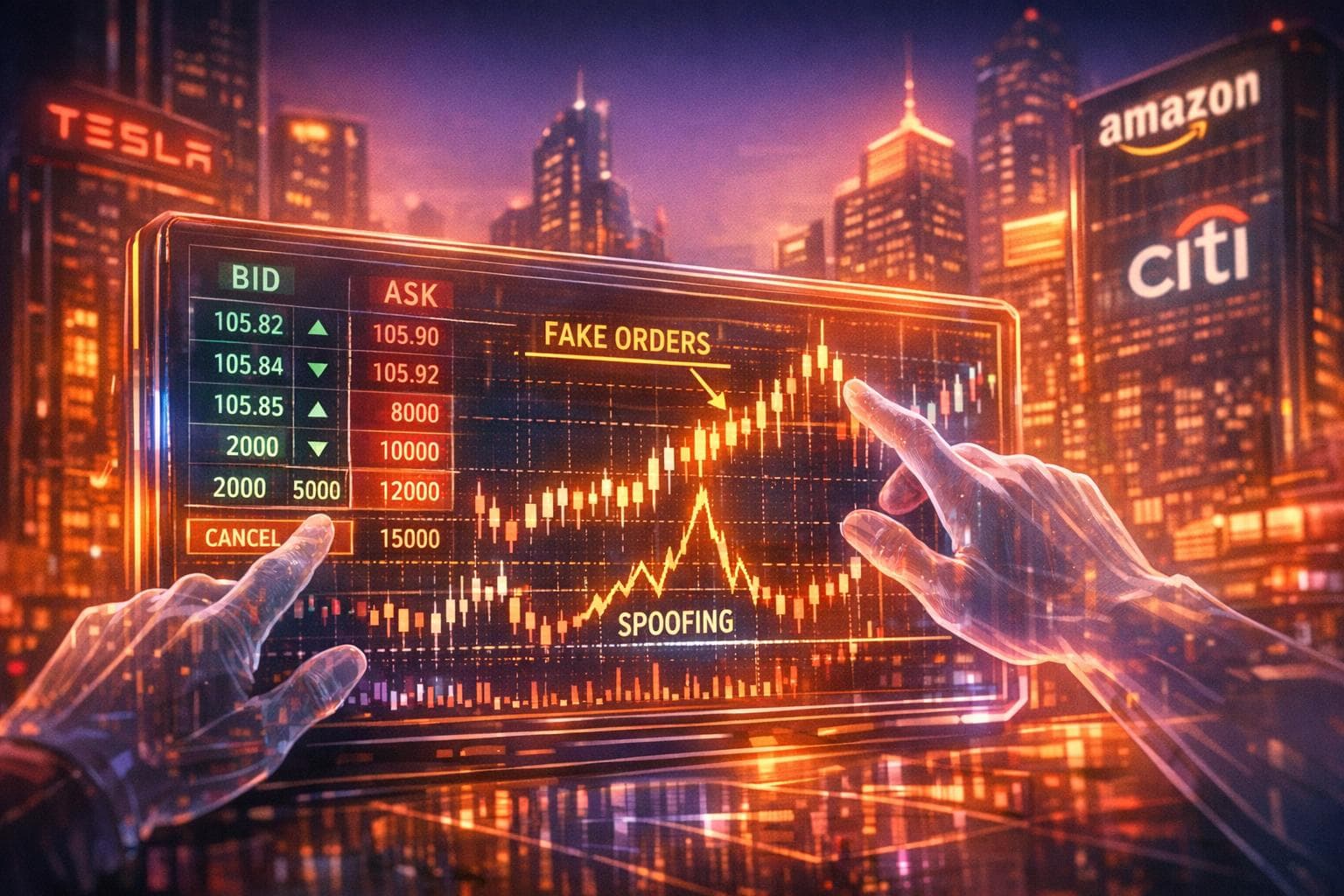
Spoofing is a banned trading tactic where fake buy or sell orders are placed to manipulate market prices. The goal? Trick other traders into reacting to false demand or supply signals. Spoofers cancel these fake orders quickly, profiting from price changes caused by the deception. This practice is illegal under U.S. law (Dodd-Frank Act, 2010) and carries severe penalties, including fines and prison time.
Key points about spoofing:
- How it works: Place fake orders, manipulate prices, cancel orders, and profit.
- Examples: Traders like Navinder Singh Sarao (2010 Flash Crash) and firms like JPMorgan Chase ($920 million fine in 2020) have been penalized for spoofing.
- Detection: Look for rapid order cancellations, large fake orders, and unusual market activity.
- Prevention tools: Use advanced monitoring systems, like QuantVPS, to detect and respond to spoofing in real time.
Spoofing distorts market integrity and harms traders. Understanding its mechanics and using detection tools can help protect your trades.
What Is Spoofing in Trading?
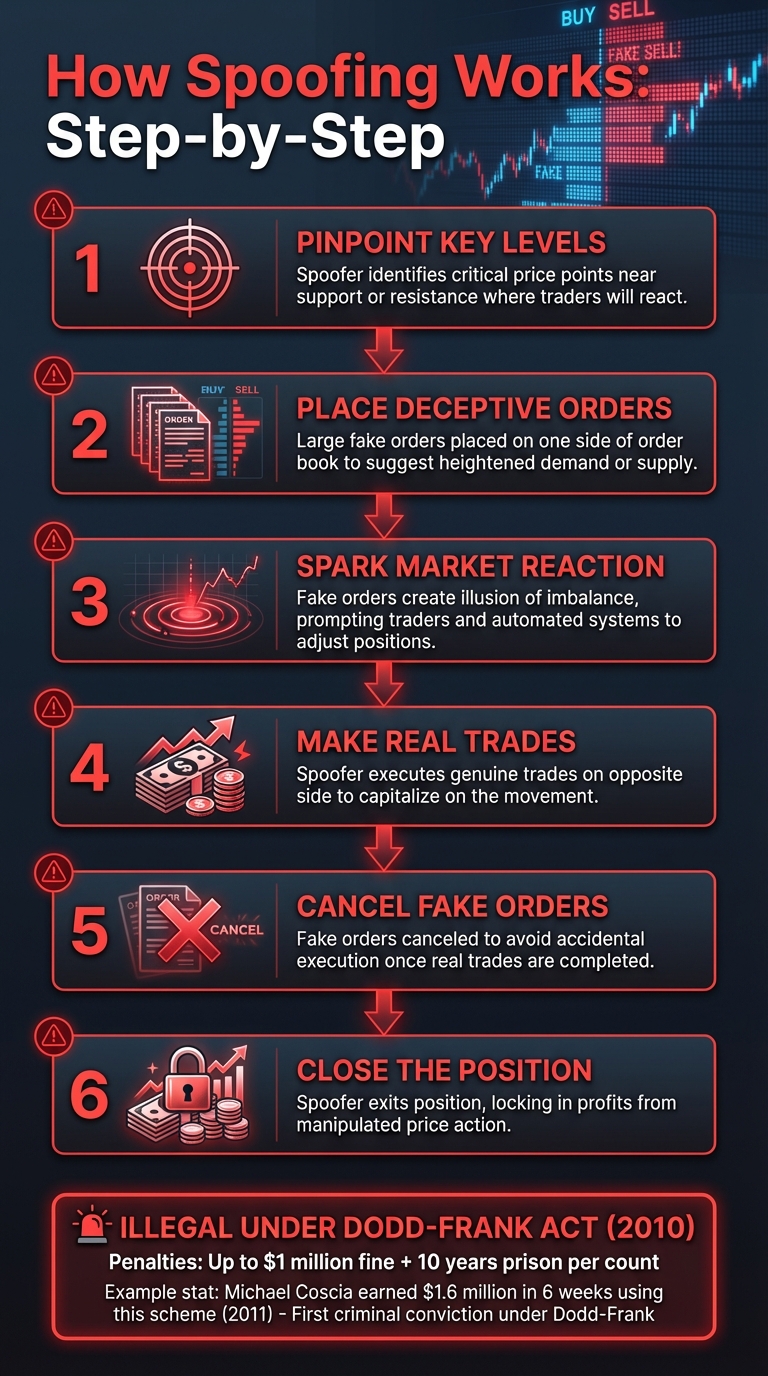
How Spoofing Works: 6-Step Trading Manipulation Process
Basic Definition of Spoofing
Spoofing is a deceptive trading tactic where large buy or sell orders are placed with no intention of fulfilling them. The goal? To create a false impression of market demand or supply, influencing other traders to react to these artificial price signals.
Unlike legitimate trading strategies - where orders are placed with the genuine intention of execution - spoofing orders act as bait. By manipulating the limit order book, spoofers send misleading signals about market depth and liquidity. High-frequency trading algorithms and bots are often behind these schemes, placing and canceling thousands of orders in fractions of a second. This speed makes it nearly impossible for human traders to spot the manipulation in real time. In the U.S., spoofing is a criminal act under the Dodd-Frank Act, and it's similarly outlawed in the U.K. by the Financial Conduct Authority.
Now, let’s break down how spoofing works step by step.
How Spoofing Works: Step-by-Step
Here’s how spoofing typically unfolds:
- Pinpoint Key Levels: The spoofer identifies critical price points, often near areas of strong support or resistance, where traders are likely to react.
- Place Deceptive Orders: Large fake orders are placed on one side of the order book to suggest heightened demand or supply.
- Spark Market Reaction: These fake orders create an illusion of imbalance, prompting traders and automated systems to adjust their positions.
- Make Real Trades: While the market reacts to the fake orders, the spoofer executes genuine trades on the opposite side to capitalize on the movement.
- Cancel Fake Orders: Once the real trades are completed, the spoofer cancels the fake orders to avoid accidental execution.
- Close the Position: Finally, the spoofer exits the position, locking in profits from the manipulated price action.
One infamous example involves Michael Coscia, who used an algorithm on the CME Globex platform between August and October 2011. Over six weeks, he earned $1.6 million by employing this scheme. Coscia’s actions led to the first criminal conviction for spoofing under the Dodd-Frank Act.
In another case, the Department of Justice revealed in September 2025 that BofA Securities agreed to pay a $5.6 million fine for spoofing violations. Between October 2014 and February 2021, two traders carried out 717 instances of spoofing in U.S. Treasury securities. One trader, Sidney Lebental, used iceberg orders to disguise real trades while displaying $50 million in spoof orders, inflating perceived liquidity by an astonishing 2,600%. In another instance, 523 spoof orders were canceled within three seconds, with 447 receiving no executions - clear evidence of manipulation [4].
These tactics not only disrupt markets but also carry severe legal consequences.
Your trading computer. In the cloud.
Connect and control your trading strategies from any device, anywhere in the world, through secure remote desktop, while execution remains on QuantVPS.
Explore the hardwareFrom $29.99/mo · Windows or Linux · 8 datacenters
0.52ms to CME from our Chicago nodes.
Spoofing vs. Legal Trading Practices
The line between spoofing and lawful trading lies in intent and transparency. Legitimate strategies involve genuine orders placed with the expectation of execution, while spoofing relies on deception to manipulate the market.
| Feature | Spoofing (Illegal) | Legitimate Trading (Legal) |
|---|---|---|
| Primary Intent | Mislead others by canceling orders before execution | Execute orders under specific conditions |
| Market Impact | Creates artificial price movements and liquidity | Supports accurate price discovery |
| Order Types | Layering (multiple fake orders at different levels) | Fill or Kill (FoK), Stop-loss, Iceberg, and Passive orders |
| Transparency | Orders act as decoys to manipulate market signals | Orders represent genuine intent to trade |
Regulators face challenges in proving intent, as traders may cancel orders for valid reasons, like reacting to changing market conditions. However, patterns of rapid cancellations often reveal manipulative behavior.
"While forms of algorithmic trading are of course lawful, using a computer program that is written to spoof the market is illegal and will not be tolerated."
– David Meister, Enforcement Director, CFTC
Real-World Examples of Spoofing
Example: Spoofing in Stock Markets
From October 2011 to September 2012, Eric Oscher, a principal at Briargate Trading, LLC, orchestrated a spoofing scheme targeting NYSE-listed securities. He exploited the NYSE "Order Imbalance Message", a pre-market indicator designed to reflect supply and demand.
On March 20, 2012, Oscher placed 400,000 fake buy orders to counteract a sell imbalance, creating the illusion of strong demand. This manipulation drove prices higher on other exchanges. Briargate then shorted 43,400 shares at the inflated price. Once the spoof orders were canceled and prices fell, they covered their short position, pocketing a $7,233 profit. Over the course of the scheme, Briargate raked in approximately $525,000 in profits. The SEC later ordered the firm to pay back the entire amount.
This case underscores how spoofers exploit market mechanisms, like pre-market data feeds, to deceive other traders and profit from artificially induced price changes.
Spoofing isn't confined to traditional markets, though. Similar tactics have found fertile ground in the world of cryptocurrencies.
Case Study: Spoofy and Crypto Market Manipulation
Cryptocurrency markets present a different battleground for spoofing, largely due to their lower liquidity and limited regulatory oversight. One infamous example is "Spoofy", a name coined for an anonymous entity accused of manipulating Bitcoin prices on the Bitfinex exchange. Spoofy, along with other high-frequency trading bots, is said to have used massive spoof orders to create a false sense of market depth.
These tactics are particularly effective in targeting low-cap tokens and unregulated exchanges, where thin liquidity makes price manipulation easier. By placing large fake orders, crypto spoofers can instill fear or excitement, prompting traders to act on misleading signals. This manipulation often triggers extreme volatility, increasing the risk of unintended order executions .
While the mechanics of crypto spoofing resemble those in traditional markets, the lack of robust oversight makes detection far more difficult. Unlike stock exchanges, which are monitored by regulators like FINRA and the SEC, many cryptocurrency platforms operate with minimal regulatory frameworks. This lack of oversight allows spoofing schemes to persist longer, creating a haven for manipulators to exploit unsuspecting traders.
Legal Framework and Regulations
Spoofing Under the Dodd-Frank Act
The Dodd-Frank Wall Street Reform and Consumer Protection Act, signed into law in 2010, reshaped the way financial markets handle deceptive trading tactics. One of its key provisions, Section 747, amended the Commodity Exchange Act (CEA) to explicitly outlaw spoofing. Spoofing is defined as “bidding or offering with the intent to cancel the bid or offer before execution”.
This distinction is crucial because not all order cancellations are considered deceptive. Legitimate strategies, like Fill or Kill orders or stop-loss orders, are placed with a genuine intent to execute. Spoofing, on the other hand, involves placing orders with the specific intention of canceling them to mislead the market about supply or demand.
To prosecute spoofing, regulators must prove that the cancellation was planned in advance. Under the CEA, spoofing is treated as a serious offense, punishable by fines of up to $1 million and prison terms of up to 10 years per count [3].
The responsibility for enforcement is shared among several agencies. The Commodity Futures Trading Commission (CFTC) oversees commodities and derivatives markets, while the Securities and Exchange Commission (SEC) tackles spoofing in securities markets through anti-fraud provisions like Rule 10b-5. Meanwhile, the Department of Justice (DOJ) handles criminal cases, often using the federal wire fraud statute (18 U.S.C. § 1343), which carries a 10-year statute of limitations and allows for harsher penalties [3].
This legal and regulatory framework has paved the way for vigorous enforcement efforts in recent years.
SEC and CFTC Enforcement Actions
Regulators have taken an aggressive stance against spoofing, imposing hefty penalties and pursuing criminal prosecutions. A landmark case came in July 2013, when Michael Coscia became the first trader prosecuted under the anti-spoofing provisions. His conviction was upheld in August 2017 by the Seventh Circuit Court of Appeals, which ruled that the CEA’s anti-spoofing provision “provides clear notice and does not allow for arbitrary enforcement” [3].
These actions emphasize that while algorithmic trading is legal, it must not involve manipulative intent. Any trading program designed to deceive the market will face regulatory scrutiny.
The crackdown has extended beyond individual traders to major financial institutions. In September 2020, JPMorgan Chase agreed to a record $920 million settlement over spoofing allegations involving precious metals and Treasury securities. Between 2008 and 2016, traders on the bank’s precious metals desk placed hundreds of thousands of spoof orders, resulting in fines, restitution, and disgorgement.
Liability has also reached software developers. In 2018, Jitesh Thakkar became the first software engineer charged as a co-conspirator for creating a program used in spoofing, showing that even those who build spoofing tools can face criminal charges [3]. Firms can also be penalized for failing to supervise their employees adequately. For example, under CFTC Regulation 166.3, companies can face fines of up to $25 million for insufficient oversight [3].
In a more recent case from August 2022, the CFTC ordered proprietary trader Eric Schwartz to pay a $100,000 civil penalty for spoofing Natural Gas and RBOB gasoline futures on the CME. Schwartz placed spoof orders that were more than ten times the size of his legitimate orders and received a four-month trading ban as part of his punishment.
These cases highlight the broad scope of enforcement, targeting everyone from individual traders to multinational banks and even software developers, ensuring that market manipulation is addressed at every level.
Stay online and closer to execution.
Host your platform beside its market: Chicago for CME futures, New York for US markets, London for FX EAs.
Explore the hardwareFrom $29.99/mo · Windows or Linux · 8 datacenters
0.52ms to CME from our Chicago nodes.
How to Detect and Protect Against Spoofing
Warning Signs of Spoofing Activity
Spotting spoofing early is crucial due to the serious risks it poses to the market. Certain patterns can act as red flags. For instance, large orders that vanish almost as soon as they appear and imbalanced fills - where only a small portion of a large order is executed before cancellation - are common indicators. Another telltale sign is position oscillation, where rapid, back-and-forth position changes create a distinctive pattern.
Order layering is another tactic to watch for. This involves placing multiple fake orders at various price levels to create a false impression of market depth. A notable example occurred in November 2023, when FINRA fined BofA Securities $24 million for 717 spoofing incidents. In some cases, supervisors placed $50 million fake buy orders for 30-year bonds to manipulate the market and execute "iceberg" sell orders for related Ultra T-Bonds. These orders were often canceled in less than a second after the genuine trades were completed.
Market flipping is another red flag. This involves a trader rapidly switching from bidding to offering (or vice versa) at the same price point to exploit the resulting market movement. Modern surveillance systems often assign risk scores to trading clusters, with scores above 75 signaling potential spoofing activity [11].
Recognizing these patterns highlights the importance of advanced monitoring systems.
Using QuantVPS for Real-Time Order Book Monitoring
To combat spoofing, traders need tools that combine speed and accuracy. QuantVPS provides low-latency infrastructure, enabling real-time order book monitoring with latency as low as 0.52ms to CME from Chicago. This allows traders to identify and respond to spoof orders almost instantly. QuantVPS has locations in Chicago, New York, London, Dublin, Amsterdam, Frankfurt, Tokyo and Singapore.
QuantVPS’s advanced visualization tools offer a clear view of how large orders interact with the market, making it easier to spot patterns like rapid order deletions. Additionally, its high-performance system can track cross-product spoofing by analyzing notional values across multiple limit order books. This capability is vital for uncovering schemes where manipulation in one market benefits positions in another.
Algorithmic Tools for Spoofing Detection
Algorithmic tools play a key role in identifying manipulative behavior. These tools analyze metrics like order cancellation ratios, volume modifications, and imbalanced fills to flag suspicious activity. Specific behaviors like vacuuming - where large orders are canceled to bait the market - and spread squeezing, where traders artificially narrow the spread before switching sides, are often detected using these systems [11].
Machine learning models add another layer of sophistication by tracking rapid switches between bids and offers. Together with QuantVPS’s low-latency infrastructure, these tools enable traders to adjust their strategies in real time, protecting their positions from artificial price manipulation.
"Currently it takes a fairly high level of understanding of the behavior, in order to determine if spoofing is happening at an organization." - Alan Jukes, Product Manager, Nasdaq [12]
Conclusion
Spoofing undermines price discovery by creating a false sense of supply and demand. This deceptive tactic pushes traders into making decisions they wouldn’t otherwise consider, often leading to widespread instability in the market.
Because of its disruptive nature, spoofing draws harsh regulatory scrutiny. Authorities impose stringent penalties to deter such behavior. Under the Commodity Exchange Act, spoofing is classified as a felony, carrying penalties of up to $1 million and a maximum of 10 years in prison for each offense [3].
"While forms of algorithmic trading are of course lawful, using a computer program that is written to spoof the market is illegal and will not be tolerated... to protect market participants and promote market integrity." - David Meister, Enforcement Director, CFTC [2]
Modern trading environments rely on advanced tools to combat spoofing. Real-time monitoring systems can detect suspicious activities as they happen. For instance, QuantVPS’s low-latency infrastructure allows traders to identify unusual order behavior quickly. Paired with algorithmic tools that assess order cancellation rates and detect cross-product manipulation, these technologies provide the precision and speed necessary to safeguard trading operations in today’s fast-paced markets.
FAQs
How can traders protect themselves from spoofing during live trading?
Traders can shield themselves from spoofing by combining advanced technology with smart trading strategies. Cutting-edge monitoring tools are designed to analyze order books and identify suspicious activities, such as large orders that are quickly canceled or layered orders aimed at distorting prices. These systems often provide real-time alerts, allowing traders to adjust or halt their actions before falling prey to manipulated price movements.
Beyond technology, certain trading techniques can also help. For instance, using hidden or iceberg orders can reduce the visibility of large trades, making them less vulnerable to manipulation. Setting strict price limits and defining slippage thresholds can further safeguard trades from executing during sudden, spoof-driven market fluctuations. Staying vigilant with market surveillance reports and practicing meticulous order management are equally important steps to minimize the risks associated with spoofing tactics.
What consequences do individuals or firms face if caught spoofing in trading?
Individuals involved in spoofing risk severe legal consequences, including criminal charges like wire fraud, which can result in imprisonment. Companies found guilty of spoofing may face steep civil penalties, such as large fines and settlements enforced by regulatory agencies like the Commodity Futures Trading Commission (CFTC) and the Department of Justice (DOJ).
These measures are designed to discourage fraudulent behavior and uphold the fairness and integrity of financial markets, emphasizing the critical need for adherence to trading regulations.
How is spoofing in cryptocurrency markets different from traditional markets?
Spoofing in cryptocurrency markets works much like it does in traditional financial markets. Traders place large fake orders to influence prices, only to cancel them once the market reacts in their favor. However, the crypto world brings its own set of hurdles. These markets run 24/7, often on decentralized platforms, with thinner order books and higher price volatility. This creates an environment where price manipulation can thrive more easily compared to regulated stock markets.
What makes it even trickier? The anonymity of blockchain participants and a patchwork of regulations across different jurisdictions. Unlike U.S. equities and futures markets, where spoofing is illegal, crypto markets often lack consistent rules, leaving traders more vulnerable to such tactics. And while blockchain technology offers transparency through on-chain data, the activity within exchange order books remains largely hidden. This lack of visibility makes spotting spoofing in the crypto space an even tougher challenge.