Have you ever placed a futures order only to find it canceled at day's end when you wanted it active, or left open overnight unintentionally? Choosing between a Good Till Cancel order and a Day order shapes your trading results. This article explains how each order type works, when to use each one, and how to align your order duration with your trading strategy.
Executing futures trades with precision depends on your platform running without interruption. Our Quant VPS keeps your order management software live around the clock, ensuring GTC orders stay open as intended and day orders close on time at session end, with no missed signals or unexpected gaps from dropped connections.
Summary
- Futures markets do not follow a single universal clock, and that distinction has real consequences for order management. The CME Group defines trading sessions by product, meaning crude oil futures trade nearly 24 hours a day on Globex while certain agricultural contracts close well before 4 PM ET. Assuming a day order expires at 4 PM Eastern because that is when equities close is a mistake that can leave positions open far longer than intended.
- GTC orders carry a persistence risk that most traders underestimate. A limit order placed during a low-volatility period can sit quietly in a queue and execute weeks later under completely different market conditions. Most brokers allow GTC orders to remain active for up to 90 days before automatic cancellation, creating a long window for price context to shift while the order stays live.
- Contract expiration creates a specific risk for GTC orders that stock traders rarely encounter. As a futures contract approaches expiration, liquidity shifts to the next contract out, and a GTC order on an expiring contract does not automatically roll forward. Depending on the broker, it may fill in a thinning market, get canceled without notice, or, in some cases, trigger delivery obligations if the trader is not paying close attention.
- The choice between a day order and a GTC order depends on whether the trade thesis is session-bound or price-bound. Day orders are the logical choice when the setup relies on current-session conditions like intraday volume profile or that morning's economic data, because carrying that logic into the next session introduces noise rather than discipline. GTC orders make sense when a specific price level holds strategic significance regardless of when the market reaches it.
- Reliable order management is a repeatable process, not a single decision. Before each session, traders need to confirm time-in-force settings, check contract expiration dates, and cancel any GTC orders where the original price thesis no longer applies after a significant news event or technical structure break. Tastylive recommends targeting 50% of maximum profit when using GTC orders to manage winning positions, a threshold precise enough to place as a standing order without requiring constant monitoring.
- Automated strategies introduce an additional layer of risk that is easy to overlook. A GTC order placed by a bot or expert advisor does not disappear if the platform goes offline. It executes the moment price touches the target level, whether or not the trader is watching. A trading VPS addresses this by keeping order-management software running continuously, so the logic that placed the order stays active and responsive when the market moves toward it. When placing a trade, you decide not only what to buy or sell but also how long your order remains active. The two main options are:
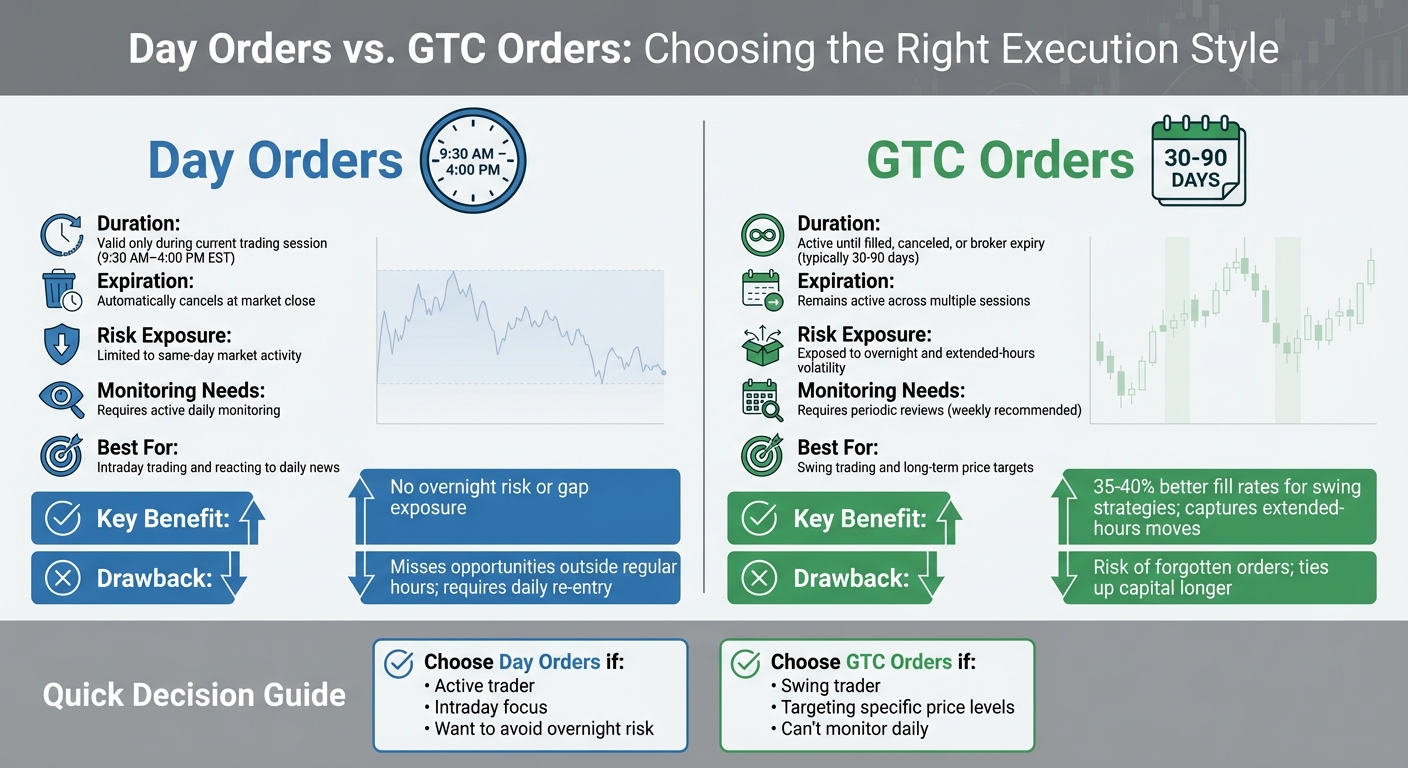
- Day Orders: Valid only during the current trading session (9:30 AM–4:00 PM EST). They automatically cancel when the market closes.
- Good Till Cancel (GTC) Orders: Stay active across multiple sessions until filled, manually canceled, or expired by the broker (typically 30–90 days).
Key Takeaways:
- Day Orders: Best for intraday strategies; limit exposure to overnight risks but require daily re-entry.
- GTC Orders: Ideal for longer-term goals; automate execution but are exposed to overnight price changes and require periodic review.
Quick Comparison:
| Feature | Day Orders | GTC Orders |
|---|---|---|
| Duration | Same trading day only | Active until filled or broker expiry |
| Risk Exposure | Limited to one session | Includes overnight and extended-hours volatility |
| Monitoring Needs | Requires daily attention | Periodic review |
| Best Use Case | Intraday trading | Swing trading, long-term targets |
Choosing the right order type depends on your strategy, risk tolerance, and time horizon.
Day Orders vs GTC Orders: Key Differences for Traders
What Are Day Orders?
A Day Order is a trading instruction to buy or sell a security at a specific price, but it only stays active until the end of that day's trading session. If your order isn't completed by the time the market closes - usually 4:00 PM ET for major U.S. exchanges - it gets automatically canceled.
Most brokerages set day orders as the default option, meaning each trading day starts fresh with no leftover orders from the previous session.
How Day Orders Work
Day orders are valid during regular trading hours, typically between 9:30 AM and 4:00 PM ET, unless you specify otherwise to include pre-market or after-hours trading. They can be used as market orders for immediate execution or, more commonly, as limit orders where you set a maximum buying price or a minimum selling price.
The automatic cancellation feature ensures your order won't execute under unintended market conditions. If the market doesn't hit your target price during the session, the order is canceled at the close. This prevents stale orders from carrying over into the next day, where unexpected events might cause unwanted executions. This system is especially useful for managing risk and keeping your trading activity confined to the current trading day.
When to Use Day Orders
Day orders are a great fit for intraday trading strategies that focus on same-day price movements while avoiding the risks of holding positions overnight. As Tyler Corvin, Senior Trader at LuxAlgo, puts it:
Day orders are the pulse of short‑term strategies, keeping you nimble and in the driver's seat.
What Are Good Till Cancel (GTC) Orders?
A Good Till Cancel (GTC) order is a buy or sell instruction that stays active until it's filled, manually canceled, or expires based on your broker's timeframe - usually between 30 and 90 days. Unlike day orders, which expire at the end of the trading session, GTC orders remain in place across multiple sessions, giving you the chance to hit your target price over a longer period.
Here's an interesting detail: since 2016, major exchanges like the NYSE and Nasdaq no longer accept GTC orders directly. Instead, your broker holds the order in their system and resubmits it daily. This shift ensures the order stays active, but it also changes how these orders interact with the market.
How GTC Orders Work
GTC orders act as ongoing instructions managed by your broker. For example, if you place a GTC limit order to buy a stock at $45 while it's trading at $50, the broker keeps the order in their system rather than submitting it directly to the exchange. Each day, the broker resubmits the order, ensuring it remains valid.
This setup allows your order to execute during regular trading hours and, depending on your broker's policies, during extended sessions too. However, because the order carries over to the next day, it's exposed to overnight price changes. For instance, a stock could experience sharp moves due to earnings reports or breaking news, potentially triggering your order at a price that differs from the previous day's close.
With these mechanics in mind, let’s look at when GTC orders might be the right fit for your trading approach.
When to Use GTC Orders
GTC orders are perfect for traders aiming to hit specific price points over an extended timeframe. They work well for swing trading, where price movements unfold over several days, and for setting take-profit levels without needing to watch the market constantly.
For example, breakout traders might use GTC stop-buy orders to automatically enter a position when a stock breaks through a resistance level after a consolidation phase. On the other hand, value investors often use GTC buy-limit orders to buy shares at lower, more attractive prices during market pullbacks - even if they’re not actively monitoring the market. In fact, data suggests that GTC orders can increase fill rates for swing strategies by 35% to 40%.
Unlike day orders, which limit exposure to a single session, GTC orders provide the flexibility needed for longer-term strategies. They’re especially useful for traders who can’t keep an eye on the market all day. For anything more complex than a resting limit - trailing logic, conditional entries - traders typically run the automation on an algo trading VPS instead. That said, it’s a smart move to review your open GTC orders regularly - especially during earnings season or when major economic news is expected - to make sure your price targets still align with the market’s current conditions.
How Do GTC and Day Orders Work in Futures?
Futures markets don't follow the stock market's schedule. The CME Group runs major futures exchanges for commodities, equity indices, and interest rates with trading sessions defined by product, not by a single universal close. Crude oil futures trade nearly 24 hours a day on Globex, while certain agricultural contracts have set pit session hours that end well before 4 PM ET. Assuming a "day order" expires at 4 PM Eastern because that's when the stock market closes is a critical mistake that can leave positions open much longer than intended, or close them at the wrong time entirely.
"Futures trading sessions are defined by product — not by a single universal close — meaning a 'day order' on crude oil behaves very differently than one on an agricultural contract." — CME Group Exchange Guidelines
| Order Type | Duration | Best Used For |
|---|---|---|
| Day Order | Expires at end of that product's session | Short-term, session-specific trades |
| GTC (Good Till Canceled) | Remains active until manually canceled | Longer-term price targets |
| Globex Session | Nearly 24 hours/day | Products like crude oil futures |
| Pit Session | Set hours, often ends before 4 PM ET | Certain agricultural contracts |

Run 24/7 while you sleep. Keep bots, platforms, and trade copiers online on a dedicated VPS.
Low-latency VPS hosting for your trading platform.
 CHINYC
 LON
LONFrom $29.99/mo


 CHI/CME futuresNYC/US marketsLON/FX EAs
 DUB/Polymarket
 AMS/EU FX
 FRA/Central EU
 TYO/APAC crypto
💡 Tip: Always check the specific session hours for your futures product on the CME Group website before placing a day order — never assume a 4 PM ET cutoff applies.
⚠️ Warning: Assuming your day order expires at 4 PM Eastern is one of the most common mistakes futures traders make. Depending on the product, your order could remain active for hours longer than intended, exposing you to unexpected price moves.
 What "Day" actually means in a futures contract
In futures, a day order expires at the end of that specific contract's trading session, as defined by the exchange. For a product like the E-mini S&P 500, that session includes an overnight component that resets the "day" in ways that don't align with equity market logic. According to Religare Broking, day orders expire at the end of the trading session if not executed, but "one session" means something different for every futures product you trade.
How long can a GTC order stay open in futures markets?
GTC orders stay active across multiple sessions until they fill or are canceled. According to Religare Broking, GTC orders can remain active for up to 90 days before automatic cancellation, creating risk if a trader sets one and forgets it. A price level that seemed reasonable in a low-volatility week can become a dangerous entry point three months later when market conditions have shifted.
What happens to open orders when your connection drops overnight?
Most traders check open orders manually at the start of each session, but futures run around the clock. A missed session check caused by a dropped connection, system restart, or platform downtime can mean a GTC order fills at a price you would have cancelled hours ago. Our trading VPS keeps your order management software running continuously, so orders behave exactly as intended without gaps from hardware or connectivity failures.
What happens as a contract approaches expiration
Every futures contract has a defined expiration date, and as that date approaches, liquidity shifts from the front-month contract to the next one out. A GTC order sitting on an expiring contract doesn't automatically roll forward: it either fills in a thinning market, gets canceled by the broker's system, or triggers delivery obligations if ignored. Broker behavior varies significantly. Some platforms cancel all open orders on expiring contracts several days before the last trade date; others leave them active until the final session. Knowing your broker's policy determines whether you exit cleanly or face an unexpected position.
Platform and broker differences affect which order types are available in futures. Certain brokers restrict GTC functionality to specific segments. Verifying your platform's rules before relying on any order type in a live trade separates disciplined futures traders from those who learn the hard way.
Day Orders vs. GTC Orders: Main Differences
Day orders and GTC (Good 'Til Canceled) orders serve different purposes depending on your trading style and time commitment. Day orders are ideal for short-term traders who actively monitor the market throughout the day. These orders automatically expire at the market's close, usually 4:00 PM EST. On the other hand, GTC orders are designed for longer-term strategies, remaining active across multiple trading sessions until they are filled, canceled, or reach the broker's expiration limit - typically set between 30 and 90 days.
Day orders require constant attention to daily price movements. In contrast, GTC orders allow traders to set their targets once and perform periodic reviews to ensure their goals remain aligned with market conditions.
When it comes to risk, day orders limit exposure to the volatility of a single trading day. GTC orders, however, are subject to risks from overnight or extended-hours price fluctuations. The table below provides a clear breakdown of these differences.
Comparison Table: Day Orders vs. GTC Orders
| Feature | Day Order | GTC Order |
|---|---|---|
| Duration | Valid only for the current trading session | Remains active until filled, canceled, or broker expiry |
| Expiration Timing | Expires at market close (typically 4:00 PM EST) | Typically expires after 30–90 days |
| Monitoring Needs | Requires active daily monitoring | Requires periodic reviews |
| Risk Exposure | Limited to same-day market activity | Exposed to overnight and extended-hours volatility |
| Best Use Case | Intraday trading and reacting to daily news | Swing trading and long-term price targets |
These differences highlight how each order type aligns with specific trading strategies and risk tolerances.
What Are the Main Differences Between GTC and Day Orders?
How does a day order work within a single trading session?
A day order is valid only for the current trading session. According to PersonalFinanceLab, day orders expire at the end of the trading day, which is 4:00 PM EST for most US exchanges. Futures markets are more complex: many contracts trade around the clock across overnight and pre-market sessions, so "end of session" depends on the specific exchange and contract. The CME Group defines session boundaries for each product, and a day order placed during the day session does not carry into the evening Globex session. This distinction matters when trading crude oil, equity index futures, or grain contracts where overnight price movement can be significant.
How does a GTC order persist across multiple sessions?
A GTC order stays live beyond a single session. Tiger Brokers reports that GTC orders remain active for up to 90 days until filled or canceled. In futures trading, this persistence presents both opportunity and risk: markets move fast, fundamentals shift, and an order placed at a sensible price three weeks ago may execute in a fundamentally different environment.
How the two order types compare
| Feature | Day Order | GTC Order |
| Time in force | Current trading day/session | Remains active beyond the current session |
| Unfilled order | Expires at the applicable session/day end | Remains active until filled, canceled, or otherwise terminated |
| Best suited to | Session-specific setups | Multi-session price levels |
| Main advantage | Prevents stale orders carrying forward | Avoids daily order re-entry |
| Main risk | Setup expires before price is reached | Old price levels can remain executable |
| Review requirement | Reassess before placing again | Review while the order remains open |
| Futures consideration | Follow the contract's trading-day/session rules | Check exchange, broker, and contract expiration rules |
Where does the failure point usually occur?
The failure point is usually inattention, not bad intentions. Traders set a GTC order with a clear reason in mind, then the market context shifts over days or weeks, and the order sits waiting for a price level that no longer reflects the original reasoning. Day orders solve this by forcing a daily reset, but they create friction: you must re-evaluate and re-enter every session, adding discipline but also operational load.
How does infrastructure affect order management across sessions?
Most traders managing active futures positions rely on a stable, always-on environment to keep their order management systems running continuously. A dropped connection during a session transition can mean a day order that never gets placed or a GTC order that goes unmonitored at a critical moment. Our trading VPS closes that gap by keeping your platform live across session boundaries, so whichever order type you choose, the infrastructure behind it isn't a variable you have to manage.
Which order type actually fits your trading behavior?
Which order type fits your trading behavior is less obvious than most people think.
When to Use Day Orders vs GTC Orders in Futures Trading
When your trade reason depends on today's price action, use a day order. When your entry or exit logic targets a specific price level no matter the date, use a GTC order.
"The order type you choose isn't just an administrative detail — it's a direct reflection of your trading thesis and time horizon." — Futures Trading Principle
| Factor | Day Order | GTC Order |
|---|---|---|
| Duration | Expires at market close | Remains active until filled or canceled |
| Best For | Today's price action & momentum trades | Specific price targets regardless of date |
| Risk of Forgetting | ✅ Auto-cancels daily | ❌ Must manually monitor & cancel |
| Ideal Trader | Active, intraday-focused traders | Patient, level-based position traders |
| Price Sensitivity | Current session conditions | Exact target price is the priority |
🎯 Key Point: Use a day order when your trade thesis is time-sensitive and tied to today's market conditions — if the price doesn't hit your level today, the opportunity is gone.
⚠️ Warning: GTC orders can be dangerously easy to forget. Always maintain a log of open GTC orders to avoid being filled at a price that no longer aligns with your current market view.
 When does session context matter most?
A trader watching the E-mini S&P 500 (ES) ahead of a Federal Reserve announcement has a session-specific thesis: if ES breaks a resistance level today, momentum is real and worth trading. If it doesn't, the setup is stale. Tomorrow brings new data, new sentiment, and different market structure. A day order is logically correct here—it expires with the session, as does the reason behind it. Forcing that order to persist overnight means holding a setup that no longer exists.
Day orders fail when used by habit rather than strategy. Ask whether the setup has session-level shelf life. If yes, the day order is clean and precise. If no, you create unnecessary friction by re-entering the same order each morning.
When does price level matter more than timing?
GTC orders exist for a different kind of conviction. Imagine you have identified a key support level on crude oil futures (CL) at $74.50. Your analysis says that level matters whether price reaches it on Tuesday or the following Monday. According to the TrendSpider Learning Center, futures markets trade nearly 24 hours a day, five days a week, making GTC orders particularly effective for capturing price targets across multiple sessions. The level is the trigger, not the calendar.
This is where most traders underestimate the work a GTC order requires. It stays live in the queue, and the market on day fifteen may look nothing like the market on day one. Most brokers automatically cancel GTC orders after a set window—typically up to 90 days, as the TrendSpider Learning Center notes. A GTC order placed before a major earnings event or central bank decision can execute in conditions you never intended to trade. The order does not know the context changed; only you do.
Managing live GTC orders across sessions requires reliable infrastructure. Traders relying on a locally run platform face a critical gap: if the machine sleeps, restarts, or loses connection overnight, monitoring breaks down even if the order remains active at the broker level. Our Quant VPS keeps the platform running continuously, ensuring alerts, position monitoring, and conditional logic tied to open GTC orders remain intact across every session boundary.
Choosing between these two order types depends on where your edge lives. If it lives in session-specific price behavior, the day order protects that edge by expiring when the opportunity does. If it lives in a price level the market has not yet reached, the GTC order holds that position without requiring manual re-entry each morning.
What These Differences Mean for Traders
Your choice between day and GTC orders can significantly impact how you approach trade planning. For day traders or those reacting to same-day news, day orders enforce discipline by requiring a fresh assessment of the market each morning. They also reduce the risk of holding positions overnight, which can be especially important in volatile markets.
On the other hand, GTC orders are a better fit for swing traders or those targeting longer-term price movements. These orders can improve fill rates by 35% to 40% for swing trading strategies by capturing price changes that occur over several days or during after-hours trading. However, to manage the risks associated with GTC orders, it’s wise to set weekly reminders to review and cancel any that no longer align with your market outlook.
Pros and Cons of Day Orders
Benefits of Day Orders
Day orders automatically expire at 4:00 PM EST if unfilled, which means you don’t have to worry about canceling them manually. This feature simplifies the process and eliminates the need for follow-up actions.
One key benefit is reducing overnight risk. By limiting exposure to after-hours market activity, day orders help protect traders from unexpected price gaps, especially during earnings season when stocks can experience significant changes before the market opens.
Another advantage is how day orders encourage disciplined trading. They require traders to reassess their positions and review market conditions daily. As Tyler Corvin, Senior Trader at LuxAlgo, explains:
Day orders are the pulse of short‑term strategies, keeping you nimble and in the driver's seat.
This approach pushes traders to analyze pre-market data and adjust their strategies regularly, promoting better decision-making.
Day orders are also straightforward to use. Since they’re the default setting on most brokerage platforms, frequent traders can execute them with minimal effort. Plus, unfilled day orders usually don’t come with trading fees, making them a cost-effective way to test different price levels across various stocks.
That said, these benefits come with certain trade-offs, which can affect how and when your orders are executed.
Drawbacks of Day Orders
Day orders aren’t without their downsides. One of the biggest issues is the risk of missed opportunities. If a stock hits your target price after-hours or the next day, your order won’t execute because it expires at the close of the trading session. For traders using day orders in swing strategies, this can be a significant limitation - around 35% of signals may be missed because setups often occur after-hours or limits fail to fill before the market closes.
Another drawback is the need for daily re-entry of orders. This can become a tedious task, especially when managing multiple stocks or securities.
Stay online and closer to execution. Choose a VPS location for CME futures, New York markets, London FX, API trading, and more.
Host your platform near the market route that matters.
CHINYCLONFrom $29.99/mo
CHI/CME futuresNYC/US marketsLON/FX EAsDUB/PolymarketAMS/EU FXFRA/Central EUTYO/APAC cryptoThere’s also the challenge of execution risk during volatile periods. Without active monitoring, day orders might fill at less-than-ideal prices during sudden market spikes or fail to execute entirely as liquidity dries up. This can leave traders with unwanted positions or missed opportunities if market conditions shift rapidly.
Weighing these pros and cons carefully is crucial to ensuring your order type aligns with your trading strategy.
Pros and Cons of GTC Orders
Benefits of GTC Orders
One of the biggest perks of Good-Till-Canceled (GTC) orders is their set-it-and-forget-it nature. This eliminates the hassle of re-entering orders daily, saving time and effort for traders managing multiple positions.
Another advantage is their ability to capture price moves during extended trading hours. For swing traders, this can lead to improved fill rates - up to 35%–40% better - compared to regular day orders.
GTC orders are also ideal for long-term strategies. They automatically execute when a predefined price is hit, allowing traders to stick to their plan without constant monitoring. Jacob Denbrock, Chief Commercial Officer at LuxAlgo, highlights this convenience:
The main appeal of GTC orders is convenience and automation. They save you from re-entering orders daily - useful when managing multiple positions.
However, while these advantages are appealing, GTC orders also come with certain risks.
Drawbacks of GTC Orders
The biggest downside of GTC orders is the risk of them becoming stale. Since these orders can remain active for 30 to 90 days, traders may forget about them as market conditions evolve. A price target that initially made sense might no longer be relevant due to shifting sentiment or new data, like earnings reports.
Overnight market gaps are another concern. A stock could open significantly higher or lower than its previous close due to after-hours news, potentially leading to executions at unfavorable prices. Short-lived spikes in volatility can also trigger fills that may not align with the trader's intent.
Additionally, GTC orders can tie up capital for extended periods. Unlike day orders, which release funds at the end of the trading day if unfilled, GTC orders keep those funds reserved until the order is either executed or canceled. This could limit your ability to act on new opportunities. Some brokers even charge maintenance fees for GTC orders that remain inactive for several months.
To reduce these risks, traders should perform regular reviews of their GTC orders - weekly check-ins can help ensure that open orders still align with current market conditions. Pairing GTC orders with tools like ATR-based stop-losses (e.g., 1.5× the Average True Range) can also help manage volatility.
Comparison Table: Pros and Cons
Here's a quick look at how Day and GTC orders stack up:
| Day Orders | GTC Orders |
|---|---|
| Advantages | Advantages |
| - Automatically expire at market close, avoiding manual cancellation | - "Set and forget" for long-term targets |
| - No overnight risk or gap exposure | - Capture extended-hours moves with 35–40% better fill rates |
| - Encourage daily strategy reassessment | - Reduce manual order re-entry |
| - No fees for unfilled orders | - Align with multi-day trends and breakout setups |
| Disadvantages | Disadvantages |
| - Miss opportunities outside regular market hours | - Risk of forgotten or outdated orders executing |
| - Require daily re-entry for multi-day strategies | - Vulnerable to overnight gaps and volatility |
| - Execution risk during volatile periods without monitoring | - Tie up capital for longer durations |
| - Limited to same-day activity |
Understanding these pros and cons can help you choose the right order type for your trading goals and risk tolerance.
When to Use Day Orders in Your Trading
Day orders work best for strategies that rely on intraday price movements. If you're a day trader who closes all positions before 4:00 PM EST, day orders are a natural fit. They automatically expire at the market's close, removing the risk of holding positions overnight when you can't actively manage them.
One major advantage of day orders is avoiding gap risk. After-hours news - like earnings announcements or geopolitical developments - can cause stock prices to surge or drop before the market reopens. Day orders help shield you from these surprises by ensuring no active orders linger outside regular trading hours. They're also ideal for responding to same-day news events. For instance, if a biotech company releases trial results via an 8-K filing, you can place a day order to seize the immediate price movement without worrying about the order executing later when the news is no longer relevant.
Day orders come with the added benefit of a "clean slate" approach. Any unfilled orders automatically cancel at the market close, which prevents accidental executions if market conditions change. Most trading platforms default to day orders, making them a convenient choice for traders focused on short-term moves. This setup helps keep your strategy precise and aligned with intraday trends.
A practical tip: always use limit orders alongside day orders. This approach gives you control over your entry and exit prices, especially during volatile trading sessions, and ensures you don’t overpay or sell at an unfavorable price.
When to Use GTC Orders in Your Trading
For traders using longer-term strategies, GTC (Good-Til-Canceled) orders can be a game-changer. These orders are especially useful when you're focused on extended time horizons and prefer not to monitor the market continuously. Swing traders and breakout traders, in particular, can benefit from GTC orders as they allow you to capture target moves automatically. Whether it's a breakout past resistance or a gradual market shift, GTC orders handle the execution for you. This eliminates the need to re-enter your order every trading day at 9:30 AM EST - once placed, the order remains active until your target price is hit or you cancel it manually. This is a stark contrast to day orders, which expire at the end of each trading session and require daily re-entry.
Breakout trading is a prime example of where GTC orders shine. Imagine placing a GTC buy stop just above a resistance level during a consolidation phase. Whether the breakout happens the next day or three weeks later, your order executes automatically - no need to monitor the screen constantly. This "set it and forget it" method can improve fill rates by 35% to 40% for swing trading strategies. It also captures moves during pre-market or after-hours trading, times when you might not be actively watching your positions.
Value investors also find GTC orders useful, especially when waiting for a stock to hit their calculated price target. For instance, if your analysis suggests a stock is worth $85 but it's currently trading at $92, you can set a GTC buy limit order at $85. Whether it takes three days or three months, your order will trigger when the price aligns with your target. Similarly, GTC orders are effective for automated profit-taking. For example, you could buy a stock at $100, set a GTC sell limit at $105, and your position will close automatically when the target is reached - even if it happens during a sudden pre-market rally.
GTC orders also act as long-term risk management tools. A GTC stop-loss order can protect your capital without requiring constant attention. However, keep in mind that most brokerages limit the duration of GTC orders to 30 to 90 days. For instance, Robinhood caps GTC options orders at 90 days. To maintain your strategy, you’ll need to periodically review and renew these orders.
It’s wise to schedule a monthly review of your open GTC orders. Market conditions change, earnings reports are released, and what seemed like a good plan six weeks ago may no longer align with current fundamentals. Also, remember that GTC orders can tie up buying power and don’t automatically adjust for events like stock splits or dividend payments. By incorporating these practices, you can strengthen your long-term trading strategy and manage risks more effectively.
How Can You Manage GTC and Day Orders Reliably?
Keeping track of both order types at the same time requires system discipline. Treating order management as a priority, not an afterthought, prevents forgotten GTC orders from executing against abandoned theses.
"A forgotten GTC order is not a passive position — it is an active risk waiting for the market to trigger it." — Trading Risk Management Principle
💡 Tip: Build a daily order review habit — check every open GTC order each morning before the market opens to ensure it still aligns with your current thesis.
⚠️ Warning: Never assume a GTC order is harmless just because it hasn't filled yet. Market conditions can shift overnight, turning a well-reasoned entry into a costly mistake.
| Order Type | Duration | Key Risk | Best Practice |
|---|---|---|---|
| GTC (Good Till Canceled) | Until manually canceled | Executes against an abandoned thesis | Review daily |
| Day Order | Expires at market close | Missed entry if not monitored | Reset each session intentionally |
 Build a pre-session checklist that actually runs
Before each session, confirm the time-in-force setting on every pending order. Verify your broker's specific rules, as cancellation windows and GTC policies vary. Check contract expiration dates; a GTC order on a front-month futures contract approaching rollover is a liability, not a position. Scan your open GTC orders and cancel anything stale—any order where the original price thesis no longer applies after significant news events, earnings releases, or technical structure breaks.
According to the TrendSpider Learning Center, GTC orders typically remain active for up to 90 days before most brokers automatically cancel them. This extended timeframe allows market conditions to shift significantly while your order sits in the queue. Reassessing levels after major events distinguishes a disciplined entry from an accidental trade.
When automation enters the equation
The failure point is usually invisible until it is not. If your strategy uses an expert advisor, API connection, or trade copier to place and manage orders, the platform running your automation must stay connected. A GTC order placed by a bot that goes offline does not disappear—it executes the moment price touches your level, with or without you watching. Most traders discover this problem during a power outage or internet disruption, not during planning. Our trading VPS keeps your platform running continuously, so the order management logic remains active and responsive when the market moves toward it.
For traders managing winners with GTC limit orders, the target level matters as much as the entry. Tastylive recommends targeting 50% of maximum profit when using GTC orders to manage winning positions: a threshold specific enough to place as a standing order without real-time monitoring. This precision holds only if the order remains in place and the system managing it stays online.
Good order management is not a single decision but a repeatable process: set the order with the right time-in-force, review it regularly, cancel what no longer fits, and ensure the infrastructure behind any automation is as reliable as the strategy itself. One weak link—whether a stale order or a dropped connection—can turn a well-reasoned trade setup into unintended exposure.
Using QuantVPS for Day and GTC Orders
How QuantVPS Improves Trade Execution
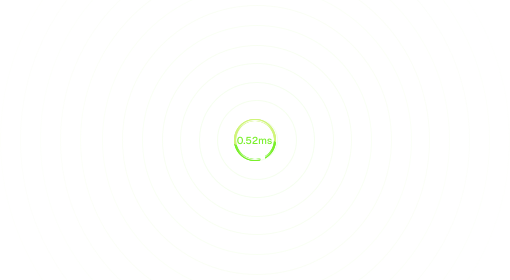
When it comes to executing day orders or managing GTC (Good 'Til Canceled) positions, having the right infrastructure can make all the difference. QuantVPS operates from a Chicago-based datacenter located directly next to the CME Group's matching engines. This setup delivers an ultra-low latency of 0.52ms - a stark contrast to the 50–200ms typical of standard home internet connections. This kind of speed is critical for hitting target prices, especially during periods of market volatility.
Beyond low latency, QuantVPS ensures 24/7 uptime, which is essential for GTC orders that demand constant monitoring. With servers running continuously, QuantVPS keeps an eye on your orders around the clock. This means if a sudden breakout happens during off-hours, your orders can execute automatically - no need to rely on your home computer or local internet. As of March 23, 2026, QuantVPS supported a staggering $11.73 billion in daily futures trading volume, underscoring its reliability and capacity for uninterrupted operation.
The hardware also plays a big role. QuantVPS uses AMD EPYC and Ryzen processors alongside NVMe storage, ensuring high performance even during intense market activity. This setup minimizes bottlenecks, ensures precise order execution, and reduces slippage for both day and GTC orders.
QuantVPS Benefits for Day and GTC Orders
QuantVPS doesn't just stop at performance - it also provides robust tools for managing orders more effectively. It supports over 85 trading platforms, including popular options like NinjaTrader and MetaTrader 4/5. Additionally, its infrastructure includes direct fiber-optic cross-connects to major exchanges, cutting down on network hops that can add unnecessary latency.
For day traders, the proximity to CME's matching engines in Chicago ensures that their orders reach the exchange faster than those relying on standard internet routes. Meanwhile, GTC traders benefit from QuantVPS's 99.999% uptime rating, which guarantees that long-standing orders are monitored continuously - even when you're away from your desk. Plus, with remote access via Microsoft Remote Desktop, you can check in on your VPS or tweak your orders from any device, anywhere.
"Your QuantVPS server runs 24/7 independently in our secure datacenter, keeping your futures platform and bots active even when your home computer is off." - QuantVPS
This combination of speed, reliability, and accessibility makes QuantVPS a powerful tool for both day and GTC order traders.
Conclusion
Day orders are ideal for intraday traders who want to avoid overnight risks and prefer to reassess their strategies daily. On the other hand, GTC orders work well for swing traders and long-term investors aiming for specific price levels without the need to constantly monitor the market. Since GTC orders remain active across multiple sessions, they can boost swing trade fill rates by 35–40% by capturing prices during extended trading hours.
Both types of orders require careful handling. Using limit prices with day orders can help avoid poor fills during volatile trading periods. For GTC orders, reviewing them weekly is crucial to ensure they align with current market trends, especially during earnings reports or major economic events. Keep in mind that many brokerages cancel GTC orders automatically after 30 to 90 days, so it's important to check your broker's specific rules.
To make the most of these order types, having a reliable trading setup is essential. QuantVPS offers ultra-low latency and 99.999% uptime, delivering the speed and dependability needed for executing both day and GTC orders - whether you're chasing an early breakout or fine-tuning an intraday move.
FAQs
Can I change a day order to GTC after placing it?
Yes, you can switch a day order to a GTC (Good-Till-Canceled) order after placing it. Unlike day orders, which expire at the market's close if not filled, GTC orders remain active until they are either executed or manually canceled. However, whether or not you can make this change depends on the specific features and rules of your trading platform. Always check your platform's guidelines for order modifications.
Will my GTC order adjust for stock splits or dividends?
A Good-Til-Canceled (GTC) order might be modified in certain situations. For instance, if a dividend is issued, the order could be reduced by the dividend amount on the ex-dividend date. However, GTC orders won’t automatically adjust for stock splits unless your broker explicitly states otherwise. It’s important to check your broker’s specific policies to understand how such adjustments are handled.
How can I reduce overnight gap risk with GTC orders?
GTC orders remain active until they are either filled or canceled, which can help minimize the risks associated with overnight price gaps. However, they are not immune to sudden price swings or market gaps that may occur. On the other hand, day orders automatically expire at the close of the trading day, eliminating overnight exposure and reducing vulnerability to such risks.