
Multi-Provider Mode in NinjaTrader lets you connect to multiple brokers or data feeds simultaneously, enhancing your trading flexibility. Here's how to enable it:
-
Check Requirements:
- Use NinjaTrader Desktop version 8.1 or later.
- Ensure administrator access and a stable internet connection.
- Sync your Windows clock for connections.
-
Enable Multi-Provider Mode:
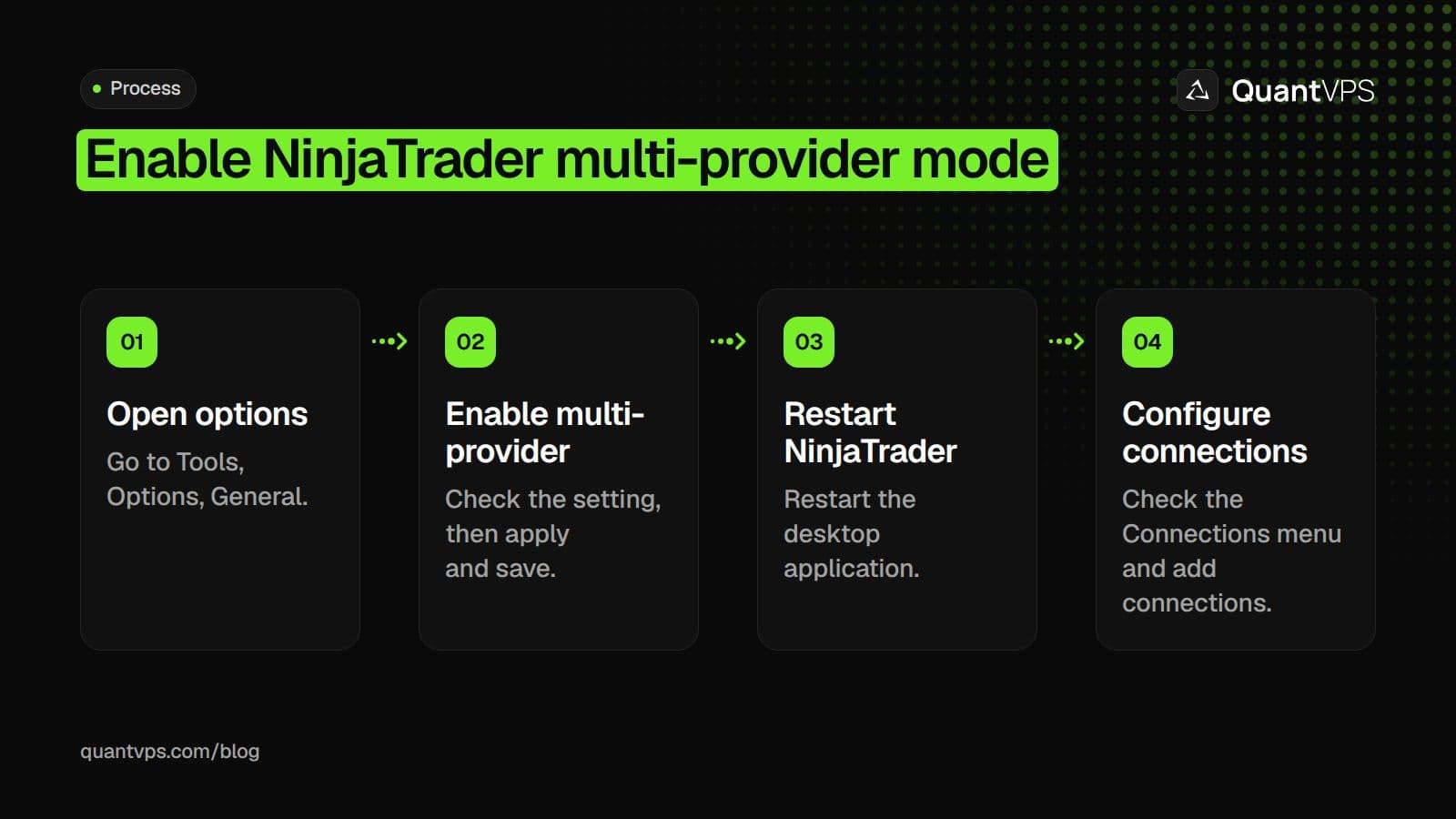
- Open NinjaTrader, go to Tools > Options > General.
- Check the Multi-provider box, click Apply, then OK.
- Restart NinjaTrader to activate changes.
-
Confirm Activation:
- After restarting, check the Connections menu in the Control Center for the Configure button. This confirms Multi-Provider Mode is active.
-
Set Up Connections:
- Use the Configure button to add and manage brokers like Interactive Brokers, Rithmic, and Tradovate.
- Customize settings, such as connection names or startup preferences.
-
Troubleshooting:
- If the configure button doesn’t appear, recheck the Multi-provider box and restart.
- Ensure credentials are accurate and your system clock is synced.
What You Need Before Starting
Before turning on Multi-Provider Mode, make sure your setup checks all the boxes. Missing even one requirement could prevent the feature from working or cause connection issues. Here's what you need to verify before getting started.
NinjaTrader Version and Account Setup
First things first, make sure you're running the right version of NinjaTrader. You’ll need NinjaTrader Desktop version 8.1 or later to use Multi-Provider Mode. Older versions don’t have the updated account management system necessary for this feature. You can confirm your version by checking the splash screen when the software opens or by going to "About" in the Control Center.
"License Keys are no longer needed to connect to your account on the latest version of the NinjaTrader Desktop app (version 8.1 or later)." - OneUp Trader
If you upgraded from version 8.0, your license key was automatically linked to your NinjaTrader Account username. To log in and manage your primary connection, you'll need your NinjaTrader.com credentials (username and password). For third-party brokers like Rithmic or Tradovate, make sure you have the login details provided by your broker.
Technical Requirements
Multi-Provider Mode is configured at the desktop level, so you’ll need administrator access to enable it. Also, make sure your Windows clock is synced correctly (go to Settings > Time & language > Date & time > Sync now) to avoid login issues with providers like Rithmic and Tradovate.
A reliable internet connection is essential. While the minimum system requirements are 4GB RAM and a dual-core processor, having 8GB or more of RAM and a quad-core CPU will give you a smoother experience, especially when running multiple data feeds and charts. Don’t forget to restart NinjaTrader after making any changes.
How to Enable Multi-Provider Mode
Follow these steps to activate Multi-Provider Mode in NinjaTrader Desktop.
Opening the Settings Menu
Start by launching NinjaTrader Desktop and opening the Control Center. From there, click on Tools in the Control Center and select Options (or Settings).
Order flow
Built for scalpers. Heatmaps on dedicated resources.
Order-flow heatmaps and DOM ladders run on dedicated CPU, memory and NVMe, so your charts keep responding during volatility.
See the dedicated hardware





From $29.99/mo · Windows or Linux
Turning On Multi-Provider Mode
Once you're in the settings menu, you can enable Multi-Provider Mode. In the Options window, go to the General section on the left-hand menu. Check the box for Multi-provider and then click Apply followed by OK. Keep in mind, Multi-Provider Mode won't activate until you complete the next step.
Restarting NinjaTrader
To finalize the changes, you need to completely close and restart NinjaTrader Desktop. After reopening the platform, Multi-Provider Mode will be active. You'll notice a new "configure" button at the bottom of the Connections dropdown menu in the Control Center. This confirms that the setup is complete.
Important: The platform enables Global Simulation Mode by default to help you avoid accidental live trades. You can adjust this setting later if needed.
Checking That Multi-Provider Mode Is Active
You’ll want to confirm that Multi-Provider Mode is active right after restarting NinjaTrader. The process is simple and doesn’t take much time.
Using the Connections Menu
Start by opening the Control Center and clicking on the Connections dropdown menu. Look for the "configure" button - it’s the key sign that Multi-Provider Mode is active and ready to go.
When you click the configure button, a management window will pop up. This window lists all providers, highlighting active connections in green. Additionally, a status light in the bottom-left corner of the Control Center gives you a quick view of your connection health. If these indicators are missing, it’s time to dig into troubleshooting.
Troubleshooting Missing Features
If the configure button isn’t visible after restarting, head over to Tools > Options > General (or Tools > Settings) and check that the Multi-provider checkbox is selected. If the setting doesn’t stick, try unchecking and rechecking the box, then restart NinjaTrader.
For those who don’t see live or funded accounts in the menu, make sure to disable Global Simulation Mode in the settings. Also, double-check that your Windows system clock is properly synchronized - a clock that’s out of sync can stop connections from initializing correctly.
Setting Up and Managing Multiple Connections
With Multi-Provider Mode enabled, you can connect to multiple brokers and data providers, making it easier to manage your trading accounts.
Adding New Connections
To start, go to the Connections dropdown and click the configure button. This will open two lists: Available (providers you can add) and Configured (providers you've already set up). To add a provider, locate it in the Available list - such as NinjaTrader, Rithmic, or Interactive Brokers - and either double-click it or click Add to move it to the Configured list.
For NinjaTrader Brokerage accounts, you can set up separate connections for both Live and Simulation accounts, allowing simultaneous access to both. If you're using Rithmic-based connections for prop firms like Apex, you'll need to select the specific System (e.g., Apex) and Gateway (e.g., Chicago Area) provided by your broker or prop firm during account setup. New Topstep accounts don't connect this way: Topstep says "TopstepX™ is the only available trading platform."
Adjusting Connection Settings
Once your connections are added, you can fine-tune their settings to match your trading preferences. Use the Connection name field to create easily recognizable labels like "Apex-Live" or "Ninja-Demo", which help avoid confusion when switching between feeds. If you'd like the connection to establish automatically when the platform starts, enable Connect on startup. For added security, you can activate Ask password on connect, requiring manual password entry each time.
When entering your credentials, type them carefully to avoid trailing spaces, which can cause "Logon failed" errors. For Rithmic connections used with RTrader Pro, ensure Plug-in Mode is enabled in NinjaTrader's connection properties, and verify that "Allow Plugins" is activated in RTrader Pro.
Multi-Broker Add-on License Requirements
Once your connections are configured, here’s an important note: NinjaTrader 8.1 no longer uses license keys. Plans and add-ons are tied to your NinjaTrader username, and a license bought for an older version can be imported in the Client Dashboard. Multi-Provider Mode itself is turned on with the Multi-provider box under Tools > Options > General.
Keep in mind, however, that the "Rithmic for NinjaTrader Brokerage" adapter typically supports only one active Rithmic login at a time. If you require multiple Rithmic accounts, they usually need to be sub-accounts under a single login. These settings will take effect after you’ve completed the individual connection configurations.
Uptime
99.999% uptime. Built for 24/7 trading reliability.
Your VPS runs in Tier IV datacenters with redundant power and network, monitored 24/7 on site.
See the uptime SLAFrom $29.99/mo · Windows or Linux
Fixing Common Problems
When Settings Don't Save
If you've enabled the Multi-provider checkbox but don't see the Configure button in the Connections menu, make sure to completely exit and reopen NinjaTrader. The platform requires a full restart for the changes to take effect. If the settings still don't update after restarting, make sure any license from an older NinjaTrader version has been imported in the Client Dashboard.
"You'll need to go to the account page account.ninjatrader.com and import your license. And you'll need to go to Tools -> Options and check multi provider then restart and set up your connections again." (Bruce DeVault, QuantKey Trading Vendor Services)
Keep in mind that enabling Multi-Provider Mode automatically switches Server-Side ATMs to Local ATMs. This means you'll need to manually reconfigure any ATM strategies you were using before. Always confirm your changes by clicking OK in the Connection Properties window.
Once your settings are saved, you can move on to addressing any connection errors.
Resolving Connection Errors
If your settings are saved but you’re still facing connection issues, follow these steps to troubleshoot.
If the connection fails to turn green, manually re-enter your username and password. Even a small mistake, like an extra space, can cause a "Logon failed" error. For Rithmic connections, syncing your Windows clock can help resolve authentication problems. Go to Settings > Time & language > Date & time and click Sync now.
When using Rithmic through R|Trader Pro, make sure to launch R|Trader Pro first and enable Allow Plugins before opening NinjaTrader. In NinjaTrader's connection settings, activate Plug-in Mode only if you're bridging through R|Trader Pro. Remember, Rithmic typically allows only one active connection at a time, so disconnect any existing connection before switching to a new provider. For new accounts, log in to your provider's web portal and complete any required data agreements before attempting to connect through NinjaTrader.
Improving Platform Performance
Optimizing performance is just as important as fixing connection issues, especially when managing multiple providers.
Running multiple connections can increase CPU and memory usage. To reduce strain on your system, close unused charts, limit the amount of historical data loaded, and make sure NinjaTrader has the necessary permissions in your firewall settings. For a smoother experience with multi-account trading, ensure your system or VPS has at least 4GB of RAM and 2 CPU cores.
Additionally, make sure NinjaTrader is allowed through the Windows Defender Firewall. If you encounter connection drops, try flushing your DNS by running ipconfig /flushdns. If data gaps or missing bars appear on your charts, right-click the chart and select Reload history (server). For Rithmic users handling multiple accounts, using Plugin Mode through R|Trader Pro often provides better stability than direct connections.
Multi-Provider Mode recap
Activating Multi-Provider Mode in NinjaTrader Desktop simplifies the management of multiple trading accounts. To enable it, go to Tools > Options, check the Multi-provider box under the General section, click OK, and restart NinjaTrader. Once enabled, you’ll see the Configure button in the Connections menu, giving you centralized control over all your connections.
With Multi-Provider Mode, you can connect to multiple brokers, data feeds, and proprietary firm accounts at the same time. This means you can manage accounts from providers like Apex, Bulenox, and Tradovate - all within a single interface - without needing to run multiple instances of the platform. It also makes it easy to run live and simulation accounts side by side, which is especially useful for testing and validating trading strategies.
Additional Configuration Tips
- Account Entitlements: NinjaTrader 8.1 ties plans and add-ons to your username, so import any older license in the Client Dashboard before you connect.
- Rithmic Plugin Mode: If you’re using Rithmic in Plugin Mode, open RTrader Pro first and enable the "Allow Plugins" option before connecting to NinjaTrader.
- Automation: Use the "Connect on Startup" setting to streamline your workflow by automatically connecting accounts when the platform launches.
Optimizing Performance
Managing multiple connections can be resource-intensive, especially on local systems. Upgrading to VPS hosting can improve performance and ensure uninterrupted trading. Services like QuantVPS offer scalable hosting plans designed to handle the demands of a multi-provider setup, running smoothly 24/7.
Keep in mind that enabling Multi-Provider Mode may switch Server-Side ATMs to Local ATMs, which can affect performance. To optimize further, close unused charts and limit the amount of historical data loaded. With proper configuration and sufficient system resources, Multi-Provider Mode transforms NinjaTrader into an efficient workspace, consolidating all your accounts into one streamlined interface.
Once Multi-Provider Mode is on, give each connection a clear name, such as Apex-Rithmic or Tradovate-Sim, so orders never go to the wrong account. Every connection drops when NinjaTrader closes, so the platform has to stay open while you trade. NinjaTrader VPS hosting from QuantVPS keeps your server login details in the dashboard.
FAQs
Can I trade live and sim accounts at the same time?
Yes, it's possible to trade both live and demo accounts at the same time in NinjaTrader by turning on the Multi-Provider Mode. This option allows you to connect to multiple accounts or data sources simultaneously, making it convenient to handle both account types in one platform.
Why are my accounts missing after enabling Multi-Provider Mode?
If some accounts are missing, it could be due to Multi-Provider Mode not being configured correctly. This mode requires both accurate setup and a platform restart to detect all connected accounts. If the configuration wasn't saved or is incomplete, certain accounts may not show up. To address this, double-check that all settings are properly configured and saved. Once that's done, restart NinjaTrader Desktop to ensure all accounts are detected.
Will enabling Multi-Provider Mode change my ATM strategies?
It can. If you opted into server-side ATMs (beta), enabling Multi-Provider Mode switches you to local ATMs, because server-side ATMs only work with the NinjaTrader connection and only while Multi-provider is off. Check and reconfigure your ATM strategies after the switch.


