Micro Silver Futures (SIL) are smaller versions of standard silver futures, designed for traders with less capital. Each contract represents 1,000 troy ounces, one-fifth the size of a standard silver futures contract. With a tick size of $0.005 per ounce and a tick value of $5, SIL offers precise risk management and lower margin requirements. Trading nearly 24/5 on the COMEX exchange, these contracts provide flexibility for both new and experienced traders.
Key Points:
- Contract Size: 1,000 troy ounces.
- Tick Size: $0.005 per ounce.
- Tick Value: $5 per contract.
- Margin Requirements: $4,400 initial, $4,000 maintenance.
- Trading Hours: Sunday 6:00 PM ET to Friday 5:00 PM ET (1-hour daily break).
- Settlement: Physical delivery, though most traders close positions before expiration.
SIL contracts are ideal for those seeking exposure to silver with lower upfront costs and more control over position sizes. They also offer significant leverage, with a single contract controlling silver worth approximately $30,000 when priced at $30 per ounce. However, leverage can amplify both gains and losses, so careful risk management is essential.
For traders looking to enhance their SIL trading experience, using a Virtual Private Server (VPS) like QuantVPS can improve order execution speed and reliability, especially during volatile market periods.
Contract Specifications and Margin Requirements
Full Contract Specifications
Micro Silver Futures, traded on the COMEX exchange under the CME Group, carry the symbol SIL. These contracts allow for trading nearly around the clock, running 24/5 from Sunday 6:00 PM ET to Friday 5:00 PM ET, with a daily one-hour pause between 5:00 PM and 6:00 PM ET. This extended schedule ensures traders can participate in both U.S. and international silver markets.
The contracts have an expiration cycle covering eight months of the year - January, March, May, July, September, October, November, and December - spanning the next 12 months. The last trading day falls on the third-to-last business day of the delivery month. While settlement is by physical delivery, most traders choose to close their positions before reaching this stage.
| Specification | Detail |
|---|---|
| Exchange | COMEX (CME Group) |
| Trading Symbol | SIL |
| Contract Size | 1,000 troy ounces |
| Tick Size | $0.005 per troy ounce |
| Tick Value | $5.00 per contract |
| Contract Multiplier | $1,000 |
| Hours | Sunday 6:00 PM ET – Friday 5:00 PM ET (1-hour halt: 5:00–6:00 PM ET) |
| Delivery Type | Physical Delivery |
| Contract Months | Jan, Mar, May, Jul, Sep, Oct, Nov, Dec |
Margin Requirements and Leverage
To trade a SIL contract, an initial margin of $4,400 is required, with a maintenance margin of $4,000. The initial margin represents the upfront capital needed to open a position, while the maintenance margin is the minimum balance required to keep the trade active. Falling below the maintenance level triggers a margin call.
These margin levels provide substantial leverage. For example, with silver priced at approximately $30.00 per troy ounce, a single SIL contract (1,000 ounces) represents $30,000 worth of silver. By posting the $4,400 initial margin, traders effectively control an amount nearly 6.8 times greater than their upfront investment. This leverage means that a 10% price move in silver could result in a $3,000 swing in contract value - equivalent to a 68% change relative to the margin posted.
"Conveniently sized and tailored to the individual investor, these contracts offer less capital commitment, lower margin, and smaller exchange fees than the larger-sized Gold and Silver futures contracts - but with the same flexibility, safety, and security." - CME Group

Run 24/7 while you sleep. Keep bots, platforms, and trade copiers online on a dedicated VPS.
Low-latency VPS hosting for your trading platform.
 CHINYC
 LON
LONFrom $29.99/mo


 CHI/CME futuresNYC/US marketsLON/FX EAs
 DUB/Polymarket
 AMS/EU FX
 FRA/Central EU
 TYO/APAC crypto
Tick Size and Tick Value
The smallest price movement for SIL, known as the tick size, is $0.005 per troy ounce. Given the contract size of 1,000 troy ounces, each tick equates to a $5.00 change in the contract's value. For example, a 10-tick movement (or $0.050 per ounce) results in a $50 change per contract, while a 100-tick shift (or $0.50 per ounce) translates to a $500 gain or loss.
Compared to standard silver contracts, which have a tick value of $25.00, the smaller tick value for SIL offers traders more precise control over their positions and risk exposure. This feature makes SIL an attractive choice for those looking to manage their trading strategies with greater flexibility.
Calculating Profit, Loss, and Risk
How to Calculate P&L Using Tick Value
When trading SIL contracts, your profit or loss hinges on how many ticks the price moves. Each tick represents $5.00, so calculating your profit or loss is as simple as multiplying the number of ticks by this value. For instance, if the price moves $0.025 (5 ticks), that translates to a $25 gain per contract. A larger move, such as $0.10 (20 ticks), results in a $100 change per contract. If you're trading multiple contracts, just multiply the per-contract result by the number of contracts. For example, with five contracts and a $0.05 price move (10 ticks), your profit would be $250.
Another way to calculate P&L is by using the total price change per troy ounce and the contract size of 1,000 troy ounces. For example, if silver climbs from $30.00 to $30.50, that $0.50 price increase results in a $500 profit per contract. This method not only helps you gauge potential profits but also lays the groundwork for determining position size and managing risk effectively.
Position Sizing and Dollar Risk
The smaller contract size of SIL offers traders the ability to fine-tune their positions. A $1 price move per troy ounce changes the contract value by $1,000, giving you the flexibility to adjust your exposure based on market conditions and your risk tolerance. During periods of high volatility - when silver prices might swing $2.00 to $3.00 in a single day - a single contract could see fluctuations of $2,000 to $3,000 in value.
For those with limited capital, SIL provides an accessible entry point. Unlike standard 5,000-troy ounce contracts with a $25.00 tick value, SIL allows you to start small - perhaps with one or two contracts - and gradually increase your positions as your account grows and your confidence builds. This flexibility makes it easier to align your position size with your specific risk comfort level.
Managing Leverage and Margin Risk
Understanding how leverage impacts your trades is critical for managing risk, especially when dealing with margin requirements. With an initial margin of $4,400, you control a contract worth roughly $30,000 when silver is priced at $30.00 per ounce. This gives SIL a leverage ratio of about 6.8 to 1. However, leverage works both ways. A $0.50 unfavorable price move leads to a $500 loss - equivalent to about 11.4% of your margin. A larger $4.40 price move would completely deplete your initial margin.
"You'll want to familiarize yourself with the minimum price fluctuation - the tick size - for whatever futures contracts you plan to trade. You'll also need to know how a price change of any given amount will affect the value of the contract." - National Futures Association (NFA)
Trading Mechanics and VPS Hosting
Order Types for SIL Trading
SIL contracts have a minimum price fluctuation of $0.005 per troy ounce, and traders can choose from several standard order types to manage their trades effectively. A market order ensures immediate execution, which is useful in fast-moving markets. Meanwhile, a limit order lets you aim for a specific price level, and stop orders help limit losses by triggering an exit at your predetermined price. Considering that a 10-tick move (equivalent to a $0.05 price change) results in a $50 variation per contract, these tools are crucial for precise risk management. Pairing these strategies with quick and accurate execution becomes even more seamless when supported by a high-performance VPS.
How VPS Hosting Improves SIL Trading
A Virtual Private Server (VPS), like QuantVPS, can dramatically enhance your trading experience by minimizing latency and ensuring reliable execution - both critical in volatile markets like SIL. With QuantVPS, you can achieve latency as low as 0–1 ms, allowing your orders to reach exchange servers almost instantly. Beyond speed, QuantVPS provides 100% uptime, DDoS protection, automatic backups, and global accessibility, ensuring uninterrupted connectivity during SIL's nearly 24-hour trading window from Sunday to Friday.
Choosing the Right QuantVPS Plan for SIL Trading
QuantVPS offers tailored plans designed to meet various trading requirements:
- VPS Lite: Ideal for manual traders monitoring 1–2 charts. This plan costs $41.99/month (billed annually) and includes 4 cores with 8GB of RAM.
- VPS Pro: Suited for traders managing 3–5 charts. At $69.99/month (billed annually), it provides 6 cores, 16GB of RAM, and supports up to 2 monitors.
- VPS Ultra: Perfect for algorithmic traders using multiple tools. Priced at $132.99/month (billed annually), it offers 24 cores, 64GB of RAM, and robust capabilities for complex setups.
- Dedicated Server: Designed for professional setups managing numerous SIL positions. At $209.99/month (billed annually), it delivers 16+ dedicated cores, 128GB of RAM, and supports up to 6 monitors.
All QuantVPS plans include Windows Server 2022, unmetered bandwidth, and compatibility with leading trading platforms like NinjaTrader, MetaTrader, and TradeStation. For those needing peak performance during high-volume market activity, enhanced Performance Plans (+) are available to maximize processing speed.
E-Micro Gold Futures and Silver 1000oz Futures
SIL vs. Other Silver Futures Contracts
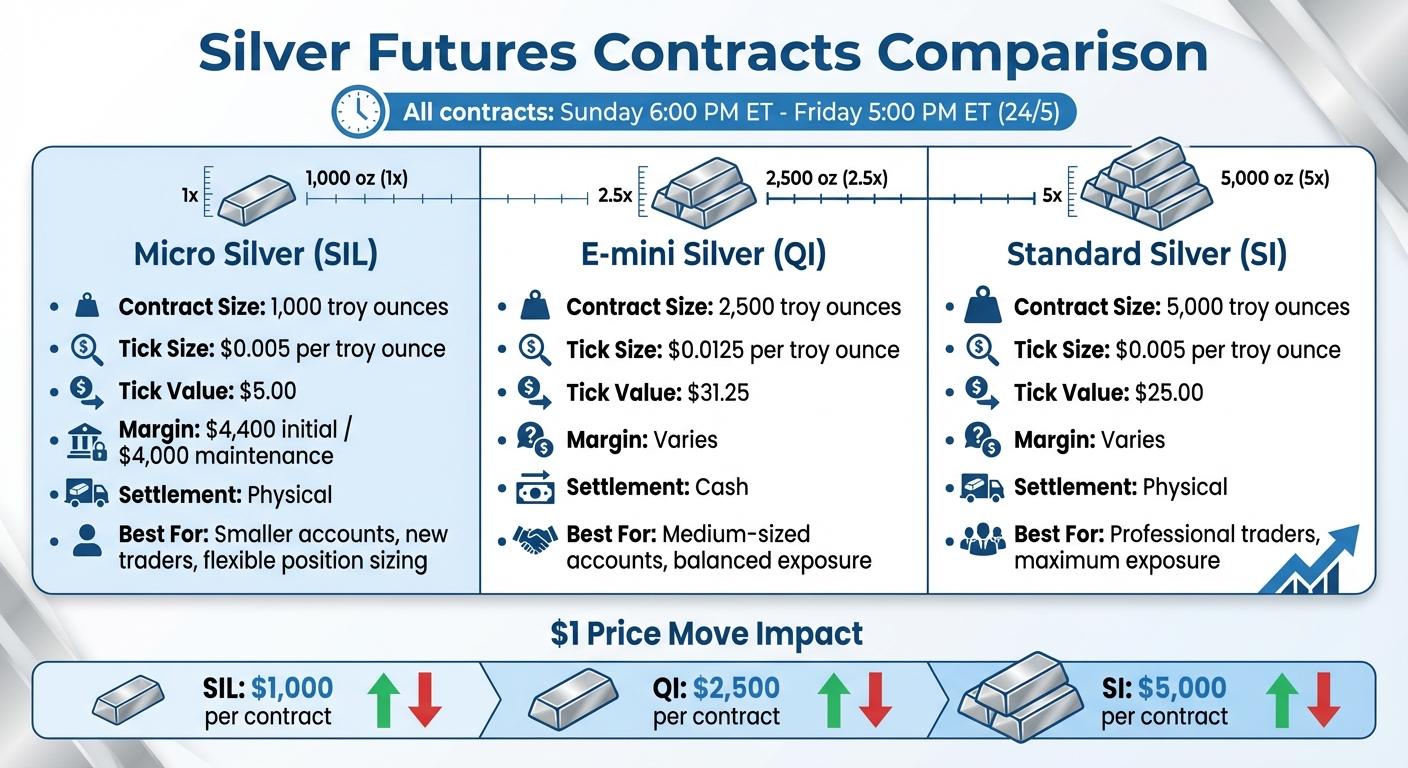
Micro Silver Futures (SIL) vs E-mini vs Standard Silver Contract Comparison
Stay online and closer to execution. Choose a VPS location for CME futures, New York markets, London FX, API trading, and more.
Host your platform near the market route that matters.
CHINYCLONFrom $29.99/mo
CHI/CME futuresNYC/US marketsLON/FX EAsDUB/PolymarketAMS/EU FXFRA/Central EUTYO/APAC cryptoContract Size, Tick Value, and Capital Comparison
The CME Group provides three silver futures options, each tailored to different trading needs. The largest is the Standard Silver (SI) contract, representing 5,000 troy ounces with a tick value of $25.00. This makes it the most capital-intensive choice. Next is the E-mini Silver (QI) contract, which covers 2,500 troy ounces and has a tick value of $31.25. Finally, the Micro Silver (SIL) contract is the smallest, covering 1,000 troy ounces with a $5.00 tick value.
| Feature | Standard Silver (SI) | E-mini Silver (QI) | Micro Silver (SIL) |
|---|---|---|---|
| Contract Size | 5,000 troy ounces | 2,500 troy ounces | 1,000 troy ounces |
| Tick Size | $0.005 per troy ounce | $0.0125 per troy ounce | $0.005 per troy ounce |
| Tick Value | $25.00 | $31.25 | $5.00 |
| Margin/Maintenance | Varies | Varies | $4,400 / $4,000 |
| Settlement | Physical | Cash | Physical |
The Micro Silver (SIL) contract stands out for its lower capital requirements, making it an accessible option for traders who want exposure to silver without committing significant funds. This breakdown helps traders decide which contract aligns best with their account size and risk tolerance.
When to Use SIL, SI, or QI
Your choice of contract largely depends on your trading goals and available capital. The Micro Silver (SIL) contract is ideal for smaller accounts or traders experimenting with new strategies. With a size of 1,000 troy ounces, a $1.00 price movement translates to $1,000 per contract. This makes it great for flexible position sizing and managing risk.
On the other hand, the Standard Silver (SI) contract appeals to professional traders with larger accounts who want maximum exposure to price movements. Meanwhile, the E-mini Silver (QI) contract provides a middle ground, balancing exposure and capital requirements. Keep in mind, QI settles in cash, whereas SI and SIL settle physically, an important distinction if you plan to hold contracts until expiration.
Liquidity and Trading Hours Comparison
All three contracts are available for trading almost 24/5, from Sunday 6:00 p.m. ET to Friday 5:00 p.m. ET, with a one-hour break daily from 5:00 p.m. to 6:00 p.m. ET. This extended access allows traders to react to global news and market shifts as they happen.
As of December 14, 2025, the March 2026 SIL contract (SILH6) showed a volume of 22,010, while the January 2026 (SILF6) and February 2026 (SILG6) contracts had volumes of 387 and 40, respectively. Liquidity tends to concentrate in front-month contracts, which typically offer tighter spreads and better execution. For traders, this means the nearest expirations are often the most efficient for entry and exit.
Conclusion
Key Benefits of SIL Contracts
Micro Silver Futures (SIL) provide an excellent way to enter silver trading without requiring a large upfront investment. With a contract size of 1,000 troy ounces, traders gain meaningful market exposure while keeping risk at a level that's easier to manage. This allows for precise control over both position sizing and overall risk.
SIL contracts are particularly appealing to traders who value flexibility. Unlike the larger Standard Silver (SI) contracts, SIL allows for gradual scaling into positions or managing multiple contracts without tying up too much capital. This flexibility makes SIL an attractive option for traders looking to balance exposure and risk efficiently.
Leveraging QuantVPS for SIL Trading
To make the most of SIL's advantages, having a reliable trading infrastructure is crucial. QuantVPS offers the speed and reliability needed for effective trading, especially during volatile market movements or overnight sessions influenced by global news. With latency as low as 0–1 ms and a 100% uptime guarantee, QuantVPS ensures your trades are executed without delays.
For traders using automated strategies or juggling multiple SIL positions, QuantVPS offers tailored plans. The VPS Lite plan, priced at $41.99/month, is ideal for running 1–2 charts, while the VPS Pro plan at $69.99/month supports 3–5 charts and includes multi-monitor functionality. Features like DDoS protection, automatic backups, and compatibility with platforms such as NinjaTrader and TradeStation ensure uninterrupted access to SIL's 24/5 trading schedule. By combining SIL's accessible trading specifications with QuantVPS's advanced infrastructure, traders can optimize their market strategies and execution.
FAQs
What makes Micro Silver Futures a better choice for some traders compared to standard silver futures?
Micro Silver Futures come with a few key benefits that make them an attractive option for many traders. For starters, they require less upfront capital, which opens the door for individuals with smaller accounts or those who prefer to approach trading with a more cautious risk strategy. Additionally, they offer more flexibility when it comes to scaling positions. This means traders can gradually adjust their exposure to the silver market, tailoring their approach to match their goals. Lastly, the smaller contract size translates to reduced risk per trade, a feature that’s particularly helpful for beginners or anyone dealing with unpredictable market swings.
How does leverage affect your trading in Micro Silver Futures?
Leverage in Micro Silver Futures lets you take control of a larger position with a relatively small upfront investment, known as margin. This setup can amplify your potential profits, making even small price movements in silver highly impactful. However, it’s a double-edged sword - leverage also increases your exposure to losses if the market moves in the opposite direction.
For instance, a minor shift in silver prices can translate into sizable gains or losses compared to your initial margin. Because of this, it’s crucial to manage risk wisely and fully understand how leverage works within your trading strategy before stepping into the market.
How does a VPS improve trading performance for Micro Silver Futures?
A VPS enhances trading performance for Micro Silver Futures by delivering quick, dependable, and low-latency connections - key factors for executing trades with speed and precision. This minimizes slippage and ensures that orders are processed instantly, even during periods of intense market activity.
On top of that, a VPS offers a stable environment for trading by keeping your platforms running around the clock, unaffected by local power outages or internet interruptions. This consistency is particularly beneficial for traders who depend on automated strategies or require uninterrupted system access to make timely decisions.