Algorithmic trading comes with complex tax rules that can impact your bottom line. Here's what you need to know:
- Trader vs. Investor Status: Your trading activity determines whether you qualify for Trader Tax Status (TTS) or are classified as an investor. TTS offers better tax benefits, including unlimited loss deductions and expense write-offs.
- Asset-Specific Taxation: Stocks, futures, forex, and cryptocurrencies are taxed differently. For example, futures enjoy a blended 60/40 tax rate, while crypto transactions face wash-sale rules starting in 2025.
- New Reporting Rules: Starting with the 2025 tax year, brokers will report digital asset transactions on Form 1099-DA, increasing IRS oversight.
- Deductible Expenses: TTS traders can write off costs like VPS hosting, software, and data feeds, reducing taxable income.
- Compliance Risks: Errors in reporting or failing to track wash sales can lead to penalties, with fines up to 75% for severe cases.
Key takeaway: Staying compliant requires understanding your tax classification, tracking every transaction, and leveraging tools like tax software and VPS systems to simplify reporting.
Tax Problems in Algo Trading
Many algorithmic traders treat taxes as a year-end accounting task. That belief is expensive. The structure of algorithmic trading—high transaction velocity and automated execution—creates tax exposure that compounds quietly while gross returns look healthy on the surface.
"The structure of algorithmic trading creates tax exposure that compounds quietly while gross returns look healthy on the surface."
⚠️ Warning: Treating taxes as a year-end task is one of the costliest mistakes an algorithmic trader can make — by the time you review, the damage is already done.
💡 Tip: High transaction velocity means your tax liability is being built trade by trade, not at year-end. Monitor your tax exposure in real time, not retroactively.
| Trading Approach | Tax Risk Level | Key Danger |
|---|---|---|
| Year-end review only | 🔴 High | Compounded exposure goes undetected |
| Quarterly tax check-ins | 🟡 Medium | Some lag in identifying issues |
| Real-time tax monitoring | 🟢 Low | Exposure caught and managed early |

Why does trade volume create such a large tax burden?
A long-term investor might make a dozen trades yearly. An algorithmic strategy makes that many before lunch. Each completed trade is a taxable event, and trades that close within a year are classified as short-term. According to the LuxAlgo Blog's 2025 analysis of taxation and algo trading, short-term capital gains are taxed at ordinary income rates, reaching up to 37% for high earners in the US. For a strategy generating $200,000 in gross gains, the difference between short-term and long-term treatment can mean $60,000 or more in additional tax liability.
When identical returns produce different outcomes
Think about two traders who both make a 22% gross return on a $500,000 portfolio in the same calendar year. Trader A uses a buy-and-hold strategy with minimal turnover. Trader B uses an automated mean-reversion system that executes hundreds of trades monthly. Trader A qualifies for long-term capital gains rates. Trader B pays ordinary income rates on nearly every dollar of profit. Same market, same gross return, meaningfully different net result—all due to tax structure.
How does the wash-sale rule create hidden losses for automated strategies?
The wash-sale rule adds complexity that most automated systems cannot handle. As the LuxAlgo Blog notes, algo traders classified as investors face a wash-sale rule that disallows losses on securities repurchased within 30 days before or after a sale. Automated strategies re-enter positions quickly, and without a dedicated compliance module reviewing trade history in real time, a system can silently disqualify loss deductions, converting a tax-loss harvesting attempt into a wash-sale violation.
Why does record-keeping at scale become a serious operational problem?
Keeping records at a large scale is where operational reality becomes most difficult. Most traders manage documentation through brokerage statements and spreadsheets, which work at low volume. When a strategy generates thousands of trades across multiple brokers or exchanges, this approach breaks down. Cost basis calculations become error-prone, audit trails fragment, and the risk of misreporting grows with each additional position.
Traders operating across international markets face an added burden: every foreign transaction must be converted into the reporting currency at execution time, and tax treaty rules vary by jurisdiction. A reliable trading VPS from QuantVPS ensures continuous execution and clean, timestamped trade logs, though the documentation challenge still requires systems built with tax awareness in mind.
Most of these tax costs are not inevitable. They result from building a trading system without a corresponding tax strategy.
Trader vs Investor Status: How the IRS Classifies You
The IRS doesn’t judge your status based on your account balance - it’s all about your trading habits and goals. This distinction shapes your tax obligations, including whether you can deduct business expenses like VPS hosting or data feeds.
Trader Tax Status (TTS) isn’t something you can just check off on a form. Instead, it’s a classification based on facts - specifically, your trading activity. The IRS examines whether you’re aiming to profit from short-term market movements or holding for long-term gains. For algorithmic traders, there’s an extra layer: if you’re relying on a pre-built system created by someone else, with little involvement on your part, those trades might not count toward TTS qualification. However, if you’re the one writing the code or actively managing the entry and exit signals, those trades generally qualify.
Requirements for Trader Status
To qualify as a trader, the IRS evaluates several factors, with holding period being the most critical. If your average holding period doesn’t meet their expectations, the other criteria won’t matter. Experts suggest keeping your average holding period to 31 days or less.
Here’s what the IRS looks for:
- At least 720 trades per year (about 60 per month)
- Active trading on around 75% of available market days (roughly 189 out of 252 trading days)
- Spending more than four hours daily on your trading business
- Maintaining a minimum account balance of $15,000 to $25,000 to meet pattern day trader rules
“If your goal is short-term profits from market swings rather than long-term capital appreciation, your trading activity may be deemed a business.” - IRS Guidance
Meeting these benchmarks allows you to classify your trading as a business, opening the door to valuable tax benefits. For example, you can deduct ordinary and necessary business expenses on Schedule C. If you elect Mark-to-Market accounting, you can also deduct unlimited ordinary losses, bypassing the $3,000 annual cap for capital losses. Plus, trading profits under TTS aren’t subject to the 15.3% self-employment tax.
What Investor Status Means for Your Taxes

Run 24/7 while you sleep. Keep bots, platforms, and trade copiers online on a dedicated VPS.
Low-latency VPS hosting for your trading platform.
 CHINYC
 LON
LONFrom $29.99/mo


 CHI/CME futuresNYC/US marketsLON/FX EAs
 DUB/Polymarket
 AMS/EU FX
 FRA/Central EU
 TYO/APAC crypto
Investors, on the other hand, face stricter rules. Your focus is on long-term growth, dividends, or interest - not short-term market swings. This means you’re likely holding securities for months or even years, with trading activity that’s sporadic and lacks a consistent pattern.
The tax treatment for investors is less favorable. You can’t deduct any miscellaneous investment expenses through 2025. This includes costs for data feeds, trading software, or analysis tools. Additionally, capital losses are capped at $3,000 per year against ordinary income, with any excess carried forward to future years.
One common pitfall is mixing long-term investments with trading positions in the same account. Doing so could lead the IRS to reclassify your entire portfolio as investment activity, which would disqualify you from trader status. To avoid this, keep separate brokerage accounts for your trading and investing activities.
Next, we’ll explore how these classifications impact the taxation of different asset classes.
How Different Asset Classes Are Taxed
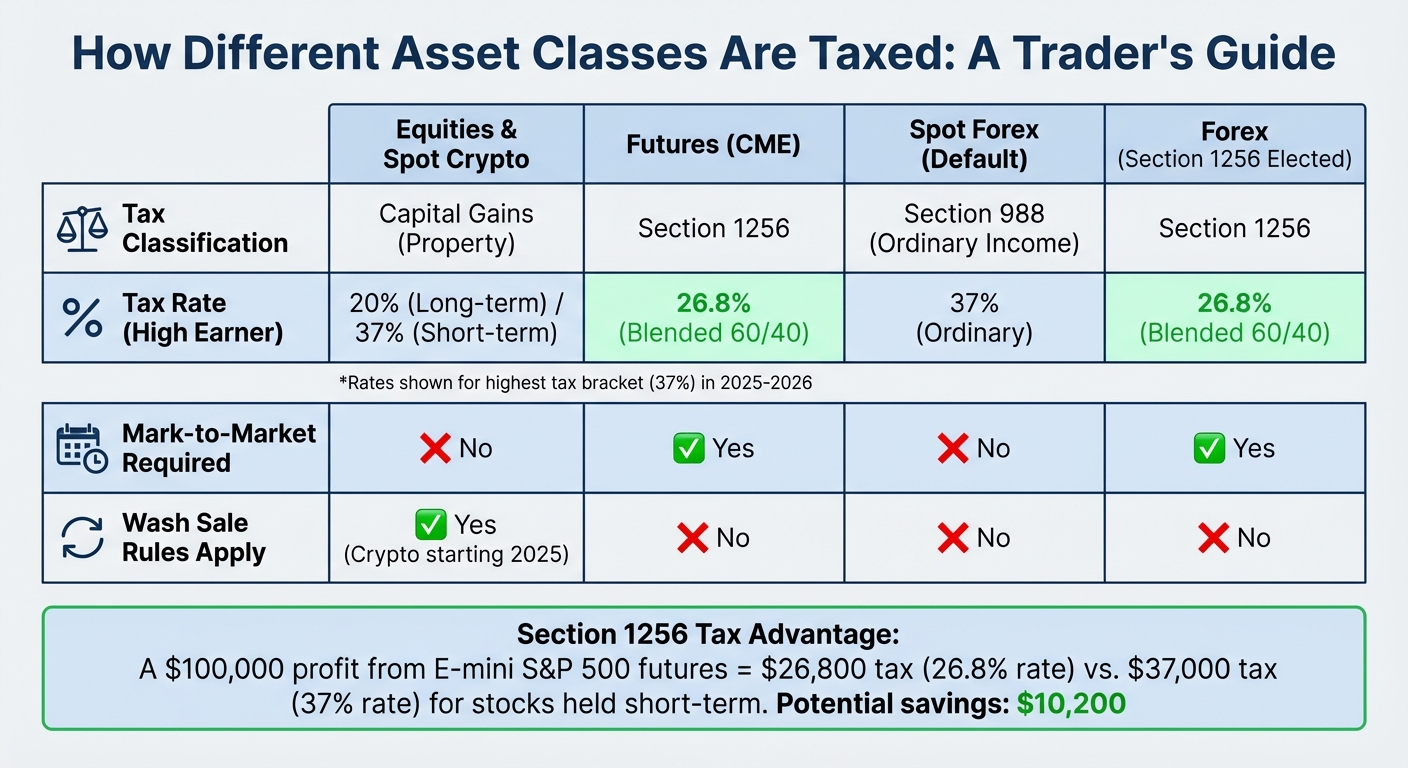
Tax Treatment Comparison for Algorithmic Trading Asset Classes
The IRS doesn’t treat all trading profits the same way. Your tax obligations can vary significantly based on the type of asset you’re trading. Equities, futures, forex, and cryptocurrencies each have their own set of rules, and understanding these differences can help you manage your tax liability more effectively.
Equities and Securities
Stock trading follows the standard capital gains tax structure. If you sell a stock you’ve held for a year or less, your profit is classified as a short-term capital gain and taxed at ordinary income rates - up to 37% for higher earners in 2025 and 2026. However, if you hold the stock for more than a year, you qualify for lower long-term capital gains rates of 0%, 15%, or 20%, depending on your taxable income. For instance, in 2025, a single filer earning up to $48,350 would pay 0% on long-term gains, while someone earning over $533,400 would face a 20% rate.
Your capital gains and losses are calculated by subtracting your adjusted cost basis (what you paid, including fees) from the sale proceeds. If you’re classified as an investor, you can only offset gains with losses and deduct up to $3,000 of ordinary income annually, with any remaining losses carried forward. Many active traders opt for the Mark-to-Market election, which removes the $3,000 limit and exempts them from the wash-sale rule.
“They [losses] can be used to offset capital gains incurred during the same tax year when the losses occurred, carried forward to offset capital gains in future years, and offset up to $3,000 of ordinary income each year.”
- David Tenerelli, Certified Financial Planner, Strategic Financial Planning
Now, let’s look at how futures and forex contracts are taxed.
Futures and Forex Contracts
Futures contracts, such as E-mini S&P 500 or CME Bitcoin futures, fall under Section 1256, which provides a tax advantage. Gains are taxed as 60% long-term and 40% short-term, regardless of how long you hold the position. For example, if you’re in the 37% tax bracket, this blended rate reduces your tax burden to about 26.8%, compared to the full 37% for ordinary income.
Here’s a practical example: If you earn $100,000 trading E-mini S&P 500 futures in 2025, your tax bill would be $26,800 at the blended rate of 26.8%. Without Section 1256, the same profit would be taxed at 37%, costing you $37,000.
Section 1256 contracts require mandatory mark-to-market treatment at year-end, meaning open positions are taxed as if sold at fair market value on December 31. This can result in taxes on unrealized gains. However, any net capital losses can be carried back three years to offset prior gains and potentially secure refunds.
Spot forex trading is treated differently. By default, it’s taxed under Section 988 as ordinary income, with rates up to 37%. If you elect Section 1256 treatment, though, you can take advantage of the 60/40 split for a lower tax burden. This election must be documented in your records before January 1 of the tax year.
“The Section 1256 60/40 rule is the most powerful tax-saving tool available to U.S. forex traders.”
- Reza Bagheri, OpoFinance
Finally, let’s dive into the tax treatment of cryptocurrencies and digital assets.
Cryptocurrencies and Digital Assets
The IRS treats cryptocurrency as property rather than currency. This means every transaction - whether trading Bitcoin for Ethereum or selling crypto for cash - is a taxable event. Gains are taxed as short-term capital gains if the asset is held for one year or less, or long-term capital gains if held longer, similar to stocks. Unlike futures, cryptocurrencies don’t qualify for the 60/40 tax split.
For example: Let’s say you buy 0.5 Bitcoin for $45,000, plus a $20 fee. A year later, you sell it for $55,000, minus a $50 fee. Your adjusted cost basis is $45,020, and your sale proceeds are $54,950, leaving a taxable gain of $9,930. At a 15% long-term rate, your tax bill would be approximately $1,489.50.
Starting in 2025, brokers will issue Form 1099-DA for digital asset sales, and the IRS will require per-wallet tracking of cost basis, replacing the previous method of pooling assets across exchanges. For high-frequency crypto traders, automated systems to track timestamps, prices, fees, and wallet addresses will be critical to staying compliant.
| Asset Type | Tax Classification | Tax Rate (High Earner) | MTM Required? | Wash Sale Rules? |
|---|---|---|---|---|
| Equities/Spot Crypto | Capital Gains (Property) | 20% (Long) / 37% (Short) | No | Yes |
| Futures (CME) | Section 1256 | 26.8% (Blended) | Yes | No |
| Spot Forex | Section 988 (Default) | 37% (Ordinary) | No | No |
| Forex (Elected) | Section 1256 | 26.8% (Blended) | Yes | No |
Business Expenses You Can Deduct
If you qualify for Trader Tax Status (TTS), you can deduct all eligible trading expenses on Schedule C, which helps lower your Adjusted Gross Income (AGI). This is a significant advantage because, without TTS, most trading expenses are off-limits for deduction under the Tax Cuts and Jobs Act. Additionally, setting up an LLC or S-Corp can open the door to further deductions.
To make the most of these deductions, proper documentation is essential. Keep receipts for expenses over $75, save monthly invoices, and use a business-only bank account and credit card for all trading-related costs. These records are crucial if the IRS ever audits you. Below are some key deductible expenses for algo traders.
VPS Hosting and Infrastructure Costs
For traders running automated strategies, Virtual Private Server (VPS) hosting is a fully deductible expense, as it ensures 24/7 uptime and low-latency execution. For example, QuantVPS offers plans ranging from $59.99 to $299.99 per month, depending on your needs. Be sure to store 12 months of invoices to back up these deductions.
| QuantVPS Plan | CPU Cores | RAM | Storage | Key Features | Monthly Price |
|---|---|---|---|---|---|
| VPS Lite | 4 | 8 GB | 70 GB NVMe | 1ms latency to CME, AMD Ryzen 7950X3D | $59.99 |
| VPS Pro | 6 | 16 GB | 150 GB NVMe | Designed for automated futures trading | $99.99 |
| VPS Ultra | 24 | 64 GB | 500 GB NVMe | Optimized for high-frequency execution | $189.99 |
| Dedicated Server | 16+ | 128 GB | 2TB+ NVMe | Institutional-grade hardware with 10Gbps+ speed | $299.99 |
If you're investing in hardware like high-performance PCs, monitors, or specialized routers, Section 179 allows you to expense up to $1,220,000 in the purchase year rather than spreading the cost over time. This applies to trading essentials like dedicated servers, cross-connects, and other infrastructure.
Software and Platform Fees
Subscriptions for trading platforms, charting tools, backtesting software, and APIs are also fully deductible for TTS traders. This includes specialized tools like custom indicators, automated strategy builders, and expert advisors. Even tax software like TraderFyles, which offers plans ranging from $89/year to $899/year, qualifies as a business expense.
Educational expenses, such as trading courses, mentorships, and books, are deductible if they help improve your trading skills. However, costs incurred before your first trade - like initial research or forming an entity - must be capitalized and amortized over 180 months. The first $5,000 of these costs may be deductible in the first year.
Data Feeds and Brokerage Commissions
Real-time market data feeds (e.g., Level 1 and Level 2), news services like Bloomberg or Reuters, and historical tick data subscriptions are deductible if they’re essential for your trading activities. For example, a Bloomberg Terminal, which costs $24,000–$27,000 per year, can be deducted if necessary for your operations. These deductions underscore the importance of detailed expense tracking to reduce your tax liability.
Brokerage commissions, however, are handled differently. Instead of being deducted as a business expense, they are added to the cost basis of the security. For instance, if you buy 100 shares of stock at $50 each with a $5 commission, your cost basis becomes $5,005. This rule applies to both TTS traders and regular investors.
Prop traders can deduct evaluation fees, challenge resets, and re-entry fees. Keeping these expenses organized will ensure you don’t miss out on any deductions.
Tax Forms and Reporting Requirements
Handling taxes for algorithmic trading means knowing which IRS forms apply to your situation. The forms you need depend on the types of assets you trade, how often you trade, and whether you've opted for the Mark-to-Market election. Accurate reporting is essential because brokers send this information directly to the IRS.
Schedule D and Form 8949 for Capital Gains
Form 8949 is where you list the details of each trade - security name, purchase and sale dates, proceeds, and cost basis. These figures are then summarized on Schedule D, which calculates your total capital gains or losses for the year. If you're an algorithmic trader handling hundreds or thousands of trades, automation is key to managing this process.
Tax rates differ depending on how long you hold an asset. Short-term gains (assets held for a year or less) are taxed at ordinary income rates, which can go as high as 37%. Long-term gains, on the other hand, are generally taxed at a maximum of 20%. For equities, brokers provide Form 1099-B, which includes the necessary trade details. Starting in the 2025 tax year, cryptocurrency exchanges will issue Form 1099-DA to report crypto transactions. When reporting crypto trades on Form 8949, specific codes are used: G, H, and I for short-term holdings, and J, K, and L for long-term ones.
If you encounter wash sales - where you buy a "substantially identical" security within 30 days of selling it at a loss - use Code "W" on Form 8949 to report the adjustment.
Next, let's look at how the Mark-to-Market election changes your tax obligations.
Mark-to-Market Election (Section 475(f))
The Section 475(f) Mark-to-Market (MTM) election changes how trading gains and losses are reported. Instead of categorizing them as capital gains or losses, they are treated as ordinary income. This eliminates the $3,000 annual limit on capital loss deductions and bypasses the wash sale rule, which can be a big plus for high-frequency traders. Under MTM, all securities held at the end of the year are treated as if they were sold at their fair market value on the last business day, and any unrealized gains or losses are reported for that tax year.
MTM traders report their results on Form 4797, Part II, instead of using Schedule D and Form 8949. While this simplifies reporting, it also means gains are taxed as ordinary income, which can reach rates of up to 37%.
Timing matters here. To elect MTM for the following tax year, you must file the election by the unextended due date of your prior year's tax return - usually April 15. If you're switching to MTM as an existing trader, you'll need to file Form 3115 (Application for Change in Accounting Method) and calculate a Section 481(a) adjustment to ensure no income is omitted or duplicated during the transition. Missed the deadline? One workaround is forming a new LLC and making the MTM election within 75 days of its formation.
Now, let’s dive into broker reporting and Form 1099-B.
Form 1099-B and Broker Reporting
Form 1099-B is the document brokers use to summarize your annual trading activity. Reconciling this form with your own trade logs is crucial to avoid any discrepancies. It includes important details like the security description (Box 1a), acquisition date (Box 1b), sale date (Box 1c), gross proceeds (Box 1d), and cost basis (Box 1e). For algorithmic traders, Box 1g is particularly relevant since it highlights disallowed wash sale losses, while Box 2 specifies whether a gain or loss is short-term or long-term.
For the 2025 tax year, brokers must send Form 1099-B by February 17, 2026. If Box 5 is marked, it indicates the security is "noncovered", meaning the broker hasn't reported the cost basis to the IRS. In this case, you'll need to track and report the cost basis yourself. Futures and forex contracts (Section 1256 contracts) are handled differently. Boxes 8 through 11 summarize aggregate gains or losses, which you then report on Form 6781 to take advantage of the special 60/40 tax treatment.
High-volume traders often rely on specialized tax software to reconcile their trade logs with Form 1099-B. This software can import data directly into Form 8949, reducing the risk of manual entry errors and ensuring accuracy in reporting.
Stay online and closer to execution. Choose a VPS location for CME futures, New York markets, London FX, API trading, and more.
Host your platform near the market route that matters.
CHINYCLONFrom $29.99/mo
CHI/CME futuresNYC/US marketsLON/FX EAsDUB/PolymarketAMS/EU FXFRA/Central EUTYO/APAC cryptoCommon Tax Mistakes and How to Avoid Them
Navigating taxes in the world of algorithmic trading can feel like walking through a minefield. Even experienced traders can stumble into costly traps. With the high trade volumes, multiple accounts, and complex wash sale scenarios that often come with algo trading, it's easy to see why these challenges arise. Knowing where these pitfalls lie - and how to sidestep them - can save you from unexpected tax headaches.
Wash Sale Rules in High-Frequency Trading
The wash sale rule is a particularly thorny issue for high-frequency traders. It disallows a loss deduction if you buy a "substantially identical" security within a 61-day window - 30 days before the sale, the day of the sale, and 30 days after. For traders running continuous strategies, this rule can lead to nearly every loss being deferred, which inflates taxable gains.
Here’s an example to illustrate this: A high-frequency trader might report $30,000 in actual net profit but face a taxable gain of $225,000 due to $195,000 in disallowed wash sale losses. This could result in a tax bill of around $72,000 - more than double the actual profit. This happens because disallowed losses are deferred, but taxes on gains are still due.
Starting in the 2025 tax year, the wash sale rule will also apply to cryptocurrencies and digital assets. This closes a loophole that crypto traders previously used for tax-loss harvesting. Another common error is the "IRA black hole" - if you sell a security at a loss in a taxable account and repurchase it in an IRA within the 61-day window, the loss becomes permanently disallowed.
Most brokers only track wash sales for identical securities within a single account. If you’re trading across multiple brokerages or even between your own and a spouse’s account, you’ll need to manually track these or use specialized software. One way to avoid the wash sale rule entirely is by electing Section 475(f) Mark-to-Market status, which also removes the $3,000 capital loss limitation. If that’s not an option, consider strategies like selling one ETF at a loss and buying a similar, but not "substantially identical", ETF (e.g., swapping SPY for VOO).
The next step to staying compliant? Keeping meticulous records.
Record-Keeping for Automated Strategies
When it comes to automated trading, precise record-keeping is non-negotiable. Your system might be on autopilot, but your records can’t be. Independent trade logs should include timestamps, asset details, buy/sell prices, and fees. Aggregating this data across all accounts ensures accuracy. This becomes especially important when reconciling with Form 1099-B, as brokers may use different methods for wash sale adjustments, leading to discrepancies.
You’ll also want to track transactions across personal accounts, spouse accounts, and IRAs to catch wash sales that brokers might overlook. For international trades, make sure to convert all transactions to U.S. dollars at the time of execution. If you’ve elected Mark-to-Market status under Section 475(f), don’t forget to document the fair market value of all positions as of December 31.
Specialized software can help simplify this process. By importing trade history via API or CSV files, you can capture every transaction and minimize manual errors. Keep trade confirmations and account statements for at least three to six years in case of an IRS audit. Also, pay attention to settlement dates - stocks settle on T+2, so trades made late in December might not settle until the following tax year, affecting how they’re reported.
Once your federal records are in order, don’t forget about state and local tax obligations.
State and Local Tax Obligations
Federal taxes are only part of the equation. State and local tax rules add another layer of complexity. Some states don’t tax capital gains at all, while others have specific rules for trading losses. If your trading activity is classified as a "business" in your state, you might need to file additional forms beyond your federal return.
If your trading spans multiple states, you could even create a tax nexus in more than one jurisdiction. Keeping separate records for domestic and international trades can help you manage these obligations. To navigate this maze, consult a tax professional familiar with your state’s rules to ensure compliance and identify any potential deductions or credits.
Tax Reduction Methods for Algo Traders
Tax costs are predictable results of decisions made before trading begins. Each major tax problem in algorithmic trading has a matching structural fix available to traders willing to build systems around them.
"Every major tax problem in algorithmic trading has a structural fix — the key is building systems around the cause, not reacting to the result." — Core Principle of Tax-Efficient Algo Trading
💡 Tip: The most tax-efficient algo traders don't scramble at year-end — they engineer low-tax outcomes into their systems before the first trade executes.
| Tax Problem | Structural Fix |
|---|---|
| Short-term capital gains | Hold-period optimization rules |
| Wash sale violations | Automated trade tracking systems |
| High-frequency tax drag | Strategy-level turnover controls |
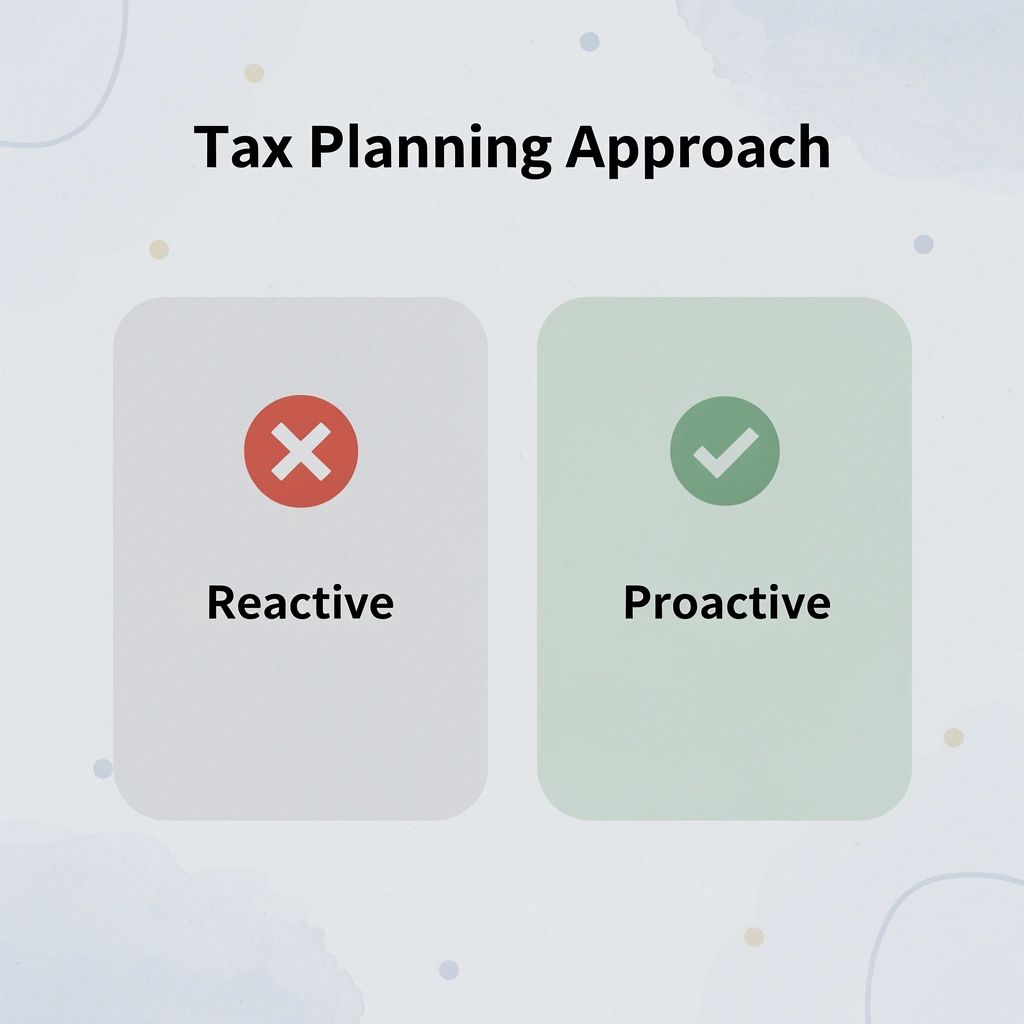
Once you know why your tax bill is high, you can build systems that address the cause rather than react to the result.
⚠️ Warning: Traders who treat tax planning as an afterthought consistently overpay—often by a significant margin—compared to those who embed tax logic directly into their trading architecture.
🔑 Takeaway: Proactive tax structuring is not optional for serious algo traders: it is a core performance lever as impactful as any signal or execution improvement.
Trading in Tax-Advantaged Accounts
Using tax-advantaged accounts for your trading strategies can reduce tax losses from frequent trades. A self-directed IRA running a futures strategy lets your gains grow without triggering taxes each time you close a trade. Match the account type to your strategy: short-term mean-reversion fits a Roth IRA (tax-free withdrawals in retirement), while a Traditional IRA works better if you want immediate deductions on contributions. Trades inside these accounts don't qualify for Trader Tax Status, so the efficiency gain comes from the account structure itself. Use taxable accounts for strategies where Trader Tax Status deductions apply, and tax-advantaged accounts for everything else.
How Tax-Loss Harvesting Creates Real Alpha
Tax-loss harvesting is a continuous execution discipline. Identify positions with unrealized losses, exit them, and immediately enter a similar but not substantially identical security to preserve market exposure. Selling SPY at a loss and buying IVV maintains full S&P 500 exposure without triggering a wash-sale violation because the IRS considers them distinct securities. According to HCVT's analysis of 12 strategies to maximize after-tax income, harvested losses can offset realized capital gains in the same year, carry forward indefinitely to offset future gains, and reduce ordinary income by up to $3,000 annually. Sophisticated algorithms can integrate this logic directly into execution, flagging harvesting opportunities when unrealized losses cross a threshold that justifies transaction costs.
Manual loss tracking breaks down as trade volume scales and positions multiply across asset classes. Our trading VPS executes harvesting logic in real time, eliminating latency gaps and missed windows from local machines that sleep, restart, or lose connectivity mid-session.
Timing Income Recognition Strategically
The year you recognize a gain matters as much as the gain itself. Traders expecting higher income next year can accelerate gains into the current tax year to lock in a lower effective rate. Those expecting lower future income delay gains by holding positions into January. Section 475(f) mark-to-market traders have additional flexibility: the timing of position start and exit around year-end directly influences the year-end MTM valuation that determines taxable income. Realizing gains to absorb capital loss carryforwards before they expire is a legitimate optimization often overlooked.
Qualified Opportunity Zones and Long-Term Deferral
Algorithmic trading produces capital gains that can be rolled into Qualified Opportunity Zone Funds within 180 days to defer the tax event. The main benefit is permanent exclusion: investments held for ten or more years exclude all gains made after the investment from federal tax. A trader rolling $1 million in deferred gains into a qualifying fund in 2025 and holding until 2035 could see that investment grow to $2.5 million, with the full $1.5 million gain excluded from taxable income. The trade-off is liquidity—capital is locked up for a decade and must meet specific fund requirements. This strategy suits traders with steady yearly gains who can commit funds to long-term positions. HCVT identifies up to 12 tax strategies available under 2026 planning frameworks, with Opportunity Zone investing among the most powerful for high-volume capital-gain generators.
When to Bring in a Tax Professional
A tax professional with expertise in algorithmic trading and cryptocurrency taxation can confirm whether you qualify for Trader Tax Status, evaluate whether setting up a trading entity makes sense, and ensure your trade data maps correctly to IRS Form 8949. These are not basic accounting tasks. The interaction between MTM elections, wash-sale rules, and entity structure requires someone who understands how execution systems create tax events, not simply how to file returns. Location matters too: every strategy discussed here applies primarily to U.S. federal tax law, while state tax treatment, international accounts, and cross-border trading introduce additional variables requiring location-specific guidance.
The most successful algorithmic traders optimize what they keep after taxes, a systematic problem as important as signal generation.
Tools for Easier Tax Compliance
When it comes to managing tax compliance, having the right tools can make all the difference. Instead of spending hours on manual processes, the right infrastructure can automate much of the work, freeing up time to focus on fine-tuning your trading strategies. For algorithmic traders, creating a dependable system that captures every transaction and securely stores data for years is essential. A strong VPS setup not only safeguards your data but also simplifies the entire tax preparation process.
Using QuantVPS with Tax Software
A reliable VPS setup is a cornerstone of effective tax reporting. QuantVPS offers automatic backups and a 99.999% uptime guarantee, ensuring that your trading logs, strategy settings, and historical data are safely preserved. This is especially important for IRS documentation and audit protection.
With RAID10 storage, QuantVPS ensures secure and dependable data storage, while its dedicated IP address provides consistent connectivity. If you’re using platforms like MetaTrader or NinjaTrader, you can easily export trade histories to tax software like TraderFyles (starting at $89/year for 1,000 trades) or CoinLedger, a platform trusted by over 300,000 users.
These integrations automate the creation of crucial tax forms like Form 8949 and Schedule D, significantly reducing the risk of manual errors. QuantVPS also offers 24/7 support, which can help resolve any platform issues that might disrupt your data logging. By combining your VPS with tax software, you enhance your compliance strategy, particularly in areas like expense tracking and maintaining accurate records.
For added security, configure your VPS to automatically sync transaction histories with cloud-based backup tools. This setup creates tamper-proof audit trails that meet IRS requirements for substantiation. Knowing that your records are secure, accessible, and ready for tax season - or an unexpected audit - provides peace of mind. With automated backups and seamless data synchronization, you can further strengthen your approach to staying tax-compliant.
Conclusion: Tax Compliance Checklist for Algo Traders
Staying on top of tax compliance can be straightforward with the right approach. Here's a quick checklist to help you stay on track:
- Determine your tax classification: Decide whether you qualify for Trader Tax Status or fall under Investor Status. If eligible, elect MTM (Mark-to-Market) accounting by April 15 to simplify deductions and avoid wash-sale penalties.
- Keep detailed records: Log every transaction, along with VPS invoices, software receipts, and broker statements. These should be kept for at least three years - or six years if there's significant underreporting. Managing thousands of trades manually can take up to 125 hours, but automated tax software can cut this down to just 2.5 hours.
- Back up trading data: Export your trading platform history monthly from your VPS. This protects your data from loss due to system crashes or updates.
-
Deduct eligible expenses: Reduce your AGI by claiming deductions for VPS hosting, data feeds, software subscriptions, and Section 179 purchases. Services like QuantVPS, with automatic backups and near-perfect uptime, help ensure your records are secure and audit-ready. As New York City Servers pointed out:
"A folder with 12 months of VPS invoices is far more convincing to a tax inspector than 'I had a server somewhere'".
Finally, don’t forget to meet quarterly estimated tax deadlines - April 15, June 15, September 15, and January 15. Use API integrations to connect your VPS-hosted platforms with tax software, creating tamper-proof records that meet IRS standards. With consistent habits and the right tools, you can focus on trading without worrying about compliance.
FAQs
Do I qualify for Trader Tax Status?
If your trading activity is substantial, regular, frequent, and short-term, you might qualify for Trader Tax Status. This generally applies to traders who have an average holding period of 31 days or less and focus on profiting from daily market movements instead of long-term investments. It's a good idea to consult a tax professional to confirm whether your activity meets the required criteria for this designation.
Should I elect mark-to-market accounting?
Mark-to-market accounting can be a game-changer for active traders. It lets you fully deduct trading losses without being limited to the $3,000 cap on capital losses. Plus, it gets rid of those pesky wash sale rules that can complicate things. But here’s the catch: you’ve got to make this election by April 15 of the tax year. It’s a smart move to check in with a tax professional to make sure this option fits your trading strategy and keeps you in line with tax regulations.
How do I track wash sales across accounts?
Tracking wash sales across multiple accounts means staying on top of IRS guidelines and keeping detailed records. Make sure to document every trade - this includes dates, securities involved, prices, and the results of each transaction. This level of detail helps you identify wash sales that fall within the 30-day rule.
It's also crucial to monitor all your accounts collectively. Consolidating this data allows you to spot any repurchases that might trigger wash sale rules. To make this process less overwhelming, you might want to explore tools designed specifically for tracking wash sales.
Lastly, don’t forget to adjust the cost basis for any repurchased securities. This step is essential to stay compliant with IRS regulations. Skipping it could lead to inaccurate reporting and potential issues down the line.