- Dynamic Protection: Unlike fixed stop-loss orders, trailing stops adjust automatically as the market moves in your favor, locking in gains while allowing trades to grow.
- Profit Security: They follow the price by a set dollar amount or percentage, ensuring you exit trades profitably if the market reverses.
- Emotional Control: By automating exits, trailing stops help eliminate impulsive decisions, a common pitfall for traders.
- Versatility: Useful across markets like stocks, futures, and forex, they adapt to trending or volatile conditions.
Key Takeaways:
- How It Works: Trailing stops adjust upward (for long positions) or downward (for short positions) as the price moves favorably. If the price reverses to the stop level, the trade closes automatically.
- Types: Choose between fixed value (dollar/point-based) or percentage-based trailing stops, depending on your asset and strategy.
- Best Practices: Use tools like the Average True Range (ATR) to set optimal trailing distances. Pair trailing stops with initial stop-losses for added protection.
- Challenges: Be mindful of market whipsaws, gaps, and slippage. Adjust trailing distances to avoid premature exits in choppy markets.
Trailing stops offer a hands-free way to manage risk, secure profits, and stay disciplined in trading. Learn how to set them up on platforms like MetaTrader, NinjaTrader, and TradeStation for smoother execution.
What Are Trailing Stop Orders?
A trailing stop order is a type of stop-loss that adjusts automatically as the market price moves in your favor. Unlike a traditional stop-loss, which stays fixed at a set price, a trailing stop "follows" the market at a specified distance. This distance can be defined as a dollar amount, a number of points, or a percentage. The idea is to let your profitable trades run while protecting against sudden reversals.
Here’s how it works: if the price of an asset moves in a favorable direction, the trailing stop adjusts upward (for long positions) or downward (for short positions) along with it. For instance, if you own a stock and its price rises, the trailing stop also rises. However, if the price starts to fall, the stop price stays at its highest point, locking in your gains. Once the price reaches the trailing stop level, a market order is triggered to close the position.
What sets trailing stops apart is their dynamic nature. Traditional stop-loss orders stay fixed unless you manually change them, and take-profit orders close your trade at a predetermined target, potentially cutting off further gains. Trailing stops, on the other hand, continuously adjust as long as the price moves in your favor, securing gains while allowing room for further upside. Kevin Horner, a Senior Specialist at Charles Schwab, explains:
"A trailing stop order is a variation of a standard stop order that can help stock traders who want to potentially follow the trend while managing their exit strategy."
It’s important to note that trailing stops are triggered by the last trade price, not the bid or ask price. They typically work during standard market hours (9:30 a.m.–4:00 p.m. ET), though some Good-'Til-Canceled orders can remain active for up to 180 days.
The main purpose of a trailing stop is to protect your profits while minimizing losses. This makes it particularly useful in trending markets, where you want to capture as much of the upward (or downward) momentum as possible without risking the gains you’ve already made.
How Trailing Stop Orders Work
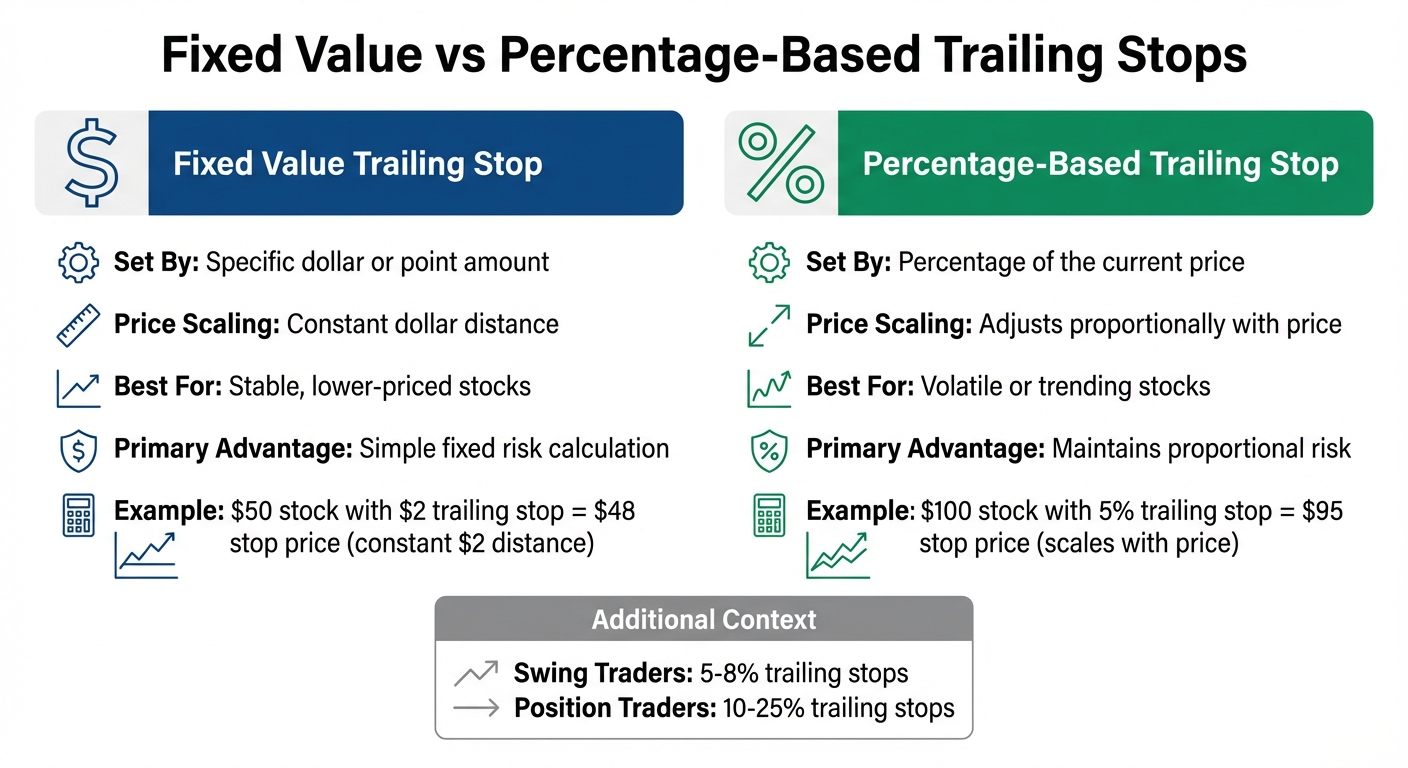
Fixed Value vs Percentage-Based Trailing Stops Comparison
A trailing stop operates with a simple yet effective mechanism: it maintains a fixed distance from the highest price (in long positions) or the lowest price (in short positions) your asset reaches after placing the order. When the price moves in your favor, the stop price adjusts - rising for long positions and falling for shorts. However, if the market reverses, the stop price stays locked at its last level, ensuring your risk doesn't increase.
For long positions, the stop price climbs with new highs; for short positions, it drops with new lows. This approach secures profits during favorable moves while capping potential losses during reversals. If the price reverses and hits the trailing stop, the order immediately converts into a market order, keeping your risk management strategy intact.
You can set the trailing distance in two main ways: as a fixed dollar amount or as a percentage of the current price. Each method is suited to different trading styles and types of assets. Below, we break down how these methods work.
Fixed Value Trailing Stops
A fixed value trailing stop maintains a set dollar or point distance from the market price. For example, if you own a $50 stock and set a $2 trailing stop, the stop starts at $48 and moves up as the stock price rises. The dollar distance remains constant, regardless of price changes.
This method is straightforward and works well for stable, lower-priced stocks with predictable daily price ranges. However, it doesn't scale with the asset's value. A $2 stop might be appropriate for a $50 stock, but it could be too restrictive - or too lenient - if the stock later trades at $200.

Run 24/7 while you sleep. Keep bots, platforms, and trade copiers online on a dedicated VPS.
Low-latency VPS hosting for your trading platform.
 CHINYC
 LON
LONFrom $59.99/mo


 CHI/CME futuresNYC/US marketsLON/FX EAs
 DUB/Polymarket
 AMS/EU FX
 FRA/Central EU
 TYO/APAC crypto
Percentage-Based Trailing Stops
Percentage-based trailing stops, on the other hand, adjust to price fluctuations by maintaining a consistent percentage distance from the peak price. For instance, if you set a 5% trailing stop on a $100 stock, the stop starts at $95 and moves proportionally as the stock price increases.
This method is more flexible, making it ideal for volatile stocks or assets with significant price changes over time. Swing traders often use trailing stops in the range of 5% to 8% to avoid being stopped out by normal market fluctuations. Position traders, who hold assets longer, might prefer wider stops, such as 10% to 25%. Since percentage-based stops scale with the asset's price, they provide consistent risk management whether the stock trades at $20 or $200.
| Aspect | Fixed Value Trailing Stop | Percentage-Based Trailing Stop |
|---|---|---|
| Set By | Specific dollar or point amount | Percentage of the current price |
| Price Scaling | Constant dollar distance | Adjusts proportionally with price |
| Best For | Stable, lower-priced stocks | Volatile or trending stocks |
| Primary Advantage | Simple fixed risk calculation | Maintains proportional risk |
Benefits of Trailing Stop Orders
Trailing stop orders bring three main advantages to the table: they help secure profits, limit potential losses, and remove emotional interference from trading decisions. These features make them a strong tool for managing risk effectively.
Protecting Profits
One of the standout benefits of a trailing stop is its ability to lock in gains as prices move in your favor. Unlike a fixed take-profit order that caps your exit at a pre-set level, a trailing stop adjusts with the market's upward movement, allowing you to benefit from extended trends.
For instance, if you purchase NVDA at $100.00 using a 10% trailing stop, the stop will climb as the price rises. This mechanism ensures that profits are captured even if the price peaks and then reverses, potentially securing gains well beyond 20%.
"Trailing stops help eliminate emotion when exiting trades, perhaps the most important part of trading." - Investopedia
In addition to locking in profits, trailing stops can also enhance the size of winning trades. While research indicates that trailing stops might slightly lower win rates, they often lead to larger average gains because they allow trades to capitalize on significant price movements.
Limiting Losses
Trailing stops are equally effective at minimizing losses. By setting a moving "floor" that rises with favorable price action but remains fixed when prices pull back, they ensure that trades close automatically if the market reverses.
A long-term study spanning 54 years revealed that using a 10% stop-loss strategy resulted in higher returns and reduced losses compared to trading without stops. Similarly, analysis of the OMX Stockholm 30 Index showed that employing trailing stop-loss levels between 15% and 20% outperformed a simple buy-and-hold approach, especially during periods of market volatility.
To make the most of trailing stops, it's essential to align the trailing distance with the asset's volatility. Many traders use a multiple of the Average True Range (ATR) - often 2 to 3 times - to differentiate between routine price fluctuations and actual trend reversals.
Reducing Emotional Trading
Another major advantage of trailing stops is their ability to curb emotionally driven trading decisions. By automating exit points, traders are shielded from making impulsive choices under pressure. This helps mitigate what some call "Equity Curve Anxiety", as profits naturally adjust without constant intervention.
"The hardest decision in trading isn't when to buy - it's when to sell." - VibeTrader Team
Emotional biases, like the disposition effect, often lead traders to sell winning positions too soon and hold onto losing ones for too long. Studies show that traders typically capture only 40% to 55% of the maximum potential profit on winning trades due to poor timing. Trailing stops counteract this by letting profitable trades run their course while cutting losses automatically.
Brokerages such as Charles Schwab support good-'til-canceled (GTC) trailing stop orders, which can remain active for up to 180 calendar days unless executed or canceled. This feature encourages long-term discipline and helps traders stick to their strategies.
How to Set Up Trailing Stop Orders
To set up trailing stops, you’ll need to configure your trading platform and ensure a reliable execution environment. The key is creating a stop that adjusts dynamically with price movements. Below, we’ll explore why using a low-latency VPS can significantly improve the efficiency of these orders.
Why Low-Latency VPS Matters
Trailing stops are highly time-sensitive because they adjust in real time as prices fluctuate. In fast-paced markets, even a tiny delay - measured in milliseconds - can lead to slippage. That’s why the location of your VPS matters. A server close to major exchanges (like Chicago for CME futures or NY4 for forex) can drastically reduce latency. For example, a NY4 Forex VPS typically achieves an impressive 0.8 ms ping time, compared to 62 ms on a standard home fiber connection. This difference minimizes execution errors and slippage.
On platforms like MetaTrader, trailing stops function on the client side. This means if you close the platform, the trailing stop feature stops working, leaving only the last set stop-loss in place. Additionally, VPS environments offer more stable performance compared to local machines. During volatile market conditions, local devices might hit CPU usage spikes of 90–100%, causing execution delays of several seconds. In contrast, QuantVPS systems usually maintain CPU and RAM usage between 15–25% under normal loads. Combined with low-latency connections to key trading hubs like Chicago, New York, and London, this stability ensures smoother order execution.
Setting Up on NinjaTrader, MetaTrader, and TradeStation
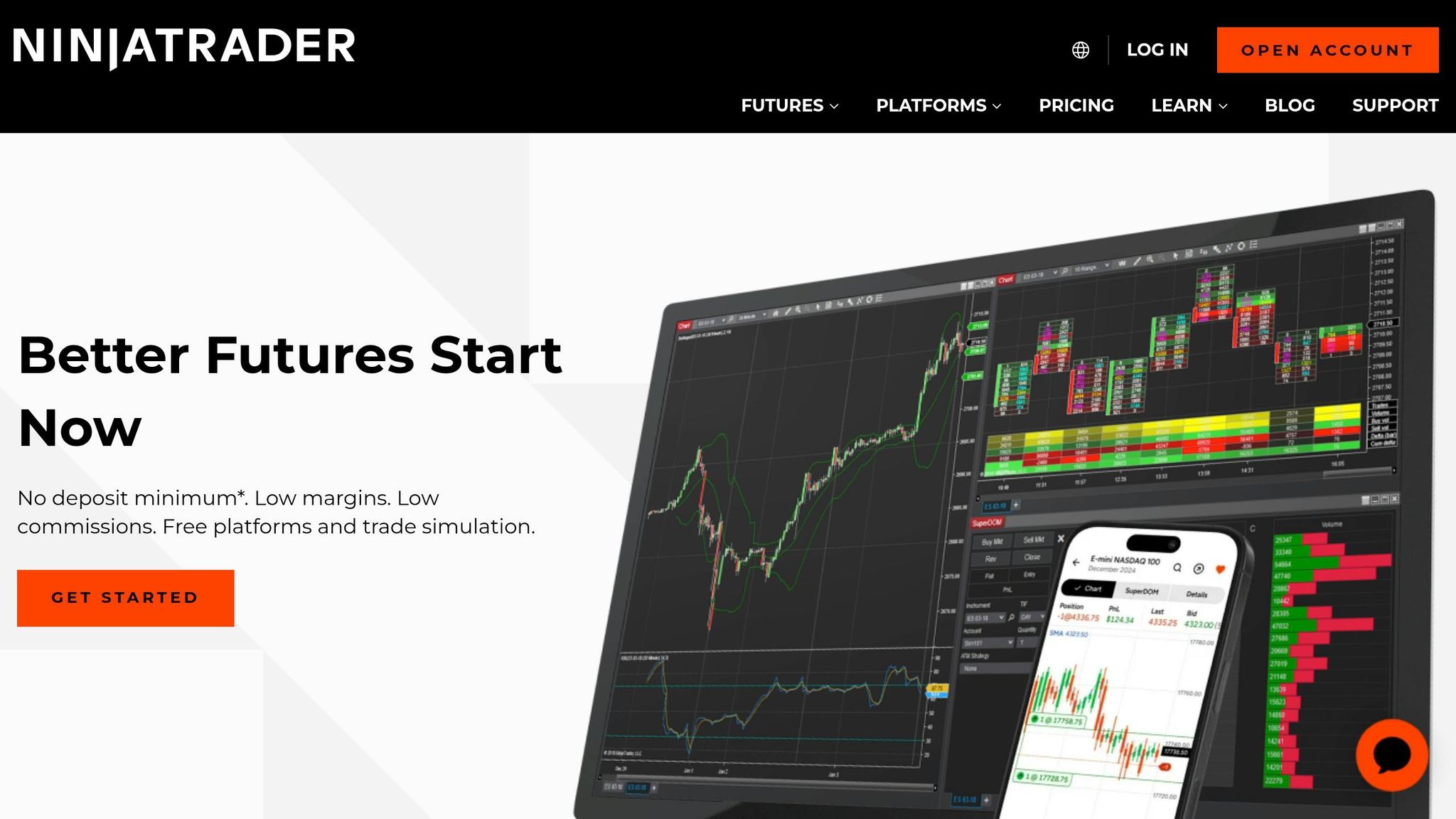
Once your VPS is set up for fast and stable execution, configuring trailing stops on your trading platform is relatively straightforward.
- NinjaTrader: For new orders, go to the Trading menu, select the arrow, and choose either "Trailing Stop (Market)" or "Trailing Stop Limit." For existing trades, enable "Auto Trail" through ATM Strategies, accessible in your Chart, SuperDOM, or Advanced section.
- MetaTrader 4 and 5: Trailing stops apply only to open positions. Right-click the position in the Trade tab (MT4), Toolbox (MT5), or directly on the dotted position line on the chart to access the trailing stop menu. Keep in mind that a "point" in MetaTrader refers to the smallest unit of a rate (e.g., 0.001 for USDJPY), and the trailing stop level must exceed the current stop level to activate the feature. A "T" mark next to the position confirms the trailing stop is active.
- TradeStation: While the interface may vary depending on the version, the general process involves using the order management tools to select trailing stop options. Running TradeStation on a high-performance VPS ensures consistent connectivity during critical trading moments.
Best Practices for Trailing Stops in Volatile Markets
In volatile markets, it’s crucial to adjust your trailing stop distance to reflect current price movements rather than sticking to fixed percentages. When volatility surges - whether from earnings reports, economic announcements, or sudden market shifts - trailing stops need extra room to avoid being triggered by routine price swings. Using tools like the Average True Range (ATR) can help you dynamically set trailing stop distances.
Using Average True Range (ATR) to Set Trailing Distance
ATR is a tool that measures how much an asset typically moves over a given period, often 14 days. Unlike arbitrary percentages, ATR adapts to an asset's natural price behavior. For instance, a stock with a 5% daily swing requires a wider stop than one with a 1% move, and ATR captures this difference effectively.
Stay online and closer to execution. Choose a VPS location for CME futures, New York markets, London FX, API trading, and more.
Host your platform near the market route that matters.
CHINYCLONFrom $59.99/mo
CHI/CME futuresNYC/US marketsLON/FX EAsDUB/PolymarketAMS/EU FXFRA/Central EUTYO/APAC cryptoThe ATR multiplier you choose depends on your trading style:
- Day traders often use 1.5x to 2x ATR to keep stops tight for quick intraday moves.
- Swing traders usually prefer 2x to 3x ATR, giving them enough room for multi-day price fluctuations.
- Position traders, holding for weeks or months, typically use 3x to 4x ATR to endure deeper pullbacks.
Research highlights that a 2x ATR stop-loss can reduce maximum drawdowns by 32% compared to static stop levels.
| Trading Style | ATR Multiplier | Stop Distance | Best Use Case |
|---|---|---|---|
| Day Trading | 1.5x – 2.0x | Tight | Intraday momentum and scalping |
| Swing Trading | 2.0x – 3.0x | Moderate | Multi-day positions and swing setups |
| Position Trading | 3.0x – 4.0x | Wide | Long-term trends and volatile assets |
When volatility spikes, consider increasing your ATR multiplier or using a longer ATR period (e.g., 20 to 50 periods instead of 14) to avoid being stopped out by temporary market noise. Remember, a trailing stop only moves in your favor; it doesn’t adjust backward, even during heightened volatility.
"ATR-based stop-losses are flexible, easy to calculate, and adaptable to changing market conditions."
– Sean Mackey, Founder & CEO, LuxAlgo
Combining Trailing Stops with Initial Stop-Loss Orders
Adjusting stop distances is just one part of a sound strategy. Pairing a trailing stop with a fixed initial stop-loss enhances risk management. A fixed stop-loss sets the maximum loss you’re willing to take from your entry point, while the trailing stop secures profits as the trade moves in your favor. Relying on a trailing stop alone leaves you vulnerable to sudden, sharp losses.
Timing matters when activating your trailing stop. Many seasoned traders wait until the trade achieves at least a 1:1 reward-to-risk ratio before switching from a fixed stop to a trailing one. For example, if you risk $500 on a trade, wait until you have $500 in unrealized profit before activating the trailing stop. This approach minimizes the chances of being stopped out by minor, early retracements.
Adjusting Position Size
Your position size should align with the stop distance:
Position Size = Dollar Risk / (ATR × Multiplier).
For example, with an ATR of $2.50 and a 2x multiplier, the stop distance is $5.00. If your risk limit is $500, you would take a 100-share position ($500 / $5.00). This ensures that you naturally take smaller positions in volatile assets.
For quality stocks, it’s rare to see a decline of more than 7% to 8% below their breakout price unless there’s a fundamental issue. Combining a fixed 8% initial stop with a 2x ATR trailing stop provides immediate protection and a way to lock in profits. During periods of heightened volatility, widening your stops by 1.5x to 2.5x the standard ATR can help account for larger price swings around major news events.
Common Pitfalls and Limitations of Trailing Stop Orders
Trailing stops can be an effective way to manage risk, but they aren’t without their challenges. One of the biggest issues traders face is whipsaws - when short-term price swings trigger your stop, only for the price to reverse and continue in your favor. This is especially common in choppy or sideways markets, where repeated premature exits can lead to missed profit opportunities. Getting the trailing stop distance right is key here. If it’s set too tight, you risk being stopped out too early. Set it too wide, and you might end up losing more than you bargained for.
"This 'shake out' is the number one reason intermediate traders fail to capture large trend moves. The problem isn't your direction; it's your distance."
– Isabella Torres, Derivatives Analyst, FXNX
Whipsaws aren’t the only issue. Gap risk is another major concern. Trailing stops generally work only during regular market hours (9:30 a.m. to 4:00 p.m. ET). That means if there’s significant news after hours, causing a sharp price gap, your stop won’t protect you. For instance, if a company announces disappointing earnings overnight, the stock could open much lower the next morning. Your trailing stop would then execute as a market order, potentially locking in a bigger loss than expected.
Execution problems can also undermine trailing stops. In fast-moving or thinly traded markets, slippage can result in an exit price far worse than anticipated. This can be frustrating, especially when you’ve carefully planned your stop levels.
Another challenge is stop-hunting, where market makers intentionally push prices to levels where stops are commonly placed - such as round numbers - before reversing direction. This tactic can leave retail traders caught off guard. To counter this, consider placing your stops at less obvious levels, avoiding predictable round-number zones.
While trailing stops are useful, understanding and addressing these limitations is critical to using them effectively.
Conclusion
Trailing stop orders are a smart way to manage risk in today’s fast-paced markets. They let you lock in profits as prices move in your favor while also minimizing losses if the trend takes a turn. Unlike fixed stop-losses, trailing stops adjust dynamically, allowing you to stay in a winning trade without capping your potential upside - a big advantage in trending markets.
The key to using trailing stops effectively lies in finding the right balance. Setting the distance too tight could cut your profits short, while too wide might expose you to unnecessary risk. A good rule of thumb? Use 2x to 3x the Average True Range (ATR) to account for market volatility and secure gains. Combining a trailing stop with a fixed initial stop-loss - often called the "Belt and Suspenders" approach - can provide both a safety net and dynamic profit protection.
Automation is where trailing stops truly shine. As noted by Investopedia's editorial team:
"Trailing stops help eliminate emotion when exiting trades, perhaps the most important part of trading".
By defining your exit strategy in advance, you avoid emotional pitfalls like holding onto losses or exiting too early.
Reliable execution is crucial. Trailing stops often trigger market orders, and in fast-moving conditions, even a brief delay can lead to slippage. A low-latency VPS like QuantVPS ensures your platform stays connected 24/7, keeping your stop levels intact even when you’re away. With sub-millisecond latency and robust uptime guarantees, QuantVPS supports seamless execution of your risk management strategy.
Set your parameters wisely, and let trailing stops do the heavy lifting. You focus on strategy - the market and your tools will handle the rest.
FAQs
What trailing stop distance should I use?
The best trailing stop distance varies depending on your trading strategy, how volatile the market is, and how much risk you're comfortable with. Some traders prefer a fixed percentage, such as 2-5%, while others opt for a specific dollar amount. Another popular approach is using a volatility-based measure like the Average True Range (ATR).
The key is to find a distance that secures your profits but still gives the price room to move naturally. Over time, you can fine-tune this distance based on your experience and how the market behaves to achieve better outcomes.
When should I switch from a fixed stop-loss to a trailing stop?
When you're looking to secure profits while still taking advantage of upward price trends, switching to a trailing stop is a smart move. Unlike a fixed stop-loss, a trailing stop adjusts itself automatically as the price climbs. This way, it locks in your gains while leaving room for further growth.
A good strategy is to begin with a fixed stop-loss to manage potential losses. Once your trade starts moving in the right direction - particularly in markets prone to sudden shifts - transition to a trailing stop. This approach helps you stay protected from unexpected reversals while maximizing your position's potential.
How can I reduce slippage and missed fills on trailing stops?
To reduce the chances of slippage and missed fills when using trailing stops, it's crucial to pay attention to timing and execution speed. Opt for low-latency trading platforms to ensure faster order execution. Additionally, set your trailing amounts carefully, aligning them with current market volatility. This helps your stop levels adjust more effectively to price movements.
Be cautious about trading during periods of extreme market volatility, as these can lead to unpredictable price swings. When it comes to order types, market orders guarantee execution but may lead to higher slippage, while limit orders can minimize slippage but carry the risk of not being filled. Finding the right balance between these options depends on your individual risk tolerance and trading strategy.