Congressional stock trading has long raised concerns about transparency and fairness. Lawmakers often trade stocks in industries they oversee, with some achieving returns far above market averages. For example, U.S. Senators have historically outperformed the market by 12% annually, and in 2024, over 20 members of Congress doubled the S&P 500's average gain. Public frustration is clear: 86% of Americans support banning congressional stock trading.
The STOCK Act of 2012 aimed to address these issues by requiring lawmakers to disclose trades over $1,000 within 30–45 days. However, enforcement is weak - violations often result in a waived $200 fine. Proposed reforms, like the Stop Insider Trading Act (H.R. 7008), seek stricter rules, including banning stock purchases by lawmakers and their families and imposing steeper penalties.
For those tracking congressional trades, data is available through government databases and third-party tools like Quiver Quantitative and Capitol Trades. These platforms simplify analysis and provide real-time updates, helping users monitor patterns and potential conflicts of interest.
Key Takeaways:
- STOCK Act: Mandates trade disclosures but has weak penalties.
- Proposed Reforms: Harsher penalties, bans on stock trading, and divestment requirements.
- Tracking Tools: Government databases and platforms like Capitol Trades provide access to trade data.
Understanding these rules and tools is essential for promoting accountability and staying informed.
The STOCK Act of 2012: What You Need to Know
The Stop Trading on Congressional Knowledge (STOCK) Act of 2012 made it clear that members of Congress must follow insider trading laws. Before this law, there was a gray area - lawmakers weren’t explicitly bound by the same rules that applied to corporate executives and everyday investors.
The Act passed with overwhelming support in Congress: 96–3 in the Senate and 417–2 in the House. President Barack Obama signed it into law, stating:
"It's the notion that the powerful shouldn't get to create one set of rules for themselves and another set of rules for everybody else. ... If we expect that to apply to our biggest corporations and our most successful citizens, it certainly should apply to our elected officials."
The law establishes that members of Congress owe a legal "duty of trust and confidence" to the U.S. government and its citizens regarding material, non-public information they gain through their roles. This means lawmakers cannot use confidential briefings, committee hearings, or policy discussions for personal financial gain. It also bars members from participating in Initial Public Offerings (IPOs) unless those IPOs are open to the public. Additionally, members convicted of felonies related to public corruption or insider trading lose their federal pensions. The law also requires members to disclose mortgage terms and report private-sector job negotiations within three business days.
Disclosure Requirements and Reporting Deadlines
Under the STOCK Act, members of Congress must file Periodic Transaction Reports (PTRs) for any stock, bond, or securities transactions over $1,000. These reports must be submitted within 30–45 days of the transaction.
To promote transparency, all disclosure reports are made available to the public through online, searchable databases maintained by the House and Senate. This allows citizens, journalists, and watchdog groups to track congressional trading activity. In 2021 alone, Senate and House members disclosed 4,000 trades worth at least $315 million.
The penalty for missing the reporting deadline is a $200 fine. However, these fines are often waived by House and Senate Ethics Committees, which has drawn criticism from transparency advocates. The Campaign Legal Center has noted:

Run 24/7 while you sleep. Keep bots, platforms, and trade copiers online on a dedicated VPS.
Low-latency VPS hosting for your trading platform.
 CHINYC
 LON
LONFrom $59.99/mo


 CHI/CME futuresNYC/US marketsLON/FX EAs
 DUB/Polymarket
 AMS/EU FX
 FRA/Central EU
 TYO/APAC crypto
"The penalty for a member of Congress violating the STOCK Act is $200 - a hardly impactful deterrence from the potential millions to be made off the stock market."
In 2021, 54 members of Congress and numerous staffers were found to have violated the STOCK Act’s reporting rules. Despite these violations, no member of Congress has ever been prosecuted for insider trading under the STOCK Act as of late 2025.
How the STOCK Act Prohibits Insider Trading
The STOCK Act explicitly states that members of Congress and their staff are subject to federal insider trading laws, including the Securities Exchange Act of 1934 and Rule 10b-5. This closed a major loophole, ensuring that using non-public information obtained through government roles for personal profit is illegal.
The law applies not just to Congress but also to the President, Vice President, senior executive branch employees, and federal judges. However, enforcement has faced challenges. Since prosecutions are handled by the executive branch, separation of powers concerns may discourage officials from pursuing cases against legislators. Another issue is the so-called "spousal loophole", which allows members to claim they were unaware of trades made by their spouses, potentially undermining the law’s intent.
In 2013, Congress amended the STOCK Act through S. 716, removing the online disclosure requirement for around 28,000 senior executive branch employees. However, the online reporting rules for the President, Vice President, and members of Congress remain in effect.
Proposed Legislation to Restrict Congressional Trading
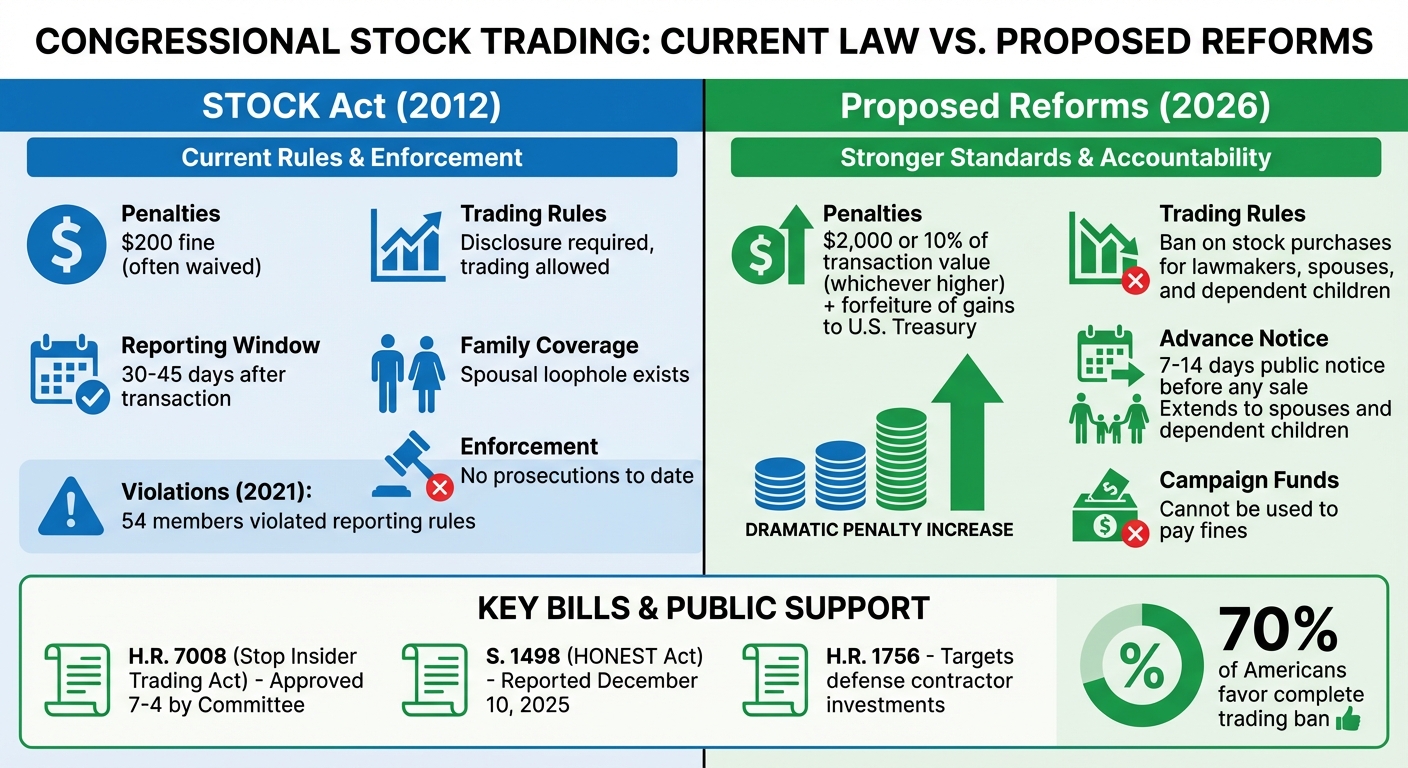
STOCK Act vs Proposed Reforms: Congressional Trading Rules Comparison
The STOCK Act aimed to improve transparency but fell short of fully addressing conflicts of interest. Now, as 2026 unfolds, lawmakers from both parties are advocating for tougher measures, including outright bans on stock trading and significantly steeper penalties for violations.
Speaker of the House Mike Johnson has voiced strong support for these reforms, stating:
"No member of Congress should be allowed to profit from insider information, and this legislation represents an important step in our efforts to restore the people's faith and trust in Congress."
Public sentiment aligns with these efforts, as 70% of Americans now favor a complete ban on congressional trading. Proposed legislation shifts the emphasis from transparency to prevention, focusing on banning new stock purchases and requiring advance notice before sales. Below is an overview of key bills shaping this reform push.
Current Bills Under Review
Several bills under consideration represent a new approach to addressing these issues. The Stop Insider Trading Act (H.R. 7008), introduced in January 2026, is one of the most prominent proposals. This bill would prohibit lawmakers, their spouses, and dependent children from purchasing publicly traded stocks. For existing holdings, it mandates public notice 7 to 14 days before any sale. Representative Bryan Steil, Chairman of the Committee on House Administration, summarized the bill's intent with a pointed remark:
"If you want to trade stocks, go to Wall Street, not Capitol Hill."
The Committee on House Administration approved the bill on January 14, 2026, with a vote of 7 to 4.
The proposed enforcement measures are far stricter than those in the STOCK Act. H.R. 7008 would replace the STOCK Act’s frequently waived $200 fine with a penalty of $2,000 or 10% of the transaction value (whichever is higher). Additionally, any net gains would be forfeited to the U.S. Treasury. Lawmakers would also be prohibited from using campaign funds or office accounts to pay these fines.
In the Senate, a similar reform effort is underway with the HONEST Act (S. 1498). Reported by the Senate Committee on Homeland Security and Governmental Affairs on December 10, 2025, this bill goes even further by banning Members and their families from owning, purchasing, or trading any covered assets. It also phases out the use of qualified blind trusts within 180 days, requiring full divestment instead.
Other proposals address narrower concerns. For example, H.R. 1756 targets investments in defense contractors, responding to findings that 18% of Members traded stocks in sectors tied to their committee work between 2019 and 2021. Penalties in other bills vary significantly, ranging from $50,000 under H.R. 253 to $250,000 under H.R. 1712.
If enacted, these reforms would take effect 180 days after passage, giving Members time to divest their holdings. However, this timeline highlights a major challenge: unlike executive officials who focus on specific policy areas, Members of Congress vote on legislation affecting the entire economy, making selective divestiture a complex task.
Where to Track Congressional Stock Trades
Tracking congressional stock trades is a crucial step in ensuring transparency and accountability. Under the STOCK Act, members of Congress must disclose trades exceeding $1,000 within 45 days of the transaction. While government databases provide the raw data, third-party platforms make this information easier to search and analyze. Together, these resources offer both foundational and detailed insights for monitoring congressional trading activity.
Government Disclosure Databases
The official sources for congressional trade data are the House Financial Disclosure Reports and the Senate Electronic Financial Disclosures (EFDS). The House database, managed by the Clerk of the House, can be accessed at disclosures-clerk.house.gov and covers all 435 Representatives. For the Senate, the database is available at efdsearch.senate.gov and tracks the 100 U.S. Senators. Both platforms are free to use and allow searches by member name or filing year.
However, these systems have limitations. Most filings are unstructured PDFs, making it difficult to analyze the data without significant manual effort. They also lack advanced features like search filters or automated alerts. Additionally, it's important to note that using House financial disclosure statements for commercial purposes (except by news media) is prohibited.
Third-Party Analysis Platforms
Stay online and closer to execution. Choose a VPS location for CME futures, New York markets, London FX, API trading, and more.
Host your platform near the market route that matters.
CHINYCLONFrom $59.99/mo
CHI/CME futuresNYC/US marketsLON/FX EAsDUB/PolymarketAMS/EU FXFRA/Central EUTYO/APAC cryptoTo address the shortcomings of government databases, third-party platforms offer tools that streamline data analysis and provide deeper insights. These platforms use OCR technology to convert unstructured PDFs into searchable and filterable formats, standardizing asset names for easier use. This allows users to track specific stocks, monitor patterns across multiple lawmakers, or identify "cluster buys", where several members purchase the same stock simultaneously.
Here are a few notable third-party platforms:
- Capitol Trades: Provides free access to congressional trade data with daily updates.
- Quiver Quantitative: Offers a free tier and a premium plan at $25.00 per month, integrating congressional trades with other data like lobbying activity, government contracts, and patent filings.
- TraderCongress: Syncs data every 30 minutes and tracks over 109,800 disclosures. It has a free tier with 60-day delayed data and a pro plan at $8.33 per month (billed annually) for real-time access and advanced insights.
These platforms also calculate reporting lag - the time between a trade's execution and its public disclosure - helping users identify lawmakers who frequently delay filings. Some tools even cross-reference congressional trades with SEC Form 4 insider filings, government contracts, and corporate lobbying data to highlight trades with potentially stronger signals. By combining government sources with these enhanced tools, you can gain a clearer understanding of how and where lawmakers are investing.
Using QuantVPS for Real-Time Trade Data Analysis
Once you've pinpointed congressional trade data, the next step is to process and act on it without delay. Speed is everything here - timely data and quick execution not only enhance trading performance but also align with the transparency principles central to this approach. Many platforms synchronize with official disclosure databases every 30 minutes, ensuring new filings are surfaced as soon as they appear.
By leveraging a low-latency trading infrastructure like QuantVPS, you can automate the entire workflow. This includes pulling congressional trade data via APIs from platforms such as Quiver Quantitative and cross-referencing it with other critical datasets like SEC Form 4 filings, federal contracts, lobbying activity, and dark pool data. With this setup, trades can be executed within milliseconds of spotting a pattern. QuantVPS ensures your systems stay online 24/7, reducing the risk of missed opportunities caused by hardware issues or internet outages. The result? A streamlined, high-speed trading operation.
Why QuantVPS Works for High-Frequency Trading
QuantVPS is built for speed, a key requirement for high-frequency trading. With ultra-low latency (0–1ms) and a network speed exceeding 1Gbps across all plans, QuantVPS ensures your trading algorithms execute orders as soon as a signal is detected. This speed is critical when dealing with congressional disclosures, where the window to act is often narrow and multiple traders may be targeting the same data.
Reliability is another cornerstone of the platform. Your trading systems need to monitor updates around the clock. QuantVPS supports hosting ETL pipelines that can process unstructured PDF filings into structured formats like JSON or CSV using OCR tools. Clean, structured data is then fed into your algorithmic models, enabling precise and rapid decision-making.
QuantVPS Plans for Congressional Trade Monitoring
QuantVPS provides four scalable plans to meet the needs of traders at every level:
- VPS Lite: Priced at $59.99/month (or $41.99/month billed annually), this plan includes 4 cores, 8GB RAM, and 70GB NVMe storage. It's perfect for running a single data ingestion bot and basic trading algorithms.
- VPS Pro: At $99.99/month (or $69.99/month billed annually), this plan offers 6 cores, 16GB RAM, and 150GB NVMe storage. It's ideal for monitoring multiple data sources simultaneously.
- VPS Ultra: Designed for more complex strategies, this plan costs $189.99/month (or $132.99/month billed annually) and includes 24 cores, 64GB RAM, and 500GB NVMe storage. It's suited for traders cross-referencing congressional trades with five or more data sources, including SEC filings, government contracts, lobbying records, dark pool data, and federal spending.
- Dedicated Server: For institutional-grade workflows or teams managing multiple strategies, this plan is priced at $299.99/month (or $209.99/month billed annually). It features 16+ dedicated cores, 128GB RAM, and 2TB+ NVMe storage, along with a 10Gbps+ network.
All plans include full root access, unmetered bandwidth, and compatibility with platforms like NinjaTrader, MetaTrader, and TradeStation. This makes it simple to integrate congressional trade data into your existing trading systems, ensuring you're always a step ahead.
Conclusion
Understanding congressional stock trading rules sheds light on the unique information advantage lawmakers hold. Members of Congress often have access to classified briefings, early insights into pending legislation, and oversight of major industries - giving them a level of foresight that everyday investors simply don’t have. Research backs this up: congressional portfolios have historically outperformed the S&P 500 by 4% to 6% annually, with some studies showing Senate trades outperforming by as much as 12% per year.
While the STOCK Act was designed to increase transparency, its effectiveness is limited. The 45-day reporting window means disclosures often reflect past activity rather than real-time moves, and penalties for late filings - set at just $200 - are frequently waived by ethics committees. This has led to overwhelming public support (86%) for stricter regulations and proposals like the ETHICS Act.
For traders looking to act on this data, it’s crucial to focus on the right signals. Prioritize purchases over sales, target trades exceeding $50,000, and cross-reference disclosures with committee roles, government contracts, and lobbying activity. These strategies tend to yield the best results over a 3- to 12-month period.
To turn these insights into actionable strategies, access to reliable data and efficient execution platforms is key. Dependable sources, ranging from government databases to third-party platforms that update every 30 minutes, are vital for staying informed. Tools like QuantVPS provide the infrastructure needed to automate data ingestion, analyze multiple signals in real time, and execute trades with minimal delay - offering 24/7 uptime, ultra-low latency, and unmetered bandwidth.
This setup transforms congressional trade data into a practical market advantage. As TraderCongress aptly puts it:
"The most powerful people in the country are placing bets on the economy. You can either ignore them, or you can watch where the money goes".
FAQs
What counts as a “trade” that must be reported under the STOCK Act?
Under the STOCK Act, a "trade" involves the purchase or sale of publicly traded securities, including stocks, bonds, options, or other financial instruments, by members of Congress, their spouses, or dependent children. To maintain transparency and adhere to the law, these transactions must be disclosed within 45 days of the trade.
How can I tell if a congressional trade disclosure was filed late?
To find out if a congressional trade disclosure was filed late, look at whether it was submitted beyond the 45-day reporting deadline mandated by the STOCK Act. Late filings are usually marked as such in the publicly available disclosure records.
What’s the most reliable way to turn PTR filings into usable, searchable data?
To ensure accuracy and reliability, the best approach is to use automated systems that pull data directly from official government sources. These systems handle tasks like parsing PDFs, eliminating duplicate entries, standardizing date formats, and verifying amounts. For scanned or less-structured documents, manual checks come into play to address inconsistencies. By blending automation with human review, you can create precise, searchable datasets based on official records.