Options trading can be confusing, especially when it comes to understanding "Buy to Open" (BTO) and "Buy to Close" (BTC) orders. Here's the key:
- Buy to Open (BTO): Use this when starting a new long position in an options contract. It’s for buying call or put options to speculate or hedge. Your risk is limited to the premium you pay.
- Buy to Close (BTC): Use this to exit an existing short position. It cancels your obligation from selling options earlier, helping you lock in profits or limit losses.
Quick facts:
- BTO is for opening a position; BTC is for closing one.
- BTO works against time decay; BTC benefits from it.
- BTO offers unlimited profit potential for calls; BTC caps profit at the premium collected.
Understanding these terms helps you avoid mistakes and manage risk effectively. Always double-check your positions before placing an order to ensure you’re using the correct one.
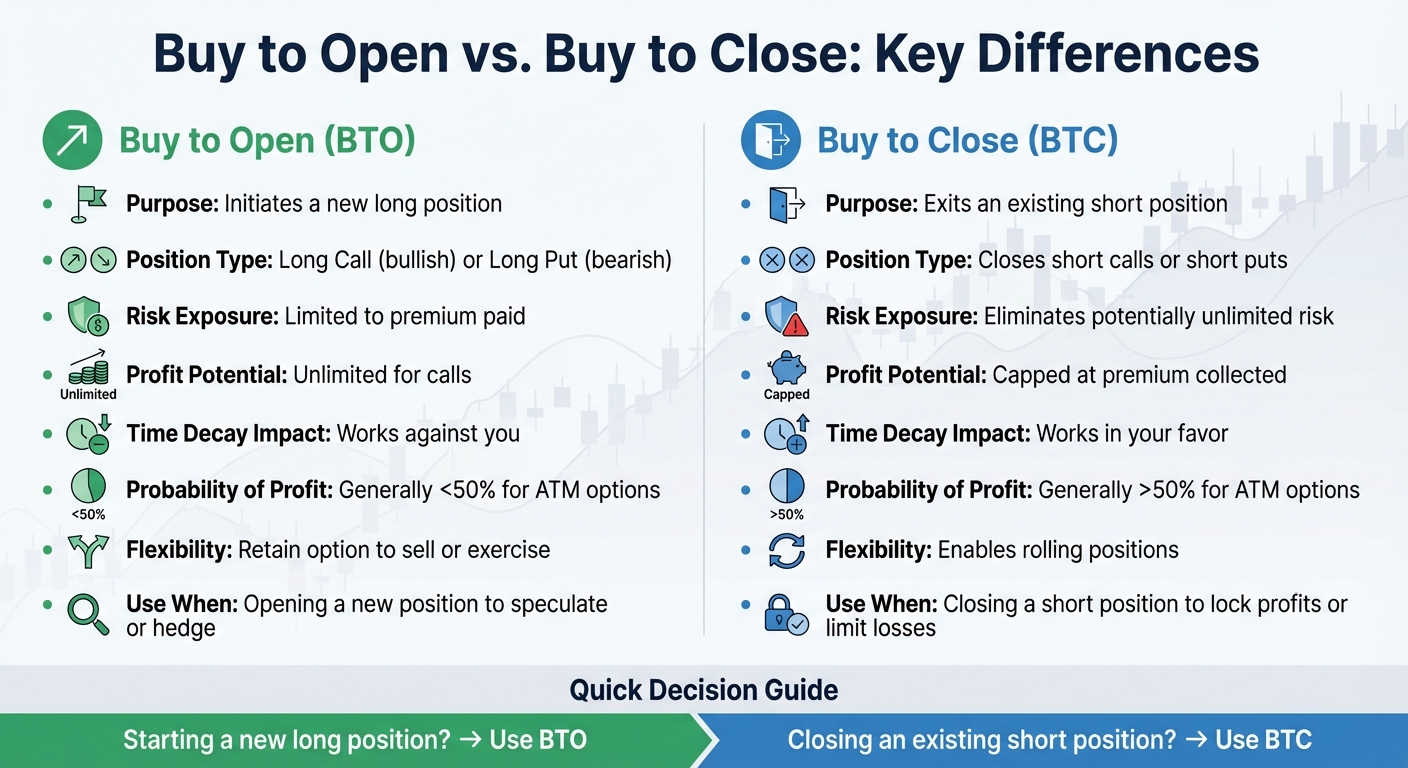
Buy to Open vs Buy to Close Options Trading Comparison Chart
1. Buy to Open
Purpose
A buy to open order is how traders establish a new long position in an options contract. By placing this order, you gain the right - but not the obligation - to exercise the option in the future. When you do this, your brokerage account is debited for the premium paid to the option writer. This type of order lets you take either a bullish or bearish position, depending on your strategy.
Position Type
There are two main types of positions you can initiate with a buy to open order:

Run 24/7 while you sleep. Keep bots, platforms, and trade copiers online on a dedicated VPS.
Low-latency VPS hosting for your trading platform.
 CHINYC
 LON
LONFrom $29.99/mo


 CHI/CME futuresNYC/US marketsLON/FX EAs
 DUB/Polymarket
 AMS/EU FX
 FRA/Central EU
 TYO/APAC crypto
- Long Call: This reflects a bullish outlook. It gives you the right to purchase the underlying asset at the strike price, offering theoretically unlimited profit potential as the stock price rises.
- Long Put: This indicates a bearish perspective. It gives you the right to sell the underlying asset at the strike price, with maximum profit achievable if the stock value drops to zero.
Both approaches allow you to strategically position yourself based on your market expectations.
Risk Profile
Your maximum loss is capped at the premium you pay for the option. For call options, you break even when the stock price equals the strike price plus the premium paid. It's also worth noting that a wider bid-ask spread can increase entry costs, so keeping an eye on that is important. Additionally, since options are usually held for less than a year, any gains are often treated as short-term capital gains by the IRS. Being aware of these factors helps you make better decisions about timing your trades.
Use Cases
Traders often turn to buy to open orders when they anticipate sharp movements in the underlying stock. Timing is critical here because options lose value over time due to time decay. These orders are also popular for protective strategies, like buying puts to hedge against potential losses in stock holdings.
For example, an options trader once placed a buy to open order for 3,158 April 36-strike call contracts on Altera Corp., paying about $0.35 per contract. This move came amid news of an Intel acquisition. By the end of the day, Altera’s shares had jumped 28%, and the value of the calls skyrocketed to $8.10. This resulted in a paper profit of roughly $2.5 million - a staggering 2,200% return. Catching an entry like that in the minutes after a headline is usually the work of a scanner or bot, which is why active options traders run those tools on an algo trading VPS rather than a laptop.
"A bot is not as outlandish as it sounds. Traders need to aggregate and filter through tremendous amounts of data quickly and will rely on technology to help if it is available." - Mike Khouw, Contributor, CNBC
2. Buy to Close
Purpose
A buy to close order is your go-to tool when you want to exit an existing short options position. When you initially sold an options contract using a sell-to-open order, you took on an obligation. By placing a buy to close order, you repurchase the same contract, effectively canceling your short position and removing your exposure. This step is crucial for locking in profits, cutting potential losses, or simply wrapping up a trade before the contract expires. Let’s break down how this applies specifically to short positions.
Position Type
This type of order is tailored for short positions you’ve initiated. For instance, if you sold a covered call to earn some income or opened a cash-secured put, a buy to close order is how you’d exit that trade. By executing it, you create an offsetting position that cancels out your original obligation.
Risk Profile
One of the biggest advantages of a buy to close order is its ability to manage risk. When you sell options - especially calls - you might face unlimited risk if the stock price keeps climbing. With a buy to close, you can limit your losses by buying back the option at the current market price. However, don’t forget to factor in brokerage fees and commissions, which can eat into your profits or add to your losses.
Use Cases
Traders often use buy to close orders to lock in profits when they hit a target - usually around 80–90% of the maximum gain. This helps avoid the risk of sudden market reversals late in the trade. Another scenario where this order comes in handy is when your short option is in the money as expiration nears. By buying to close, you can avoid assignment, which might otherwise force you to deliver shares. It’s also a useful tool for managing margin requirements, ensuring you maintain control over your trading strategy.
"The procedure helps traders capture profits or manage risks in their options trading." - Investopedia
Pros and Cons
Stay online and closer to execution. Choose a VPS location for CME futures, New York markets, London FX, API trading, and more.
Host your platform near the market route that matters.
CHINYCLONFrom $29.99/mo
CHI/CME futuresNYC/US marketsLON/FX EAsDUB/PolymarketAMS/EU FXFRA/Central EUTYO/APAC cryptoUnderstanding the key differences between Buy to Open (BTO) and Buy to Close (BTC) orders is crucial for avoiding costly mistakes and improving your trading strategy.
Buy to Open orders are used to initiate a long position, with the primary risk being limited to the premium paid. However, there’s an immediate downside - time decay starts eroding the option’s value as soon as the position is opened. Additionally, the odds of profit when buying an at-the-money (ATM) call are typically less than 50%, making this a challenging strategy for many traders. On the bright side, the profit potential for call options is theoretically unlimited, which makes BTO appealing for speculative trades when you anticipate significant price movements.
Buy to Close orders, on the other hand, are used to close out an existing short position, eliminating the unlimited risk associated with naked calls. With BTC, traders often lock in profits after time decay has reduced the value of the option sold, allowing them to repurchase it at a lower price. When selling an ATM put (later closed with BTC), the probability of profit is generally above 50%, offering a more favorable edge. However, the trade-off is that the maximum profit is capped at the premium originally collected.
Here’s a side-by-side comparison of the two:
| Feature | Buy to Open | Buy to Close |
|---|---|---|
| Risk Exposure | Limited to premium paid | Eliminates potentially unlimited risk |
| Profit Potential | Unlimited for calls | Capped at premium collected |
| Time Decay Impact | Works against you | Works in your favor |
| Probability of Profit | Generally <50% for ATM options | Generally >50% for ATM options |
| Flexibility | Retain option to sell or exercise | Enables rolling positions |
BTC also allows traders to roll their positions - closing out a losing trade and opening a new one with a later expiration date. Meanwhile, BTO provides the flexibility to either sell the option or exercise it before expiration. In both cases, keeping an eye on the bid-ask spread and liquidity is essential, particularly for thinly traded contracts. Poor execution prices in these scenarios can significantly impact your returns.
Conclusion
We've broken down the differences and scenarios for using Buy to Open (BTO) and Buy to Close (BTC) orders, so let’s quickly recap. BTO is used when starting a new long position, while BTC is for closing an existing short position that was opened with a Sell to Open order.
The distinction is straightforward: Are you opening a new position or closing an existing one? If you don’t currently hold a position in an option contract and want to go long, you’ll use BTO. On the other hand, if you’re already short on a contract, BTC helps you lock in profits or limit losses. Always double-check your positions before placing an order - confusing these can lead to unintended market exposure.
Your trading goals should guide your choice of order. Use BTO for strategies like speculation or hedging, where your risk is limited to the premium you pay. BTC, however, is essential for managing short positions, whether you’re securing profits as time decay works in your favor or cutting losses before they grow. Keeping an eye on time decay is crucial to ensure you don’t miss the best exit opportunities.
Be aware that certain market events, like trading halts or pending delistings, can limit your options. For instance, exchanges may restrict BTO orders during these times, allowing only BTC. Stay informed about market conditions to avoid execution issues.
FAQs
How do I know if I’m long or short an option before I place an order?
To figure out whether you're long or short on an option, take a closer look at your current position. Here's how it works:
- If you've bought an options contract, you're considered long on that option.
- If you've sold an options contract, you're short.
Here’s a quick breakdown of the terms:
- Buy to open: This action establishes a long position.
- Sell to open: This action creates a short position.
- To close your position: Use sell to close if you're long or buy to close if you're short.
What happens if I accidentally use Buy to Open instead of Buy to Close (or vice versa)?
Using Buy to Open when you meant to use Buy to Close (or the other way around) can cause unintended consequences. You might accidentally open a new position instead of closing an existing one, or you could miss the chance to exit a trade when you planned to. These errors can lead to unexpected market exposure or missed trading opportunities. Always take a moment to carefully review your order type to make sure it matches your trading strategy.
When should I buy to close early instead of holding a short option to expiration?
When it makes sense to buy to close early, it’s usually tied to one of three reasons: locking in profits, minimizing potential losses, or reacting to shifting market conditions. Closing out a short position before expiration can be a smart move to manage risk effectively and stay flexible when the market takes an unexpected turn. This approach helps you stay in control of your trading strategy and avoid unnecessary surprises.